

Yellow Nutsedge Weed Spotlight
9/28/2022 - By Scott Renfro
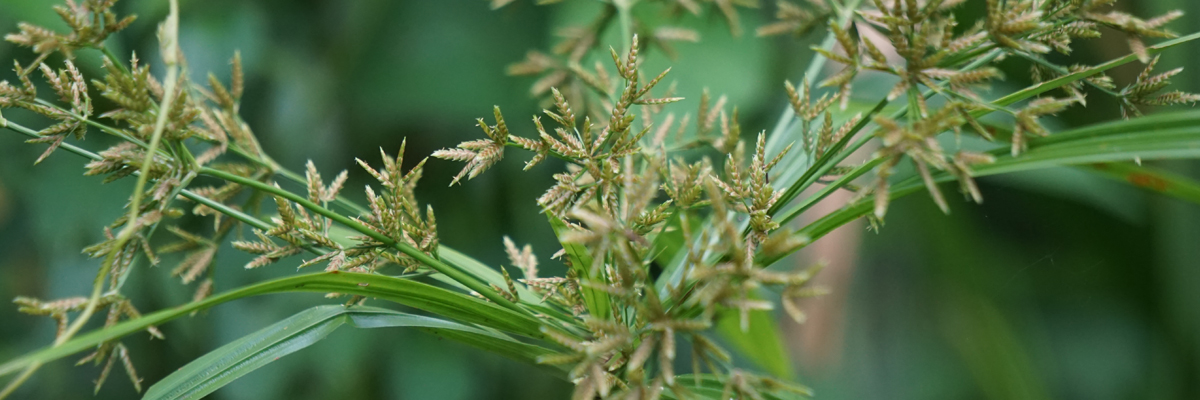
Yellow nutsedge is a perennial weed found in most
agricultural, horticulture, and nursery crops and has adapted to survive in a
diverse range of soil types found throughout North America. This weed spreads
like wildfire, and it can truly be a challenge to remove from your growing beds
once it germinates.
Yellow Nutsedge: One of the Worst Agricultural Weeds
I consider it one of the worst agricultural weeds to
eradicate due to its multiple reproductive structures. Yellow nutsedge
reproduces from two underground structures called rhizomes and nut-like tubers.
The reproduction process begins with the development of long scaley white
rhizomes that can extend 6 feet wide and 8 to 12 inches below ground with hard,
round tubers at the tip.
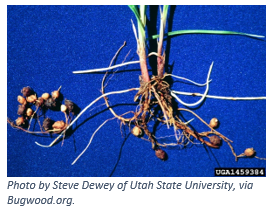
Over the course of one season, a single yellow nutsedge weed can produce hundreds of thousands of tubers, which shed their scales and form
bulbs that give rise to vegetative roots and shoots. Most of the reproduction
begins around 3 weeks after shoot emergence from an existing tuber or when
daylengths reach 14 hours. Later in the growing season around late summer, it
will produce overwintering tubers that germinate the following year, occurring
around May in Oregon.
Yellow Nutsedge Appearance and Characteristics
These overwintering tubers contain a water-soluble chemical
in their skin that inhibits dormancy. When irrigation or rainfall occurs, the
chemical is washed off thereby inducing germination only after soil
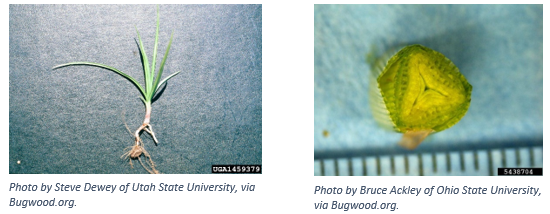
temperatures rise above 54°F. The weeds occur in groups of three at the base giving it the
characteristic triangular cross-section when cut, with flat and shiny leaves
that have a yellowish-green color.
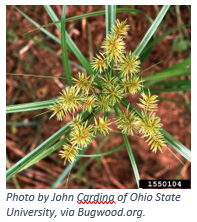
Mature plants form clumps and produce flowering stems that can
reach 3 feet tall. Flowering occurs when daylength is around 12-14 hours, and viable
seed is produced, about two to three weeks after flowering. However, germination
is very low due to the poor genetic diversity among its population.
Management of yellow nutsedge is challenging due to its vast
network of underground reproductive structures. However, pre-emergent
herbicides like S-metolachlor can provide adequate suppression if applied in
late fall and late winter. There are also a few post-emergent herbicides that
have been proven effective if applied before the 5th leaf stage of development.
These include products like Halosulfuron-methyl
and Sulfentrazone.
Nonchemical suppression of yellow nutsedge is
achieved through cultivation since most of the tubers are in the top 6 inches
of the soil and they are very sensitive to drying out. Tillage in late spring
and early summer after the tubers have germinated and before they produce new
tubers will greatly reduce subsequent populations.
For more information on yellow nutsedge reach out to your local Harrell's rep, and check
out this article
for additional information on nutsedge control.
Related Resources

In addition to being the nation’s largest distributor of branded fungicides, herbicides, and insecticides, Harrell’s produces custom-blended fertilizers, specialty liquids, and wetting agents. Additionally, Harrell’s is the exclusive US owner, formulator, and distributor of all POLYON® branded products.
TEAM HARRELL'S
STAY EQUIPPED
Never stop learning. Access FREE continuing education courses from Harrell’s.
LET'S GROW
PRESS RELEASES
PRESS RELEASES
STAY EQUIPPED
Never stop learning. Access FREE continuing education courses from Harrell’s.
LET'S GROW