

Do Preemergence Herbicides Fail, or Are Expectations Too High?
8/27/2024 - By Dr. Jeff Atkinson
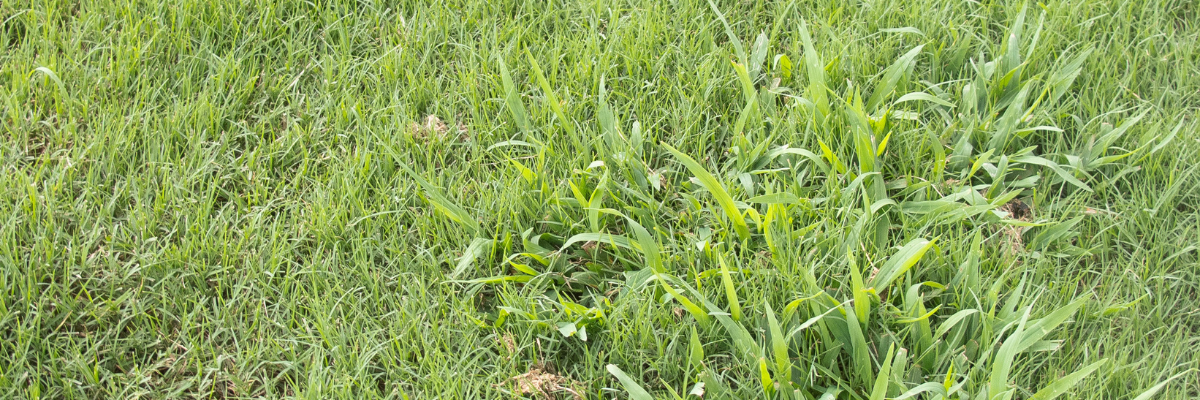
It’s early
September and throughout much of the United States nighttime temperatures are
beginning to fall and daytime temperatures are hot, but don’t seem to stick
around for quite as long. Preemergence herbicides applied long ago in spring
are hanging on, and in some cases, weeds are beginning to break through their
barrier of control. If you are observing an increase in crabgrass, goosegrass,
or other problematic summer weeds, you are not alone. Here are a few reasons
why weeds overcome preemergence herbicide applications during the late summer
period and considerations to improve control in the coming seasons.
Active Ingredients Break Down Over Time
As a rule,
preemergence herbicides are soil-active herbicides. Whether sprayed or applied
as a sparged
ingredient on a fertilizer carrier, the objective of a preemergence (PRE)
herbicide application is to treat soil rather than existing turf. Depending on
the mode of action of the active ingredient, PRE herbicides work by inhibiting
root formation or shoot formation of new seedlings, such as crabgrass.
All active
ingredients, regardless of the mode of action, have a ‘half-life’ value which describes
how long the active ingredient will remain intact in soil under normal
conditions. Half-life is defined as the amount of time it takes for an active
ingredient to degrade by half. For example, if one pound of active ingredient
is applied per 1000 square feet, the half-life is the amount of time required
to degrade the active ingredient to the point where 0.5 pounds of active
ingredient per 1000 square feet remains. In general terms, the longer the
half-life, the longer the PRE herbicide will remain effective.
It is not as
simple as picking the PRE herbicide with the longest half-life, however. Turfgrass
safety, weed control spectrum, and preventing the development of herbicide
active ingredient resistance are all considerations that must be made when
selecting which PRE herbicide to apply.
Preemergence Herbicide Longevity is Influenced by the Environment
Half-life is
not a fixed number, it is influenced by environmental factors such as soil
moisture, temperature, and microbial activity. As a rule of thumb, PRE herbicide
half-life is reduced as soil temperature, moisture, and microbial activity
increase. If PRE herbicide efficacy seemed to fall off earlier this year compared
to past seasons, it is worth considering how this year compares in terms of
temperature and rainfall to years past.
Applying Preemergence Herbicides Early Puts a Strain on Longevity
Historically,
a single spring PRE application was all it took for weed prevention throughout
the growing season. Over the last several years, a general trend has been for
applicators to apply PRE herbicides earlier in the year than traditionally to
prevent the establishment of crabgrass and other grassy weeds, which seem to
germinate and establish earlier each year. Are temperatures warmer during
Spring months compared to years past? Perhaps. In response, the industry is
applying PRE herbicides earlier in the year than the historical standard.
Applying PRE
herbicides earlier in the season puts a strain on late-season PRE weed control
efficacy. Considering again the half-life of an active ingredient, the earlier a
PRE herbicide is applied in a year, the more degradation of the active
ingredient that can be expected later in the season. In many areas of the
United States, a second PRE application mid-season is becoming the standard to
ensure PRE weed control efficacy throughout the growing season.
A second PRE
application mid-season must be balanced with the expectation for turfgrass seed
establishment in the fall since the same active ingredient that prevents grassy
weed establishment can also negatively affect desirable turfgrass establishment
from seed.
Breaking the Barrier of Preemergence Herbicides Leads to Weed Breakthrough
Preemergence
herbicides work by creating a barrier in the upper layer of the soil surface
between the weed seeds and the air above. In most cases, PRE herbicides allow weed
seed to germinate, then kill the seedling after the newly germinated seedling
has absorbed the PRE active ingredient. This works great until the barrier has
been broken.
A common
example involves the use of edging equipment on curb and sidewalk edges. Along
with increased temperatures in these areas which reduced half-life, edging
equipment often digs into the soil along sidewalk and curb edges removing the
PRE barrier and allowing for weed seed establishment. Other mechanical
disruptions of a soil surface such as mid-summer aerification or dethatching
can also disrupt a PRE weed control barrier.
Excellent Preemergence Herbicide Weed Control Starts with a Quality
Application
Preemergence
herbicides are only as effective as the quality of the application. In general,
PRE herbicides can be applied in one of two ways, either spray applied as a
liquid or applied as a ‘sparged’ material on a fertilizer carrier. For more
information on the sparging process, check out this video.
Applying a PRE
herbicide sparged on a granular fertilizer carrier is an effective way to
optimize labor inputs, allowing for two inputs to be applied at once. To
maximize efficacy, the appropriate amount of fertilizer per area must be
applied, often referred to as ‘spread rate.’ The spread rate is most often described
as pounds of fertilizer per 1000 square feet or pounds of fertilizer per acre. If
the spread rate is too low, then distribution uniformity of the PRE herbicide
(and fertilizer) will be inadequate to provide consistent weed control. Ensuring
the spread rate is adequate to allow even PRE herbicide distribution is key to
a successful PRE herbicide application on a granular fertilizer carrier.
Your Harrell’s Rep is Here for You
Every
situation is unique and often, multiple factors contribute to the success or
failure of a PRE herbicide program. A Harrell’s Territory Manager is an
excellent resource to optimize your PRE herbicide program to result in higher
turf quality, fewer complaints, and satisfied stakeholders. To learn more, contact
your local Harrell’s Representative.
Related Resources

In addition to being the nation’s largest distributor of branded fungicides, herbicides, and insecticides, Harrell’s produces custom-blended fertilizers, specialty liquids, and wetting agents. Additionally, Harrell’s is the exclusive US owner, formulator, and distributor of all POLYON® branded products.
TEAM HARRELL'S
STAY EQUIPPED
Never stop learning. Access FREE continuing education courses from Harrell’s.
LET'S GROW
PRESS RELEASES
PRESS RELEASES
STAY EQUIPPED
Never stop learning. Access FREE continuing education courses from Harrell’s.
LET'S GROW