

Two-Spotted Spider Mite

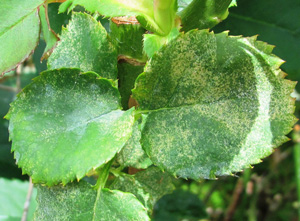 The Two Spotted Spider Mite, Tetranychus urticae, is the most prolific pest to nursery growers during the summer months.
The ‘Two Spot’ gets its name from the two black spots on the back of the adult lifestage. These spots can be seen using a hand lens, and are usually used as an identifying trait. This pest overwinters either as fertilized eggs, or as dormant adults in more temperate climates.
Eggs of the two spot are perfectly round, they too are often used in the identification process. Once temperatures start to creep towards 85F in the spring, mites will become increasingly active. When conditions are optimal, an egg can develop into a sexually mature adult in less than one week.
Females typically lay about 10-15 eggs daily for a couple of weeks under optimal conditions. In outbreak situations, colonies of the mites will produce webbing. Spider mites feed on the plant’s tissue by inserting a stylet feeding tube into the leaf tissue and sucking out the plant’s fluid. Stressed trees and shrubs are usually more susceptible to mite outbreaks. Keeping plants healthy and relatively stress free will help in the battle against this pest.
Two spot spider mites thrive in dusty environments. Mites are easiest to control with a preventative approach to IPM. Once populations get out of hand, two spot can be difficult to eradicate. Most registered miticides won’t target all life stages. Rotating between ovicidal miticides and miticides that act upon the adult lifestage is often recommended.
Spray programs should have 3 or more different modes of action. Some MOAs should be applied 2-3 times in succession, before rotating to another MOA. Always consult product labels for specific application instructions. Spray uniformity and coverage is critical when targeting mites. Often a spray surfactant is added to miticide sprays mixtures. There are also a couple commercially available mite predators which can be incorporated into IPM programs.
Looking for more comprehensive control options for two-spotted spider mites? This PDF has several spray and ICM options.
Matthew Shultz
Matthew Shultz is an alumnus of the horticulture program at West Virginia University. He is currently a grower for the well-known nursery Conrad-Pyle.<br/><br/>He was featured on the cover of Nursery Management and Production magazine for being instrumental in the implementation of an integrated pest management system at the Maryland nursery, a concept he was inspired to embrace while at WVU.
Related Resources

In addition to being the nation’s largest distributor of branded fungicides, herbicides, and insecticides, Harrell’s produces custom-blended fertilizers, specialty liquids, and wetting agents. Additionally, Harrell’s is the exclusive US owner, formulator, and distributor of all POLYON® branded products.
TEAM HARRELL'S
STAY EQUIPPED
Never stop learning. Access FREE continuing education courses from Harrell’s.
LET'S GROW
PRESS RELEASES
PRESS RELEASES
STAY EQUIPPED
Never stop learning. Access FREE continuing education courses from Harrell’s.
LET'S GROW