

Red Headed Flea Beetle Program (Systena frontalis)
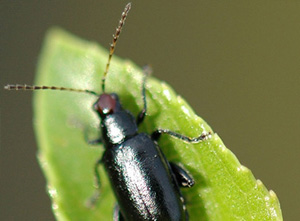 The Red Headed Flea Beetle is becoming a more prevalent pest in containerized nurseries. Eggs of the beetle are deposited in the soil of pots by the previous year’s adults, and grubs hatch in typically the first week of May in Maryland.
Grubs feed on the roots of plants, but usually cause minimal damage to root systems. Adults emerge from the soil about three weeks later and start feeding on the foliage of a wide variety of crops.
Adult beetles appear between 550-750 GDD, about the same time the orange Soldier Beetles emerge in your area, and also about the same time Itea virginiana goes into bloom. The adult stage of the beetle is the most detrimental to ornamental plants, producing a scarring on the upper surface of the leaf.
This pest can have up to three generations per year which is why it can be so devastating in an ornamental nursery. This beetle has been seen feeding particularly heavy on Itea, Weigela, Forsythia, Buddleia, and some varieties of Hydrangea paniculata.
Looking for control options? Here's a one-page document on red headed flea beetle control!
Matthew Shultz
Matthew Shultz is an alumnus of the horticulture program at West Virginia University. He is currently a grower for the well-known nursery Conrad-Pyle.<br/><br/>He was featured on the cover of Nursery Management and Production magazine for being instrumental in the implementation of an integrated pest management system at the Maryland nursery, a concept he was inspired to embrace while at WVU.
Related Resources

In addition to being the nation’s largest distributor of branded fungicides, herbicides, and insecticides, Harrell’s produces custom-blended fertilizers, specialty liquids, and wetting agents. Additionally, Harrell’s is the exclusive US owner, formulator, and distributor of all POLYON® branded products.
TEAM HARRELL'S
STAY EQUIPPED
Never stop learning. Access FREE continuing education courses from Harrell’s.
LET'S GROW
PRESS RELEASES
PRESS RELEASES
STAY EQUIPPED
Never stop learning. Access FREE continuing education courses from Harrell’s.
LET'S GROW