

Fleet-ing Suggestions
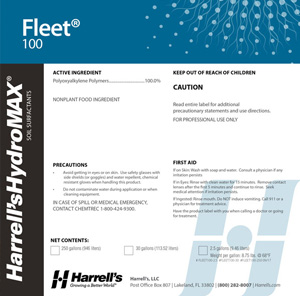 Harrell’s Fleet 100 wetting agent has proven to be a very effective product for use in turfgrass water management. Of course, we do not want you to confuse our Fleet with another product that is branded as Fleet as well, but since it is an enema you should be good to go, as both are very good at moving water downward to my understanding.
We like to refer to Fleet as a water distribution agent rather than a wetting agent due to its unique properties. Normally, Fleet is viewed as a penetrant wetting agent, which means it is characterized as a product that allows water to move downward or “penetrate” the soil profile.
Fleet is unique in its properties and application flexibility. This creates confusion and is the justification for this blog as we field many, many questions specific to how to best apply Fleet. Hopefully, this blog will address many, if not all of those questions.
Many wetting agents will burn turfgrass if they are allowed to dry on the leaf surfaces. This is due to the fact that these products are formulated as alcohols. This is not the case with Fleet. Fleet alone has not shown any burn potential; however, if you are applying Fleet in combination with other products such as Primo Maxx or fungicides, then we would recommend that you test this combination in a small area before treating the entire turfgrass area. Ideally, we recommend that Fleet be applied alone or with other soil directed products such as Harrell’s EarthMax Organic.
The recommended method to apply Fleet would be to make the Fleet application and water immediately with a sufficient amount of water to move the Fleet downward in the soil profile to the desired depth (6 to 8 inches) that you would like to distribute the water. This is the best and most effective way to apply Fleet.
Many times, this may not be possible due to other circumstances. If this approach is not possible, then it would be recommended to apply Fleet and then water as soon as you possibly can to apply the appropriate amount of water to move the Fleet to the depth that you would like for the water to be evenly distributed. It is recommended to not prolong the water application longer than 12 hours after the Fleet application.
Some turfgrass managers have applied Fleet and then watered “lightly” with the intent to get the Fleet off of the turfgrass leaves. They come back later that day or early evening and water the Fleet application in to a greater depth with more water to achieve the proper depth placement of the Fleet.
This approach is risky!
I understand the logic here given the burn potential of many wetting agents, however, that should not be of concern with Fleet. The reason this application approach is risky is that the initial application of water targeted to “wash” the Fleet off leaves may in fact “lock” in the Fleet at a very shallow depth. Then, the later application of water to move the Fleet down to the desired depth may not do anything because the Fleet is already locked in from the initial “light” watering. If this happens, the Fleet will distribute the water as designed, but unfortunately the depth of water distribution will be very shallow and will mean excessive moisture in the root zone.
If this is what happens or is what you have been guilty of doing, then we would recommend that you reapply Fleet as soon as possible and water in immediately as recommended above to the desired depth to overcome the effects of the shallow distribution of the Fleet with the initial application.
Conversely, what if you applied too much water and moved the Fleet too deep? What would happen if this occurred? It is possible to water the Fleet too deep and if that is the case, the results would be that the top inch or so of the soil profile would be drier than the soil profile below. This “drier” top of the soil profile will not be hydrophobic, but the soil moisture content will be lower than the moisture content at depths below. If this happens, we recommend reapplying Fleet with less water to overcome the effect from the Fleet being too deep in the soil profile.
Another potential issue with Fleet efficacy is organic matter content of the soil. Higher organic matter root zones will require more water to move the Fleet through the organic layer. Soils with excessive organic matter content may impair Fleet’s ability to effectively distribute water vertically within the soil profile. Wetting agents cannot outweigh the lack of cultural practices and excessive organic matter accumulation.
One last question that we get asked often relates to the tank mixture of Fleet with Symphony, which is a water retaining wetting agent. Yes, these two wetting agents can and have been tank mixed with success. This would only be recommended where the desired results were a soil profile with water evenly distributed in the top 6 to 8 inches of the profile with more water in the top 2 to 4 inches. The rates of Fleet and Symphony to be tank mixed will need to be experimented with given the soil conditions of the site.
Harrell's
Based in Lakeland, Florida since 1941, Harrell’s is a leading producer and distributor of customized, agronomic solutions – not merely “products.” This includes nutritional solutions in both granular and liquid form to help your turf, landscape and plants grow and thrive. We also specialize in delivering solutions to help protect your world from pests, environmental threats and climate extremes. Naturally, we have production and storage facilities throughout the country to ensure timely, efficient shipments.
Related Resources

In addition to being the nation’s largest distributor of branded fungicides, herbicides, and insecticides, Harrell’s produces custom-blended fertilizers, specialty liquids, and wetting agents. Additionally, Harrell’s is the exclusive US owner, formulator, and distributor of all POLYON® branded products.
TEAM HARRELL'S
STAY EQUIPPED
Never stop learning. Access FREE continuing education courses from Harrell’s.
LET'S GROW
PRESS RELEASES
PRESS RELEASES
STAY EQUIPPED
Never stop learning. Access FREE continuing education courses from Harrell’s.
LET'S GROW