

What if Overseeding Wasn’t an Option?
8/10/2021 - By Dr. Jeff Atkinson
In a typical year, there are several reasons to consider overseeding alternatives:
- Poa annua control in overseeded turf is challenging in many areas, due to herbicide resistance and lack of control options.
- It can be challenging to staff adequate labor through the winter months to maintain overseeded turf.
- Fertilizer and seed costs can add pressure to already tight maintenance budgets.
- Overseeding itself can hinder spring transition, hurting turf quality in late spring and early summer months.
2021 isn’t a typical year. Thus, a few additional reasons to consider overseeding alternatives: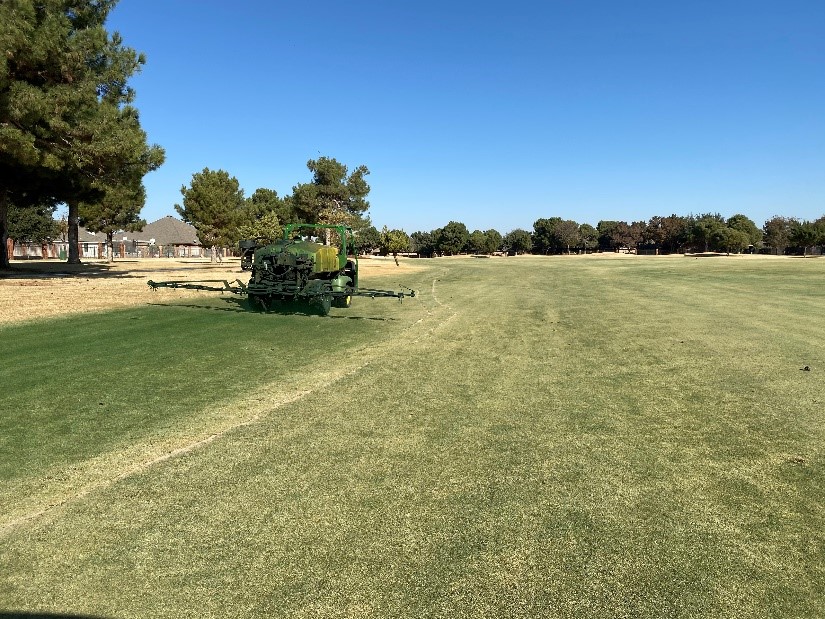
- A tight labor market has been the norm in our industry for several years running. In this observer’s opinion, it has not been as tight as it is today in recent memory.
- The COVID-19 Pandemic has more homeowners interested in lawn maintenance than ever before. That’s great for the appreciation of our industry but translates into extremely high demand from homeowners for grass seed. Since there is only so much grass seed supply to go around seed prices are elevated in the professional market.
- Higher than average temperatures and extended droughts in the Northwest have negatively impacted seed crops and further reduced availability.
- Freight costs continue to rise, further increasing the cost of seed.
As you’re likely catching onto by now from this and buzz around the industry, overseeding will be an expensive task in 2021, if you can access seed at all. Which begs the question, what are some alternatives? How do pigments, paints, and nutrition all play into management of dormant/semi-dormant turf? Here are a few examples of successful programs to maintain playability throughout the winter months with no grass seed involved.
Dormant/Semi-dormant Turf Management Programs:
1. Start Early Program, enhance color through fall with PAR® SG then Dormant Green® Plus:
The intent of this article is to outline various programs that are used successfully to enhance color through winter months. If you’re interested in the technical differences between pigment and paint products, that information can be found on our blog, “Colorants, Pigments and Dyes—What’s The Difference?”.
From a use perspective, application of PAR® SG after the first frost and prior to winter dormancy will enhance and maintain turf’s natural green color as the temperatures drop. After a couple PAR® SG applications are made and turf enters full dormancy, switch over to Dormant Green® Plus for consistent green color through winter. Application of PAR® SG to fully dormant turf will not result in adequate greening to replicate overseeded turf.
Application rates for PAR® SG and Dormant Green® Plus are user dependent as each property and superintendent have their own preference for color. In many scenarios, application of PAR® SG at 8 fl oz/A in two directions, after the first frost but before dormancy, provides consistent turf greening. Including an iron-based product such as IronMn Mg at 3 fl oz/1000 sq. ft. or Iron Pro (Item #770731) at 1.5 lb/A are additional options to enhance turf greening, between the first frost and full dormancy. PAR® SG should be reapplied on a 14–21-day interval, or as needed to maintain a desired color. A pro tip, include Harrell’s Activator + SA to enhance leaf surface coverage and greening with PAR® SG.
After full dormancy kicks in, consider a switch to Dormant Green® Plus. Similar to PAR® SG, rate will be user dependent. A common application rate is 1 gallon/A applied in two directions. Dormant Green® Plus should be re-applied on a 3–4-week interval, or as needed to maintain desired color.
One advantage of the Start Early Program (and Start Late and Do-Nothing Programs, outlined below) is that it’s ripe with herbicide options for Poa annua and winter weed control. In fact, the Start Early program should be used on perennially overseeded golf courses as an herbicide rotation tool for Poa annua management. Issues surrounding Poa annua herbicide resistance are well documented. The ONLY way to prevent resistance from becoming an issue on your property is proper herbicide rotation. Controlling Poa in dormant turf opens the door to multiple herbicide HRAC codes that are not safe to use on overseeded turf. One such combination: Cheetah® Pro + Sureguard®.
2. Start Late and Paint Program:
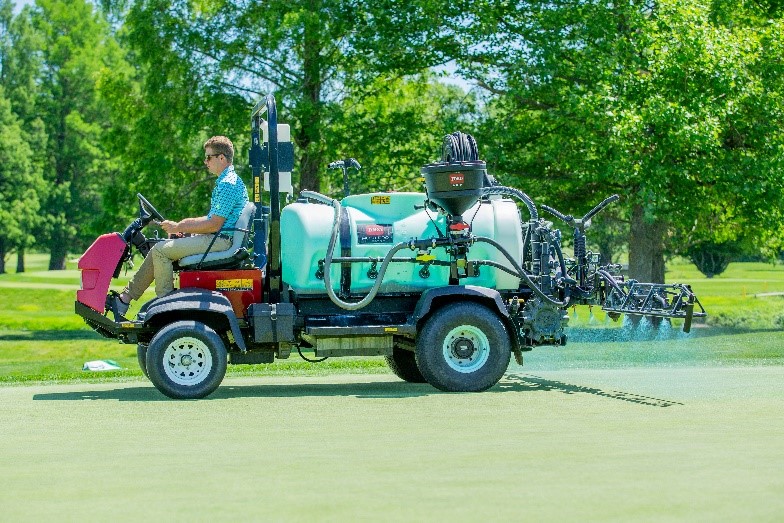 The Start Late and Paint Program is characterized by allowing turf to reach full dormancy then initiating a paint program with Dormant Green® Plus. While this approach can be successful and shares the benefit of increased herbicide options with Start Early Program, it does have drawbacks.
Painting dormant turf with Dormant Green® Plus is much like painting the walls of a house. If I paint the second coat of a quality green paint on a wall, it’s likely the coat will provide consistent coverage across the entire surface of the wall. Alternatively, if I paint the first green coat onto a primer gray wall, it is likely the coat will be splotchy and not meet my wife’s quality expectations. The same concept should be applied to painting dormant turf. If Dormant Green® Plus is applied to fully dormant turf, higher application rates will be required and application in multiple directions will be helpful to achieve adequate coverage. For this reason, it’s advantageous to follow the Start Early Program to enhance the consistency of turf color
Typical Dormant Green® Plus application rates for the Start Late Program should be higher than other programs, but again are dependent on user preference. Consider 1.5 gal/A applied in two directions as a starting point.
3. Semi-Dormant Program:
The Semi-Dormant program is for those of us who live in regions of the country where bermudagrass typically goes off color but does not go fully dormant. In addition to paints and pigments, low-rate application of N, Fe, and Mn can help hold onto color through the winter months. Consider application of the following on a 14–21-day interval to maintain winter color through those luke-warm months:
- PAR® SG - 10 oz/A
- Title Phyte® - 3 fl oz/1000 sq. ft.
- IronMn Mg - 3 fl oz/1000 sq. ft.
- 4-0-8 K+Ca - 3 fl oz/1000 sq. ft.
- Activator + SA - 0.125% v/v
Much like the other programs, the Semi-Dormant Program will require user discretion to dial in product use rates. The program listed above is a great starting point, but should be adjusted based on user preference.
4. Do-Nothing Program, let the turf go dormant:
The least aesthetically pleasing option does have a couple benefits. First, the labor requirement of the Do-Nothing Program is the lowest of all overseeding alternatives. Second, herbicide options are plentiful for control of Poa annua and other winter weeds. The downside of dormant turf, it’s not aesthetically pleasing. Not much else says cold, cloudy winter day like a brown fairway in January.
In summary, 2021 will be remembered for its own set of unique challenges for golf course superintendents. Although seed may not be plentiful and traditional management practices must be reconsidered, know that alternative strategies for winter color are available. What works in your area? I encourage you to catch up with your Harrell’s representative to tap into their local knowledge of what strategies others in your area are finding successful.
Related Resources

In addition to being the nation’s largest distributor of branded fungicides, herbicides, and insecticides, Harrell’s produces custom-blended fertilizers, specialty liquids, and wetting agents. Additionally, Harrell’s is the exclusive US owner, formulator, and distributor of all POLYON® branded products.
TEAM HARRELL'S
STAY EQUIPPED
Never stop learning. Access FREE continuing education courses from Harrell’s.
LET'S GROW
PRESS RELEASES
PRESS RELEASES
STAY EQUIPPED
Never stop learning. Access FREE continuing education courses from Harrell’s.
LET'S GROW