

Insect of the Month: Weevils
6/21/2022

The weevil is an insect pest that causes damage both as a larva and an adult. Most nursery pests don’t cause damage during multiple life stages, making the weevil unique in that regard. This is also the reason why weevils can be problematic in the production setting and landscape. In many areas, the Black Vine weevil, Otiorhynchus Sulcatusis, is the most common weevil pest but other species include Arborvitae weevil, Fuller Rose weevil, and in the northeastern US the Two-Banded Japanese Weevil.
Weevil Feeding Pattern
The black vine weevil overwinters in the soil as a larva, and in the spring comes out of dormancy and starts to feed on the roots of many broadleaf evergreen plants including Rhododendron, Yew, Hemlock, and Euonymous. As expected, Arborvitae weevils feed on arborvitae as well as some cedars. The fuller rose weevil feeds on roses and other deciduous ornamentals and fruit trees. Twobanded Japanese weevils feed on azaleas, hollies, and some deciduous material.
How to Identify Weevils
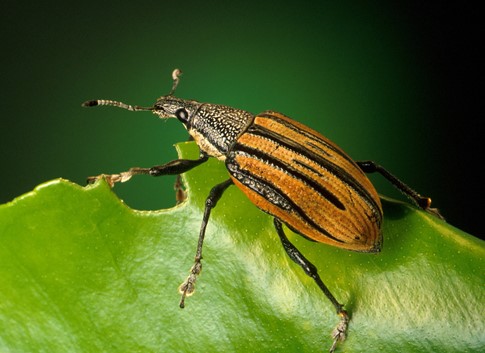
Weevil adults are easily identified because all have a trunk-like appendage as their mouthpiece, much like an elephant. This mouth part is used for chewing and adults can “notch” out large portions of leaf material, which is a dead giveaway of their presence (see photo above). Holes typically start from the leaf margin and continue in towards the leaf mid-vein. In some weevil species like the black vine weevil, the females produce eggs without the need for a male.
The C-shaped larvae are legless and white with tan heads and up to a ½-inch long. During the day, weevils hide under the mulch or debris around the base of plants. At night, the adults climb up onto plants and start chewing on the leaves, leaving telltale notches along the margins.
Though they can’t fly and move slowly, adult weevils walk easily through a production environment or landscape, claiming new victims along the way. All adult weevils are females, which lay eggs in groups, on or in the soil from June to September. After hatching, the larvae immediately move through the soil to begin feeding on roots. They spend the winter months in the soil and continue to develop in the spring as the soil warms. The larvae pupate and then emerge as adults in late spring and repeat the cycle anew.
How Do I Know if I Have Weevils?
One way to check for root weevils is to examine woody plants for fresh notches on leaf margins, and evidence of adult feeding damage, especially in tender new leaves. The notching usually begins at the base of the plant, moving upward during the summer.
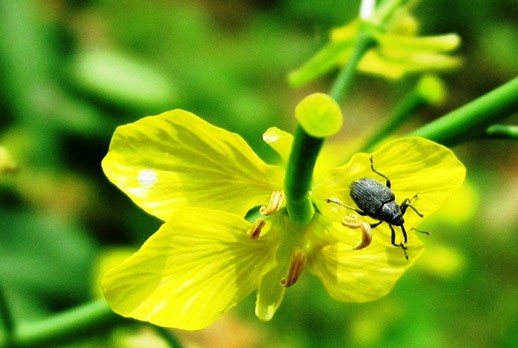
While the notched leaves are most visible, it is the root-feeding larvae that do most of the damage, often girdling plants at the base of the trunk, which can lead to death.
How to Control Weevils
The least toxic method to control weevils is to treat them in the larval stage, using a soil drench of beneficial nematodes. The Heterorhabditis bacteriophora(Hb) nematodes have been the most effective species of nematodes against this pest. However, just like with many treatments, timing is critical. There are two optimal timings:
- In the late spring to early summer, target late-stage larvae, pupae, and adult weevils before emergence. For spring control, soil temperatures must be 55 degrees or above. However, in the north, some years the spring is too cold for effective control.
- A more reliable application time can be the end of summer, in August through early October, when soil temperatures are warm and the nematodes target young weevil larvae.
Beneficial nematodes are microscopic worms, which attack only insect larvae. They are non-toxic to plants and are very effective against root weevil larvae.
Soil applications of insecticides like Mallet or DuraGuard can help too. Adults are very difficult to control, but products like Scimitar and Talstar can be effective. The best recommendation is to follow the principles of integrated pest management (IPM) and use the least toxic method early, to get the larvae early where they reside before they have a chance to grow into adults.
If you need any product recommendations or assistance in the identification and treatment of these unruly pests, you can reach out to your local Harrell's Representative anytime. We're here to help!
Related Resources

In addition to being the nation’s largest distributor of branded fungicides, herbicides, and insecticides, Harrell’s produces custom-blended fertilizers, specialty liquids, and wetting agents. Additionally, Harrell’s is the exclusive US owner, formulator, and distributor of all POLYON® branded products.
TEAM HARRELL'S
STAY EQUIPPED
Never stop learning. Access FREE continuing education courses from Harrell’s.
LET'S GROW
PRESS RELEASES
PRESS RELEASES
STAY EQUIPPED
Never stop learning. Access FREE continuing education courses from Harrell’s.
LET'S GROW