

Poa annua and Modern Weed Control Strategies for an Age-Old Problem
8/9/2021 - By Todd Lowe, Bayer
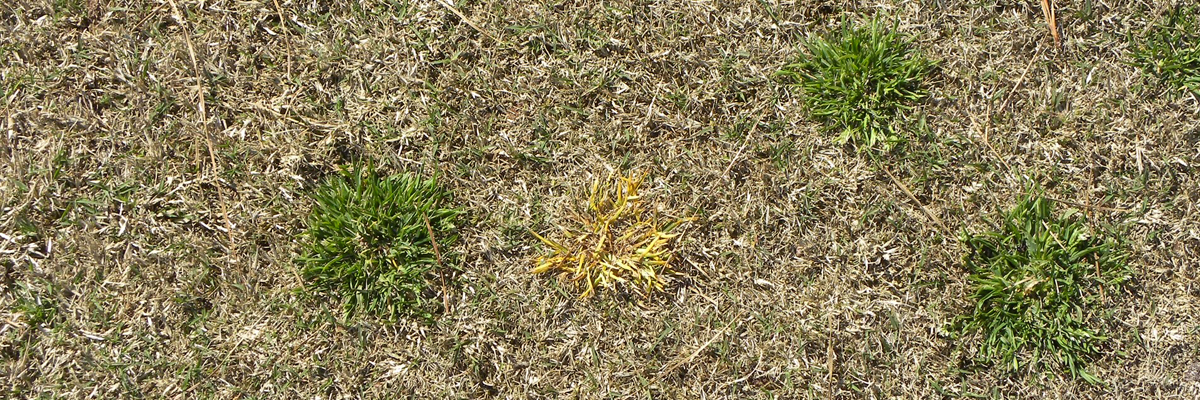
PRE/POST herbicide mixes provide a greater level of protection now and for years to come.
Poa annua Management
There are many weeds that cause problems in turf but Poa annua or “Poa,” is among the most difficult. Several factors affect its ability to persist, making it difficult to control, including its:
- Prolific seed production
- Genetic variability
- Seed dormancy/survival for many years
- Broad temperature range for germination
Managing Poa requires an integrated approach that includes maintaining healthy and dense turf through proper irrigation, fertility and soil cultivation. Traditional Poa herbicide programs generally consist of a preemergence (PRE) herbicide, postemergence (POST) herbicides or perhaps a combination of both.
PRE herbicides are only effective when applied prior to weed seed germination while POST herbicides are most effective when applied to young, immature weeds.
Poa annua Herbicide Resistance
Turfgrass managers tend to rely on proven products and programs. Once effective solutions are found, these programs are generally used year after year. In resistance terms, this is known as selection pressure.
Since Poa is so genetically diverse, relying on a particular herbicide or singular mode of action may lead to an herbicide-resistant population. In Year 1, only a few plants may survive but a single Poa plant can produce over 2000 seeds/season. It does not take long for a Poa population to become resistant to a given herbicide (typically five to ten years following repeated use).
Take the same scenario but instead apply a mix of products with several different modes of action, at the same time, instead of just a single herbicide. If a resistance gene exists within a given Poa population to an herbicide, it is highly unlikely that the same plant is resistant to other herbicides with differing modes of action.
This was the premise behind Bayer’s PRE3 herbicide program, which includes a mix of:
- An effective PRE herbicide (Specticle); WSSA Class 29
- A broad-spectrum POST herbicide (Tribute Total); WSSA Class 2
- Simazine; WSSA Class 5
A benefit of PRE3 is that Specticle is the latest PRE herbicide to enter the turf market with no documented resistance to date, unlike older PRE’s such as prodiamine (Barricade), pendimethalin (Pendulum) and dithiopyr (Dimension). In addition, Tribute Total is effective on a wide range of weeds beyond Poa.
Bottom line, this approach aligns with university weed research which has shown that tank-mixing herbicides with different modes of action is more effective than rotating herbicides with different modes of action.
Poa annua Research Results
Research trials were conducted by Bayer at four universities in 2019/2020 and again at eight universities in 2020/2021, to evaluate PRE3 on Poa control efficacy in bermudagrass turf. PRE3 programs consisted of either:
- A single application in Nov of Specticle (6 oz/A) + Simazine (32 oz/A) + Tribute Total (1 oz/A); or
- A split application of Specticle (3 oz/A) + Simazine (32 oz/A) + Tribute Total (1 oz/A) in Nov, followed by Specticle (3 oz/A) + Simazine (32 oz/A) in Dec
As a summary of the two years of trials, we found:
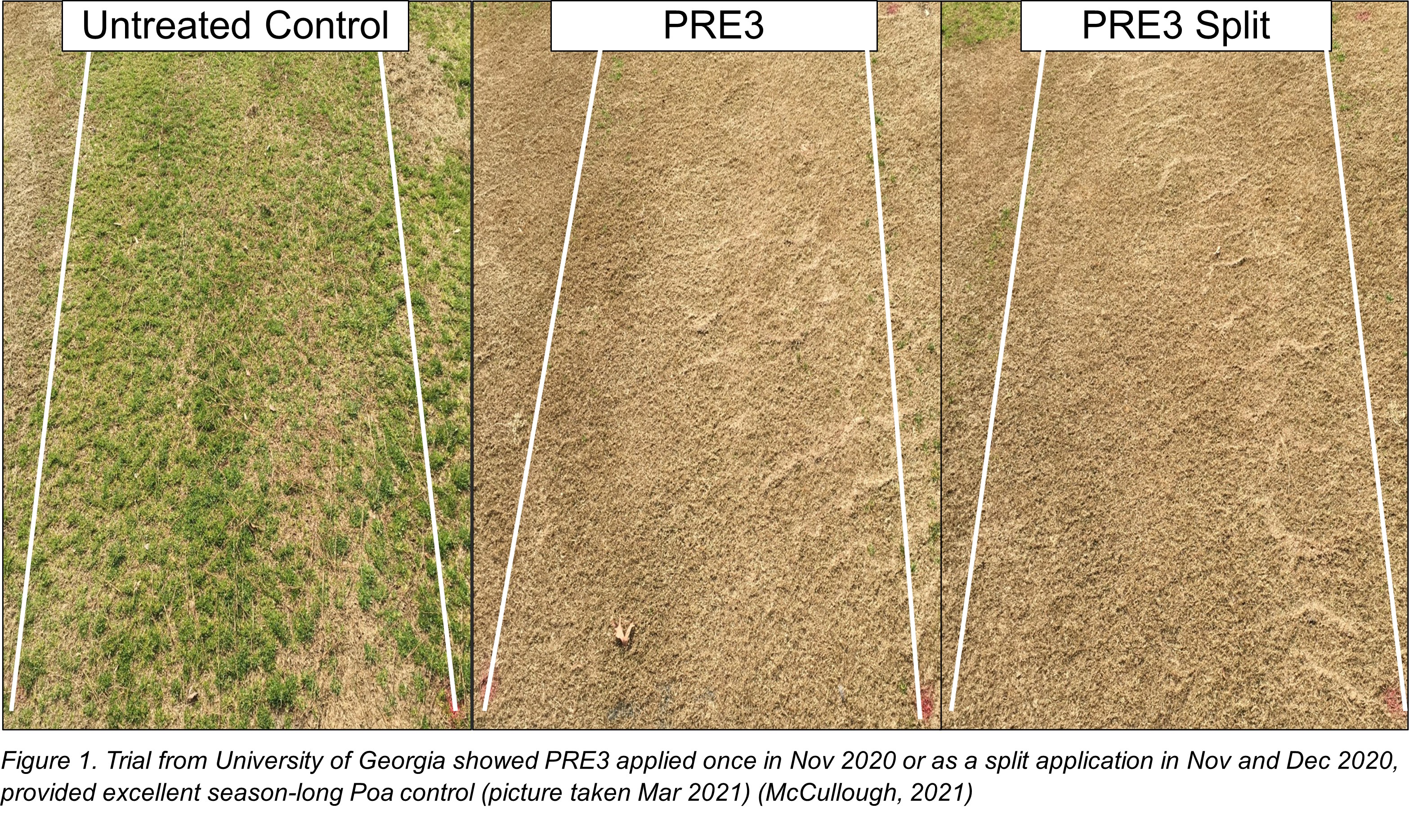
- Fall/winter PRE3 programs provided the greatest season long Poa control and were better than Specticle alone, applied at traditional timings (Figure 1)
- Split PRE3 applications were generally more consistent than single PRE3 applications
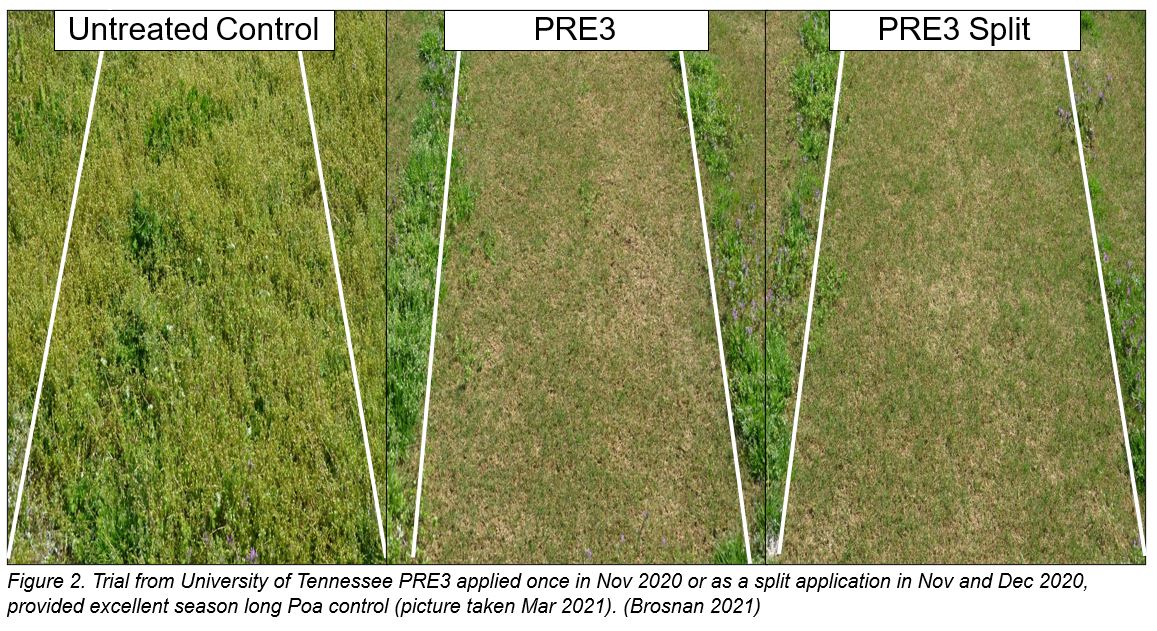
- PRE3 provided excellent overall weed control, including broadleaf weeds and Poa (Figure 2)
Poa annua Control: A Higher Level of Control
In addition to herbicide resistance management, a PRE/POST mix provides excellent turf quality and an overall better playing surface than either approach by itself. Typical PRE Poa programs begin in September, but Mother Nature is fickle and changes in rainfall and temperature can affect Poa control timing considerably from one year to the next.
While PRE herbicides are effective, it is nearly impossible to properly time applications to provide >90% season-long control consistently each year. Using the PRE3 strategy maximizes Poa control overall, minimizes inconsistency in control due to weather, plus provides control of a wide range of winter annual broadleaf weeds.
With another fall season quickly approaching, now is the time to evaluate how well your Poa control programs have worked historically and if there is concern from a resistance management standpoint. Ultimately, the PRE3 program not only provides the weed-free playing surfaces golfers desire, but an excellent resistance management strategy for superintendents to deal with this problematic pest.
For more information, go to https://www.environmentalscience.bayer.us/
Related Resources

In addition to being the nation’s largest distributor of branded fungicides, herbicides, and insecticides, Harrell’s produces custom-blended fertilizers, specialty liquids, and wetting agents. Additionally, Harrell’s is the exclusive US owner, formulator, and distributor of all POLYON® branded products.
TEAM HARRELL'S
STAY EQUIPPED
Never stop learning. Access FREE continuing education courses from Harrell’s.
LET'S GROW
PRESS RELEASES
PRESS RELEASES
STAY EQUIPPED
Never stop learning. Access FREE continuing education courses from Harrell’s.
LET'S GROW