

TurPh.Dudes Feature – Jeff Atkinson
9/7/2021 - By Mike Hess
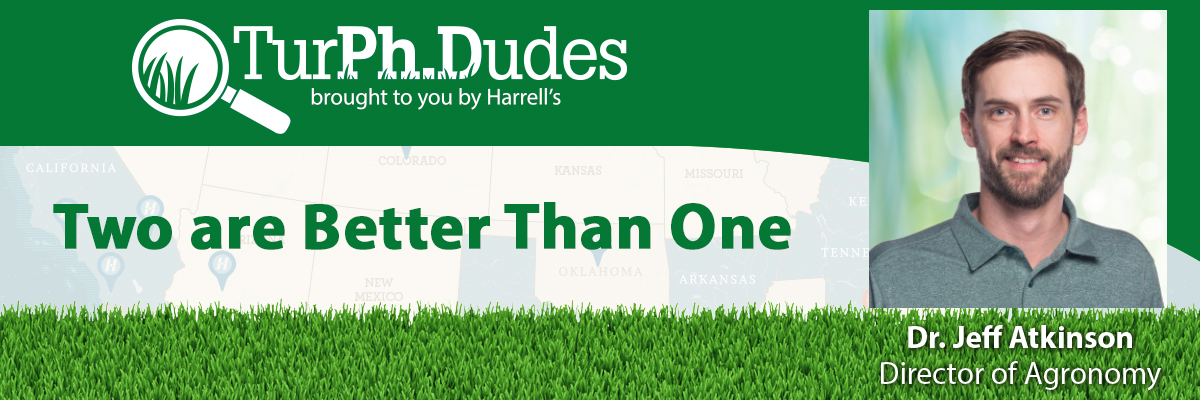
At Harrell’s, we are always seeking the best ways we can serve you. Through quality service, rigorously tested products, and cutting-edge scientific insights from some of the foremost experts in the field. Bringing you a peace of mind having an entire team of experts ready to help you succeed, every step of the way.
In this article, I had the opportunity to interview Dr. Jeff Atkinson, Director of Agronomy, and hear his story through the years he has spent in the industry
How long have you been in the industry?
I started in the industry in 2003. I guess that puts me right at 18 years.
How did you get started with Turfgrass?
Like many juniors and seniors in high school I didn’t have a clear direction for a career path entering college. At the time turfgrass management seemed to be a major which bridged my interests in baseball, golf, and the natural world around me.
Towards the end of my sophomore year a fellow turfgrass student, Greg Burgess who is currently head groundskeeper for the Greenville Drive, got me hooked up with the head groundskeeper at the time for the Charlotte Knights, Eddie Busque. This opportunity was my first real job in the turf industry.
Tell me more about your early work history.
Going into the summer with the Charlotte Knights I had dreams of becoming a major league groundskeeper. We worked hard, but I had a blast. In addition to being around a game I loved, every day I had an opportunity to watch guys like Frank Thomas and Curt Shilling up close while they were on rehab assignments. In fact, Curt Shilling made his first rehab start on our field after the 2004 ALCS bloody sock game. I also have a memory of watching batting practice with one of the Knight’s coaches and him saying, “this guy hitting will be the next big thing in Major League Baseball.” Ryan Howard was called up to the big leagues within the next couple weeks to replace Jim Thome. He won Rookie of the Year in his first season and MVP in his second season… coach was right. These and other experiences solidified for me that turf is a neat career path.
I played golf prior to my Knights experience, however ironically, I started to swing the club a lot more frequently during this time as we maintained a short par 3 hole behind our right field wall as a way to pass the time during long home stands. Towards the end of my stint with the Knights Eddie suggested that I spend time working at a golf course to expand my experience and skill set. This was the conversation that shifted my career focus.
Through the remainder of undergrad and grad school, I worked for Don Garrett at The Walker Course and spent a couple summers working for Sean Hardwick at Seabrook Island Club, just outside of Charleston, SC. Looking back, Eddie is no longer managing the Charlotte Knights; however, he did it at a high level for many years, Don and Sean are still at it at Walker and Seabrook, respectively. The longevity of these guys in their positions is something I admire. In addition to lessons about turf, these guys collectively set an outstanding example for me professionally.
Then came an opportunity to study under Dr. McCarty at Clemson. Although I broke the golden rule of completing both undergrad and grad school at the same institution, Dr. McCarty provided me opportunities to study a broad range of topics. Dr. McCarty’s program prepared me for the day-to-day diversity I encounter constantly with Harrell’s.
What first got you interested and what kept you coming back? Has this grown through experience?
My initial interest in turf was spurred on by a vision of becoming a Major League groundskeeper. I was not good enough to make a career out of playing baseball, but I wanted to stay involved with the game. My broader interest in turf grew after I began playing golf more frequently and a family friend donated a couple Masters badges to me and my father. After visiting Augusta, how could you not be hooked?
Since then, I have been fortunate to have a number of unique experiences during my relatively short career including opportunities to visit incredible properties across the US and the world. No two properties are the same and while my appreciation for management of turf at a high level has not declined, the variety of challenges I have an opportunity to work through each day keeps me coming back for more.
Tell me more about your experiences. This can be anywhere along the line; when you were in school, when you first started working, when you picked up coffee this morning, etc.
Coffee is a must. I don’t think I’ve missed a morning cup more than 5 times over the last 15 years. If any of the major hotel chains significantly improved their
coffee offerings to a palatable point, they would have a customer for the rest of my career.
Turf has provided me numerous opportunities to step outside my comfort zone. Each time I take advantage of one of these opportunities I am thankful for the ways I grow professionally and as an agronomist. I’m not in a position to pontificate as to what it takes to have a successful career, but the one suggestion I’d make to folks finishing up school and beginning a career in our industry is to take opportunities as they come, especially if they make you uncomfortable. Often times more doors will open than you expect.
Why Harrell’s? What about this company stood out to you?
After working for the Charlotte Knights in the summer of 2004 I was continuously employed by a golf course until I finished grad school in 2014. That said, I was never the guy calling the shots. I’ve dedicated a significant chunk of my existence studying turf, but as we all know, book knowledge cannot entirely replace field experience. Within Harrell’s I am surrounded by folks who have been the guy managing turf at an extremely high level. The opportunity to learn from our team is incredible. One example, in 2012 I volunteered on the agronomy team for The Players Championship. Clay Breazeale was the superintendent at the time. Our interaction at the time was limited to delegation of morning and evening assignments in the large group setting, but I can remember thinking, “man, this guy is a great leader.” Now I have the opportunity to work alongside and learn from Clay as our Florida Sales Director. That’s pretty cool, and an example of you never know who you will work beside one day in our industry.
In terms of our Ph.D. team, it was a team of two when I came on board between Raymond and myself. Since that point, we have added Dr. Tom Reed to lead development and technical support initiatives for our Specialty Agriculture division, and Dr. Paul Giordano to join our Turf team. I’ve been fortunate to be surrounded by great technical minds at each stop through my career and Harrell’s is no different. In the case of Raymond and Paul, it’s helpful for a guy with my background in weeds and plant physiology to learn from guys who spent more time in the soil science and plant pathology fields.
Corporately, Harrell’s Core Values are a model for how I want to guide my every-day life. I’m thankful to work for a company who I can align with both on a professional and personal level. When I had an opportunity to come to work for Harrell’s my tech savvy Grandmom checked out the Harrell’s website and saw our Core Values video with Jack Harrell, Jr. She was sold and that’s all the validation I needed.
How does Harrell’s compare to other places/areas you have worked in?
I’m fortunate to have had exceedingly positive experiences at each career stop I’ve made along the way. After grad school I worked for 4 years at SePRO, at first as a Research and Development Manager and then as a Portfolio Leader for turf and landscape markets. As a fresh out of school Ph.D. these opportunities gave me a quick lesson in how to manage a development program and understanding the business of golf agronomics.
Harrell’s is unique in that I am involved in a broad swath of agronomics. It’s something new every day. Between Harrell’s proprietary lines and partnerships with leading manufactures in our industry, our agronomic team is tasked with having a broad understanding of a wide range of topics. Maybe it’s a fertility program today, herbicides tomorrow, and water quality the next day. You just never know, but it’s always interesting.
What’s your vision for where Harrell’s can grow to, product and industry wise? Basically, where do you see the company having the potential to go short and long term?
As a team we want to provide our internal team and external customers the best technical support available to any team in the industry. Of course, with three of us, 120+ Harrell’s sales reps, and thousands of customers, this can be challenging. Thankfully, our Ph.D. team is surrounded by 120+ sales reps who on their own are outstanding agronomically and are often teachers to their technical support team, so they make our job easy.
From a product perspective we are continuously looking for ways to enhance the ability of a superintendent, field manager, LCO, or other turf manager to maintain high quality turf. As science continues to progress and technology becomes more accessible/affordable, our team will continue to push the advancement of new technologies and ideas. I like to think our team plays a significant role in fulfilling Harrell’s slogan of “Growing a Better World.”
What is it like having a team of experts in the field all working toward the same goal?
We’re a team of four, Raymond, Paul, and myself focus on supporting our Turf team, and Dr. Tom Reed’s focus is supporting our Specialty Agriculture team. Collectively we have a great deal of experience and knowledge to pull from. It can be daunting at times to be “the technical guy with a Ph.D.” as you’re expected to know the answer to every question off the rip. There’s plenty I don’t know so I’m thankful to have three guys I can fall back on.
From a product development perspective, it’s great to have these guys as we all provide a unique perspective on challenges and potential solutions. When considering a new technology, we often start at point A and end up at point Z by the time we are ready to bring a product to market. This journey is driven by data produced in replicated trials, but also influenced by the variety of perspectives we collectively bring to the table.
From our sales team’s perspective, I hope our technical team gives them confidence that the products they put their name behind are scientifically vetted and they can have the utmost confidence in the products, programs, and recommendations they make to their customers.
What is your favorite thing about working in this field?
Several things. The relationships you build with people. My wife and I enjoy traveling. We could travel to just about anywhere in the country and have someone we could call to recommend good places to stay, eat, etc. That’s pretty neat and all due to the close-knit network of the turf industry.
As our rep in Columbus, Ohio always says, “we’re just people helping people.” Harrell’s core values place an emphasis on serving others. There’s not much more rewarding than working to find a solution for a customer then receiving a text a couple days later saying, “thanks, the plan we put together worked great!”
I also enjoy turning on the PGA Tour on the weekend or Sunday Night Baseball and knowing that we didn’t grow the grass, we didn’t chalk the field, but we played a small part in the mystique of an immaculately manicured golf course or baseball diamond. Kids dream about playing on major league fields or putting on world class greens surfaces, it’s cool to be a small part of that dream.
What are you most excited for coming down the line? This can be any advancements, industry progression, growth specific to Harrell’s, etc.
This will be a fun one to read and look back on in 5 years. The superintendent of The Golf Club in New Albany Ohio, just North of Columbus, Keith Kresina asked a group of superintendents a similar question a couple of years ago at a golf event, “what do you think is the most important innovation to come into the golf industry during your career?” Since that conversation I think about the question often. I remember in undergrad I toured Clemson’s genetics facility. At that time the cost and time to sequence a genome was astronomical compared to what it is today. There are several companies today building extensive libraries of organism genomes in an attempt to better understand the microbial world we cannot see, and hopefully identify organisms which can play a natural role in crop production. It’s also interesting to think about how the platforms which brought us two of the COVID-19 vaccines can potentially be utilized to create products which utilize a plant’s own cellular manufacturing system to produce protective molecules within a plant. Who knows what the future will hold, but we’re always looking.
Get to know the Harrell’s TurPh.Dudes team. Check out their individual articles:
Related Resources

In addition to being the nation’s largest distributor of branded fungicides, herbicides, and insecticides, Harrell’s produces custom-blended fertilizers, specialty liquids, and wetting agents. Additionally, Harrell’s is the exclusive US owner, formulator, and distributor of all POLYON® branded products.
TEAM HARRELL'S
STAY EQUIPPED
Never stop learning. Access FREE continuing education courses from Harrell’s.
LET'S GROW
PRESS RELEASES
PRESS RELEASES
STAY EQUIPPED
Never stop learning. Access FREE continuing education courses from Harrell’s.
LET'S GROW