

Turf Wakeup Call – Does Nitrogen Form Matter?
4/6/2021 - By Dr. Jeff Atkinson

Gaseous nitrogen (N2) is the most abundant gas in our atmosphere and nitrogen is commonly deficient in turfgrass. This paradox can be explained by appreciating the environmental, biological, and human factors which are responsible for conversion of N2 to plant available nitrogen. Havlin et al. (2005) lists the various ways atmospheric N can be converted to plant available N:
- Microorganisms that live symbiotically on legume roots.
- Free-living or non-symbiotic soil microorganisms.
- Atmospheric electrical discharges forming N oxides.
- The manufacture of synthetic N fertilizers.
Most nitrogen applied to turfgrass is converted to a plant available form through synthetic manufacturing processes. (Pick up a copy of The Alchemy of Air by Thomas Hager for an interesting, quick history of the beginnings of synthetic nitrogen fertilizer manufacturing.) However, not all forms of nitrogen are equally effective in supplying adequate plant available nitrogen throughout all periods of the year. As temperatures warm, forsythia blooms, and turf begins to break dormancy. An important consideration is how the environment, specifically temperature, influences plant availability of applied nitrogen.
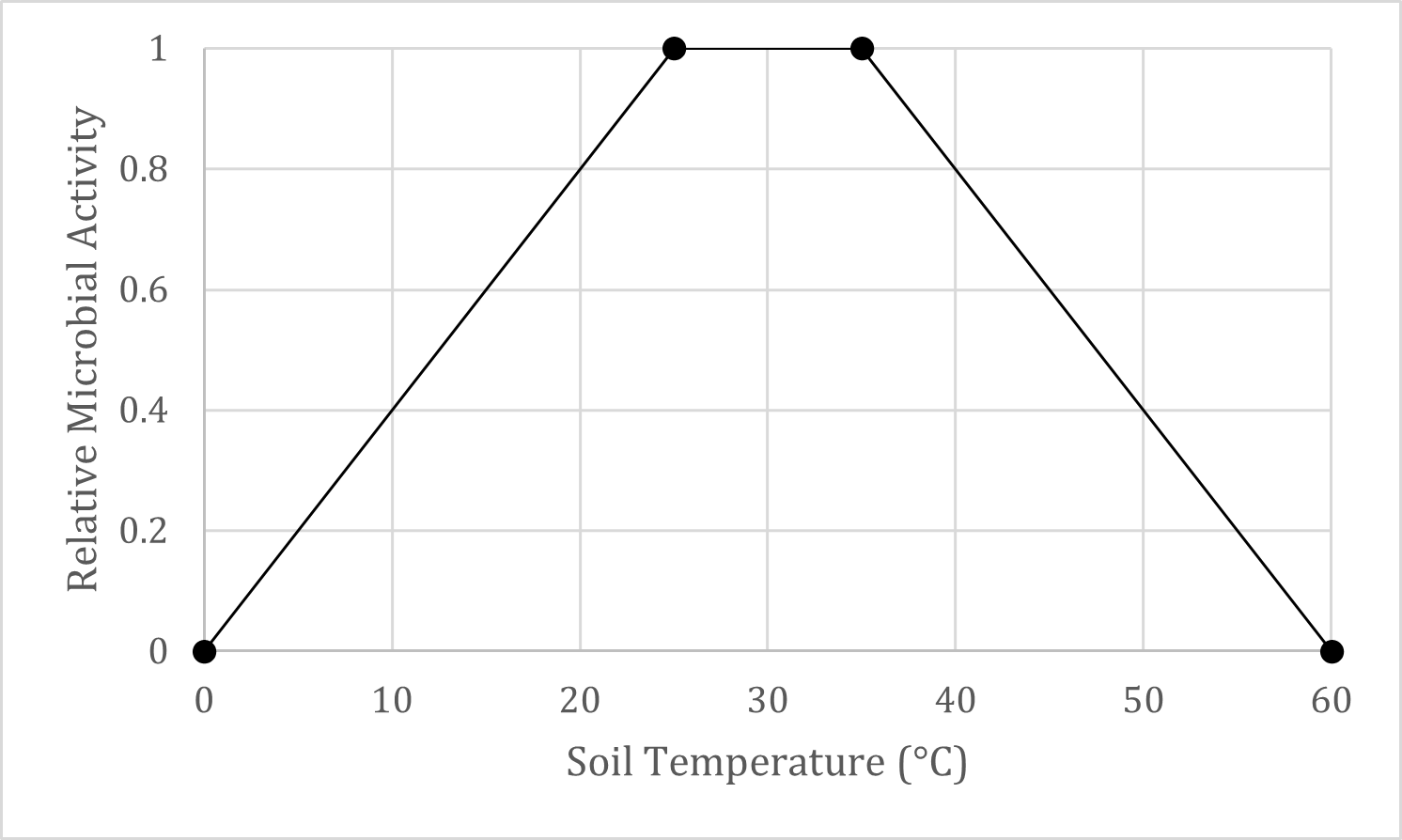 Figure 1. Influence of soil temperature on soil microbial activity. Modified from Havlin et al., 2005; Doran and Smith, 1987.
In simple terms, most of the nitrogen applied to turf is in one of three forms: urea, ammonium, or nitrate. Many fertility programs rely heavily on urea for both granular and foliar applications. To be utilized, applied urea must be converted to ammonium or nitrate through soil microbial or enzymatic processes, both of which are influenced by soil temperature. Cool spring soil temperatures are characterized by low soil microbial activity (Figure 1), thus slowing conversion of applied urea to plant available forms. Several researchers have studied the ammonification and nitrification of applied nitrogen under cool conditions. Low and Piper (1970) found urea ammonification to not be influenced by temperatures as low as 5°C, however nitrification was significantly slowed at this temperature. This supported findings by Chandra (1962) which indicated nitrification of ammonium sulfate after a 24-day incubation period at 5, 16, and 27°C to be 29, 58, and 100%, respectively.
As the final patches of snow melt across the country, consider if the products you generally rely on for in-season nitrogen feeding are appropriate for early-season wake-up applications. If you want to provide an early season boost of nitrogen, consider incorporating more nitrate and ammonium-based materials, limiting the requirement for microbial or enzymatic conversion. Products such as Bio-MAX® 4-0-0, Nitrate Plus, and Potassium plus Calcium, are three options to incorporate more nitrate-N in your program this spring. Further, Harrell’s Start Your Engines program is a proven early-season product combination.
If you have questions regarding your early season program, I encourage you to reach out to your Harrell's Representative. After all, a good start in the spring sets you up for a successful growing season.
References
Chandra, P. 1961. Nitrification in Loam Soil. Can. J. Soil. Sci, 42: 314.
Havlin, JL, JD Beaton, SL Tisdale, WL Nelson. 2005. Soil Fertility and Fertilizers. Prentice Hall, Upper Saddle River, NJ. Pp. 97-157.
Low, AJ, and FJ Piper. 1970. The ammonification and nitrification in soil of urea with and without biuret. The Journal of Agricultural Science, 75:301-309.
Related Resources

In addition to being the nation’s largest distributor of branded fungicides, herbicides, and insecticides, Harrell’s produces custom-blended fertilizers, specialty liquids, and wetting agents. Additionally, Harrell’s is the exclusive US owner, formulator, and distributor of all POLYON® branded products.
TEAM HARRELL'S
STAY EQUIPPED
Never stop learning. Access FREE continuing education courses from Harrell’s.
LET'S GROW
PRESS RELEASES
PRESS RELEASES
STAY EQUIPPED
Never stop learning. Access FREE continuing education courses from Harrell’s.
LET'S GROW