

Turf Management Basics: Understanding Disease Epidemics and Optimizing Control Tactics
7/12/2021 - By Dr. Paul Giordano
It’s July. School is out, the grill is hot, and golf courses around the northern U.S. are gearing up for some of their busiest weekends of the summer. While the course may be buzzing with golfers, who pose their own set of problems for superintendents; the turf and soil environment is also clamoring with crowds of microscopic organisms that come out of the woodwork during warm humid weather, to inflict maximum damage with no regard for tournament or holiday schedules. As a wise person once told me, “anybody can grow grass up to Memorial Day - after that, it requires a professional.” This Turf Management Basics article aims to shed some light on best practices to avoid disease outbreaks and offer tips on how to maximize turf health, while optimizing product inputs during the “dog days” of summer.
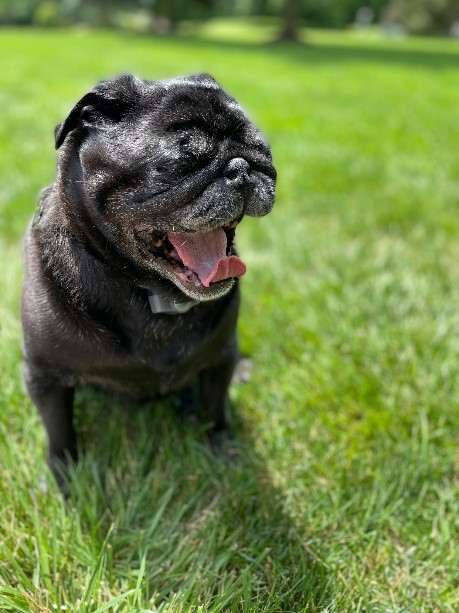 This is Ziggy – He’s a C3 dog. Like your cool-season turf, he doesn’t do so well in the heat.
A lesson on infectious diseases
The past 18 months have taught us a lot (I’m not cut out to be a kindergarten teacher for one). The COVID-19 pandemic has helped foster a better understanding of the epidemiology of transmissible disease through a population. How a microbial pathogen (virus, bacteria, fungus) spreads through a community of hosts (people, animals, plants), and what that looks like if left unchecked. While different in many ways, we can learn a lot about appropriate intervention in turf disease outbreaks by understanding the concept of “flattening the curve.” Keeping pathogen populations or “inoculum” levels low in the community to prevent catastrophic disease epidemics.
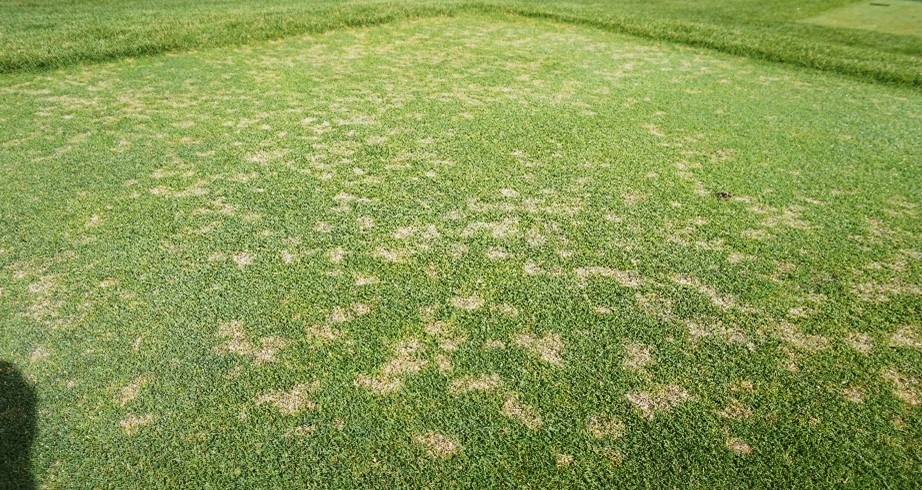 Curative applications against a large population of inoculum usually results in a perpetual game of “catch-up”, especially when weather conditions remain favorable for disease development.
Know your enemy
During the heat and humidity of the summer some turf diseases like dollar spot, anthracnose, gray leaf spot, and Pythium can “explode”. The growth and activity of these pathogens is favored during this time, and these particular fungi can be extremely prolific. Most of these pathogens can grow and proliferate in the thatch/soil beneath the turf canopy, living on dead leaf litter and organic matter – waiting for the right conditions to infect their susceptible living host and extract vital compounds such as sugars, enzymes, and proteins from your turf. Like invisible mycological vampires.
Fungicides work, but we need to understand how they affect the pathogens in the environment to employ them with the best rate of success. Dr. Rick Latin has quite literally written the book on this concept, with excellent visual descriptions and tangible examples of how fungicides “work.” Bottom line: fungicides are fungistatic, they sit in the environment or in the plant until an actively growing fungus encounters them. Fungal cells are then killed based on their intake of that active ingredient; but the entire fungal body is not destroyed. Only the growing tip is considered “active,” much of the fungus is in a state of dormancy and not actively assimilating compounds from the environment. Thus, the fungicide is not going to affect these parts – allowing them to resume their growth when conditions are favorable, and the fungicide is sufficiently depleted from the environment (more on that in a minute). We should never aim to eradicate a fungal population from our turf system, our goal rather is to thwart proliferation and keep numbers low.
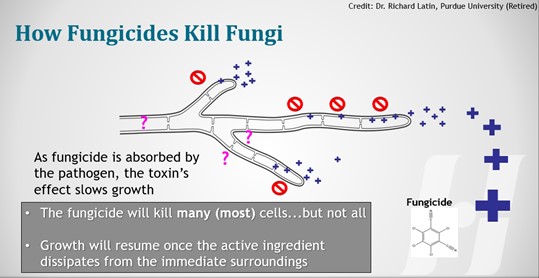 The active ingredient (+) is only taken in through the growing apical tip of the fungus. Note the numerous other cells left unaffected which will later grow and re-infect once fungicide concentrations are depleted from the turf system.
The numbers game
Ok, so now we know fungicides aren’t killing the entire population of a pathogen when applied, so how are we getting disease control for 14, 21, or even 28 days and beyond? You might think that the persistence of the fungicide in the environment is what gives us this longevity of control - but it’s not. Research has shown that a majority of commonly used fungicides break down or deplete from the turf environment around 7-10 days after application. You heard that correctly, 7 to 10 days…that’s it, gone. This is especially true in the heat of the summer, because temperature is a primary driver in fungicide depletion/breakdown.
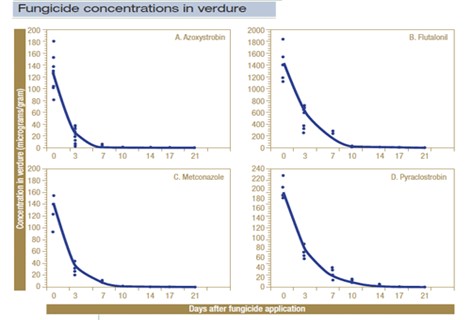 Regardless of class of chemistry, a steep drop off in concentration detected in leaf material occurs between 3-7 days after a fungicide application. This trial was conducted in a controlled environment simulating summer temperatures. Figure from Latin et al., GCM, 2012.
The best way to manage these disease epidemics for longer periods of time is by keeping the inoculum population of the pathogen relatively low. We do this with “preventive” applications of fungicides during times where environmental conditions are conducive for fungal growth, but disease symptoms are not yet present. This is how we keep the population in check or “flatten the curve” throughout the growing season. Even though the fungicide may not be detectable after 10 days, the population of active pathogen inoculum is kept to a manageable/tolerable level. It may take weeks or even months before that pathogen can grow back into disease causing levels – hence, we achieve an acceptable longevity of control interval, when making preventive applications of appropriately targeted fungicides.
Don’t get caught with your plants down
Keeping pathogen inoculum low with regular, preventive fungicide applications throughout the core of the disease season, is critical to getting the most out of your investment. But there are other factors that can help ensure optimal plant health through a difficult stretch of weather. Namely:
- Managing expectations of playability vs turf health. Increasing mowing height, encouraging more photosynthesis and bolstering energy reserves through judicious use of supplemental nutrition, will put the plant in a much better position to fend off low levels of underlying biotic and abiotic issues.
- Mitigating turf stress. Similar to the above point, products such as PAR® SG, Amino Pro V and Bio-Max® 4-0-0 have shown to alleviate various forms of plant stress such as; heat, drought, and traffic by encouraging positive physiological and metabolic processes, which ultimately lead to a more robust, disease tolerant stand of turf.
- Optimizing product application. Spray volume, nozzle selection, droplet size, contact vs. systemic activity, and fungicide formulation can all impact length of control. Incorporating an adjuvant like Activator + SA can assist with better leaf coverage, for improved uptake and disease control.
- Tightening the intervals. Compromised turf health, excessive plant growth, rapidly depleting fungicide loads, and the buildup of inoculum quickly combine to make for acute environmental conditions for a disease explosion. During these summer stretches, application intervals may need to be shortened (for example from a 21-day schedule to a 14-day schedule) for a few weeks to ensure adequate control. Research has shown adding phosphonate products to the tank, such as Title Phyte®, bolsters disease control and turf quality and can help clean up underlying Pythium populations.
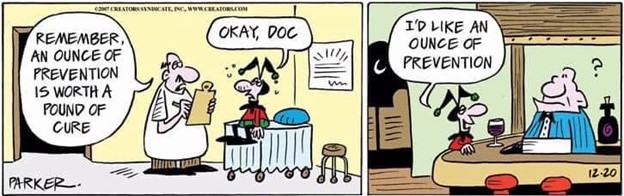
No matter how diligent applications have been, there are certain times when spray intervals need to be adjusted to account for the aforementioned factors. Don’t wait for disease symptoms to show up before applying a fungicide – this can create a “bailing water” situation where populations are so far out of hand that it’s nearly impossible to catch up! Watch the weather closely, scout indicator sites that typically are first to show disease, use tools like the Smith-Kerns Dollar Spot Model, and remember – an ounce of prevention is worth a pound of cure!
Related Resources

In addition to being the nation’s largest distributor of branded fungicides, herbicides, and insecticides, Harrell’s produces custom-blended fertilizers, specialty liquids, and wetting agents. Additionally, Harrell’s is the exclusive US owner, formulator, and distributor of all POLYON® branded products.
TEAM HARRELL'S
STAY EQUIPPED
Never stop learning. Access FREE continuing education courses from Harrell’s.
LET'S GROW
PRESS RELEASES
PRESS RELEASES
STAY EQUIPPED
Never stop learning. Access FREE continuing education courses from Harrell’s.
LET'S GROW