

Tips and Tricks to Maximize Performance of Your Turf Sprayer and Ensure Consistent Operation from Season to Season
12/8/2021 - By Josh Kravik

Your sprayer is your lifeline for managing a variety of pressures in the day-to-day management of turf. Whether spoon feeding fertility on greens, applying wetting agents to fairways to improve consistency, or preventatively applying for spring dead spot or pythium, your sprayer needs to be in shape and ready to go when you need it. In this article, we’re going to cover several useful tips for ensuring your sprayer is ready to go when you are.
Selecting the right nozzles
Nozzles come in a variety of shapes, sizes, and colors from several different manufacturers. Much like selecting the right chemistry increases efficacy in treating a specific pest, selecting the right nozzle for the application improves accuracy and increases the potential for an effective, successful treatment.
The four most common nozzle types used in turf applications are the Flood/Turf Jet, Air Induction, Twin Turbo, and the Flat Fan. These nozzles are shown below respectively from left to right and cover a variety of applications. When selected for the right application, all can improve efficacy of the application.
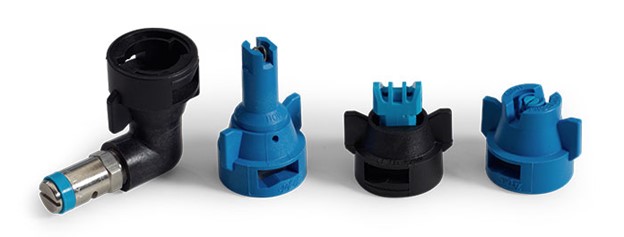
The first item to consider when selecting the right nozzle for your application is to consider the chemistry being used and whether the application requires as much contact with the plant as possible (a contact application) or if the chemistry allows for movement within the plant or soil (a systemic application). In general, contact applications perform best when as much as possible of the target surface is covered with fluid. Finer fluid droplets from the nozzle tend to allow for more surface coverage. Of the four most common nozzles used for turf spraying applications, the flat fan nozzles provide the finest droplet size and are a good contact nozzle option, as are the Twin Turbo nozzles because the twin nozzles send fluid to the applicable surface from two angles (because of the two orifices of the nozzle), allowing for more coverage.
Systemic chemistries can move through the plant or soil following application, so full coverage of the plant or surface isn’t as critical. Of the four nozzles mentioned, the Flood/Turf Jet nozzles have the coarsest droplet size and are best suited for systemic or soil applications. Air induction nozzles fall somewhere in the middle of contact and systemic nozzles with droplets coarser than the flat fans but less coarse than the Flood/Turf Jet. In addition to the type of application, whether contact or systemic, the weather in which the application is being made should be considered. If an application is being made while wind may be a factor, nozzles with more coarse droplets will be less prone to movement by wind. Fine droplet, or contact nozzles, will more readily move with the wind. If wind is in excess, it may be best to wait for a calmer wind to apply rather than risk potential movement on to an unintended plant or surface.
After you’ve decided on a contact or systemic nozzle selection, the next thing to consider is application rate. Nozzles are color coded, per ISO standards, and calibrated to a specific flow rating at a given pressure. Many nozzle and sprayer manufacturers produce charts to help you select the right flow rating for your nozzles based on the speed intended for travel. Your local equipment dealer or distributor can assist you in selecting the correct flow rating for your machine and applications as well as provide you with the selection chart needed based on the nozzles appropriate for your application.
Know your filters and develop a routine to ensure cleanliness
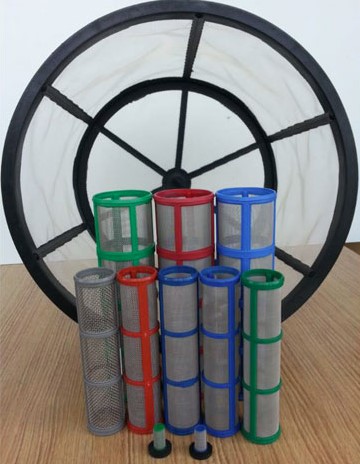
The most common reason for poor sprayer performance, and the easiest to correct, is clogged filters. No matter what make of sprayer you use, you’ll save yourself downtime if you know the filters on the sprayer and develop a routine to ensure they are clean for each application. Filter configurations vary by manufacturer but below are some of the common filters you may find on your sprayer. Please consult your operator’s manual for specific filters for your machine and location of filters.
- Fill point filter (aka basket) – this filter (or basket) is in the fill well of the tank. Its purpose is to ensure that only particles of a small size are introduced to your spray tank. Clogging of this filter will not necessarily impact your application but will make filling your tank more time consuming. If this filter begins to clog while mixing your tank, it may indicate that your mix could cause clogging in other filters that will be more detrimental to your application.
- Suction side filter – this filter, if present, will be in line between your spray tank and your pump. The purpose of this filter is to ensure that large particles or clumps of chemical are caught before potentially causing damage to the pump. Clogging of this filter will starve your pump for fluid and cause pressure to jump around erratically, thus impacting your application rate adversely.
- Pressure side filter – this filter will be in line between your spray pump and the nozzles. Its purpose is to catch any large particles or clumps before downstream damage to valves or nozzles occurs. If this filter becomes clogged, you may experience a delay in flow out of the boom reaching desired pressure, or, in more severe clogs, minimal to no flow out of the boom. Clogging of this filter should be cleaned immediately as not to adversely impact your application.
- Nozzle tip strainers – these filters, if present, will be in between the nozzle and the nozzle turret. The sole purpose of tip strainers is to protect the nozzles. If tip strainers become clogged, you’ll notice less flow from the nozzle, or nozzles, with clogged tip strainers. Again, it’s important to catch these as soon as possible and clean before potential misapplication.
Routine is important
Knowing which filters are on your machine, the location of the filters, and the machine behaviors that may signal a clog is a great starting point but developing a routine to ensure cleanliness of each filter prior to your application is what will spare you down time and set you apart from the rest. Identify a routine that works for you and the applications you typically make. Whether you’re the type that wants to clean and reinstall filters immediately following an application or would prefer to remove all filters and allow them to soak overnight in a bucket of water, you’re ensuring you won’t need to waste time cleaning filters before your next application. If you choose to soak, just remember to reinstall the filters before your next application, or bigger problems than a clogged filter could appear.
Preventative and seasonal maintenance will ensure consistent operation from season to season
In the sprayer world, you’ve probably heard the adage that an ounce of preventative is worth a pound of curative – the same concept holds true for your sprayer. Your operator’s manual will have preventative maintenance schedules for your machine that should be followed to keep the machine running well. For the sprayer portion of the machine and specific sprayer components, here are some tips to ensure consistent operation from season to season:
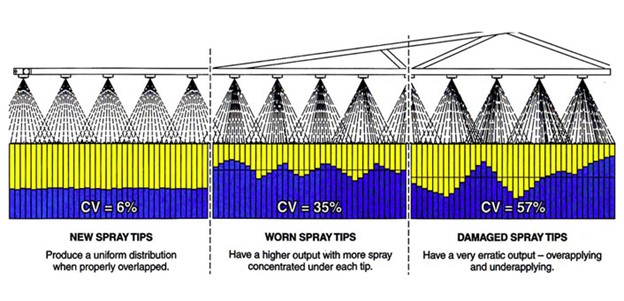
- Replace all nozzles on the boom seasonally. Often, I hear of some nozzles being replaced but not all. Nozzles tend to wear at similar rates across the entire boom and should all be replaced at the same time. Being selective in which nozzles are replaced can lead to spray uniformity problems. Consider the illustration shown below in which the pictorial on the left shows a uniform pattern across the spray boom while the middle and right pictorials show spray patterns that are not uniform due to wear. The ideal is certainly the left pictorial and replacing nozzles seasonally across the entire boom will help ensure that your spray pattern remains uniform.
- Periodically examine the inside of the hoses on your sprayer from the tank to the boom. If the pump of the sprayer is the heart of the operation, the hoses on the sprayer are the arteries. Overtime, much like arteries can clog, material can build up on the inside of the hoses, restricting flow if allowed to build up in excess. Adequate cleaning will help offset buildup but even with thorough cleaning, some chemistries can be a little “sticky” inside the hoses. Overtime, hoses may need to be replaced but it’s much less costly and disruptive if this work order is done preventatively rather than curatively.
- Seasonally winterize your sprayer or treat with an alternative pump conditioner. In the northern climates, we tend to winterize our sprayers annually by running RV antifreeze through the spray system. RV antifreeze is non phytotoxic to turf and, as it turns out, a decent pump conditioner for ductile and stainless pumps. If you apply in climates that don’t have weather patterns requiring you to winterize equipment, a pump conditioner as recommended by the manufacturer is a good practice. Conditioners can help coat the pump inner workings, provide lubrication, and potentially help remove any bound-up material in the spray system.
Now that you’re equipped with some useful tips and tricks to try out, consult and abide by the label instructions of the sprayable products you’re using and enjoy the consistent operation and longevity of your sprayers!
Related Resources

In addition to being the nation’s largest distributor of branded fungicides, herbicides, and insecticides, Harrell’s produces custom-blended fertilizers, specialty liquids, and wetting agents. Additionally, Harrell’s is the exclusive US owner, formulator, and distributor of all POLYON® branded products.
TEAM HARRELL'S
STAY EQUIPPED
Never stop learning. Access FREE continuing education courses from Harrell’s.
LET'S GROW
PRESS RELEASES
PRESS RELEASES
STAY EQUIPPED
Never stop learning. Access FREE continuing education courses from Harrell’s.
LET'S GROW