

The Role and Value of Exogenous Amino Acids to Turfgrass
1/12/2022 - By Xunzhong Zhang, Ph.D.

Nitrogen (N) fertilization is one of the most important cultural practices in turfgrass management. Nitrogen nutrition is closely associated with turfgrass quality, color, growth, and tolerance to abiotic stress. Nitrate and ammonium are the common forms of N available for plants. Plants require substantial metabolic energy for uptake of inorganic N from environments and assimilation into organic N. Nitrate has to be reduced to nitrite and then ammonium which is incorporated into amino acid biosynthesis.
Amino Acids
Amino acids are not only building blocks of proteins and enzymes, but also involved in transporting of N between roots, leaves, fruits, etc. and are precursors in the synthesis of chlorophyll and many other N-containing compounds. Amino acids also serve as the carbon and N source for the production of most ‘secondary’, or natural products. Amino acids are also associated with antioxidant and hormone metabolism and play an important role in plant tolerance to abiotic stresses (Rai, 2002). In nitrogen metabolism, glutamate is the amino acid that receives ammonium to form glutamine. Glutamate and glutamine are considered the initial amino acid products in overall amino acid biosynthesis. Amino acids play an important role in turfgrass growth and physiological fitness. For example, glutamate is a precursor of chlorophyll and associated with photosynthesis. Glutamine level is regulated in response to photosynthetic activity. Amino acid tryptophan serves as a primary precursor of the hormone auxin (indole-3- acetic acid, IAA) which is closely related to root initiation.
Glutamate
The energy required during nitrate reduction and amino acid synthesis is provided through photosynthesis and respiration. As photosynthesis declines and carbohydrates for respiration reduce under abiotic stress. The available energy for N metabolism becomes limiting, which may lead to reduced formation of endogenous amino acids. Exogenously applying certain amino acids will improve N metabolism and turfgrass performance, especially under abiotic stress environments and/or N deficiency. Exogenous amino acids can be readily absorbed and translocated by plant tissues (Joy and Antcliff, 1966; Makela et al., 1996). In a recent study with creeping bentgrass, researchers used both 15N-labeled and 15N,13C double-labeled L-glutamate applied exogenously to creeping bentgrass foliage, measuring the uptake of glutamate and its integration into γ-aminobutyric acid (GABA) and L-proline. Two amino acids with known roles in plant stress adaptation.
The results demonstrate that glutamate is rapidly absorbed into creeping bentgrass foliage and that it is utilized to produce GABA and proline, which are closely associated with plant tolerance to abiotic stresses. Glutamate is predominantly taken up intact (McCoy et al., 2020). Once absorbed, the exogenous amino acids have the capacity to function as compatible osmolytes, regulate ion transport, serve as signaling molecules, and modulate stomatal opening among other benefits. In addition, exogenous amino acids may improve soil microbial activity and chelate micronutrients once they entered the soil environments.
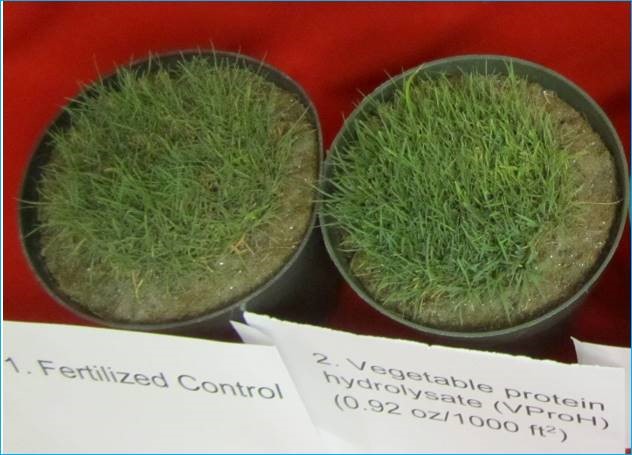
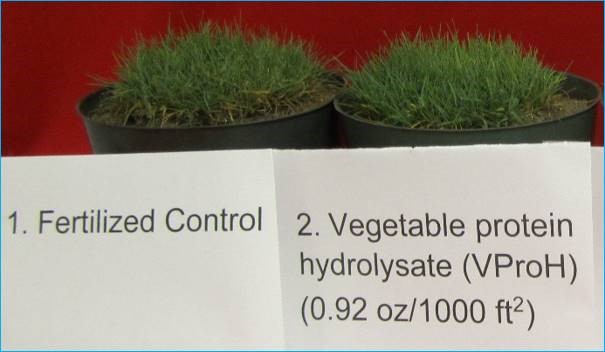
Foliar application of amino acids may improve plant N metabolism and turfgrass quality. It has been documented that exogenous application of amino acids can increase endogenous amino acids in plant leaves (Carbonera et al., 1989; Vidmar et al., 2000; Zhang et al., 2013) reported that exogenously applying an amino acid-based biostimulant GreenNcrease improved turf quality and chlorophyll content when compared to ammonium sulfate. It also increased shoot density, leaf soluble protein content and antioxidant superoxide dismutase activity relative to the control, and ammonium sulfate under drought stress conditions. In a study with barley, exogenous application of glutamine, glutamate, asparagine, or aspartic acid increased root concentrations of the applied amino acids and those of other amines and amides. Application of glutamine also increased nitrate concentration of plant roots (Vidmar et al., 2000). Application of tryptophan increased concentrations of the amino acids proline, lysine, histidine, alanine, and leucine in carrot cells (Carbonera et al., 1989). Application of two amino acid-containing protein hydrolysate products of Harrell’s sources exhibited beneficial effects on leaf color, chlorophyll content, and root growth in creeping bentgrass under heat and drought stress conditions (Zhang, 2018, unpublished data).
Meretz et al. (2019) reported application of a tryptophan-containing product or tryptophan plus urea at 24.5 kg N ha−1 every two weeks may improve leaf and root auxin content, root biomass, and subsequent creeping bentgrass quality relative to applications of urea only. Zhang et al. (2009) showed that application of a tryptophan-dosed organic fertilizer enhanced endogenous levels of IAA and cytokinins, increased leaf antioxidant enzyme activity, and improved root growth in tall fescue under drought stress conditions. Therefore, the research has provided evidences showing exogenous amino acids can be readily absorbed and translocated by plant tissues and play an important role in improving turfgrass quality, growth, and physiological fitness, especially under abiotic stress.
REFERENCES
Carbonera, D., P. Iadarola, and R. Cella. 1989. Effects of exogenous amino acids on the intracellular content of proline and other amino acids in Daucus carota cells. Plant Cell Reports 8:422-424.
Joy, K.W., and A.J. Antcliff. 1966. Translocation of amino-acids in sugar beet. Nature 211:210–211.
Makela, P., P. Peltonen-Sainio, K. Jokinen, E. Pehu, H. Setala, R. Hinkkanen, and S. Somersalo. 1996. Uptake and translocation of foliar-applied glycinebetaine in crop plants. Plant Sci. 121:221–230.
McCoy, R.M., G.W. Meyer, D. Rhodes, G.C. Murray, T.G. Sors, and J. R. Widhalm. 2020. Exploratory study on the foliar incorporation and stability of isotopically labeled amino acids applied to turfgrass. Agronomy 10, 358 doi:10.3390/agronomy10030358.
Mertz, I., N. Christians, E. Ervin, and X. Zhang. 2017. Physiological response of creeping bentgrass (Agrostis stolonifera L.) to a tryptophan-containing organic byproduct. Intl. Turfgrass Soc. Res. J. 13:575-583.
Rai, V.K. 2002. Role of amino acids in plants responses to stresses. Biol. Plant. 45:481–487.
Vidmar. J.J., D. Zhou, M.Y. Siddiqi, J.K. Schjoerring, B. Touraine, and A.D.M. Glass. 2000. Regulation of high-affinity nitrate transporter genes and high-affinity nitrate influx by nitrogen pools in roots of barley. Plant Physiol. 123:307-318.
Zhang, X., P. Summer, and E.H. Ervin. 2013. Foliar amino acids impact on creeping bentgrass drought resistance. Intl. Turfgrass Soc. Res. J. 12:429-436.
Zhang, X., E.H. Ervin, G.K. Evanylo, and K.C. Haering. 2009. Impact of biosolids on hormone metabolism in drought-stressed tall fescue. Crop Sci. 49:1893-1901.
Related Resources

In addition to being the nation’s largest distributor of branded fungicides, herbicides, and insecticides, Harrell’s produces custom-blended fertilizers, specialty liquids, and wetting agents. Additionally, Harrell’s is the exclusive US owner, formulator, and distributor of all POLYON® branded products.
TEAM HARRELL'S
STAY EQUIPPED
Never stop learning. Access FREE continuing education courses from Harrell’s.
LET'S GROW
PRESS RELEASES
PRESS RELEASES
STAY EQUIPPED
Never stop learning. Access FREE continuing education courses from Harrell’s.
LET'S GROW