

Insect of the Month – Aphids
1/13/2021 - By Mike Hess
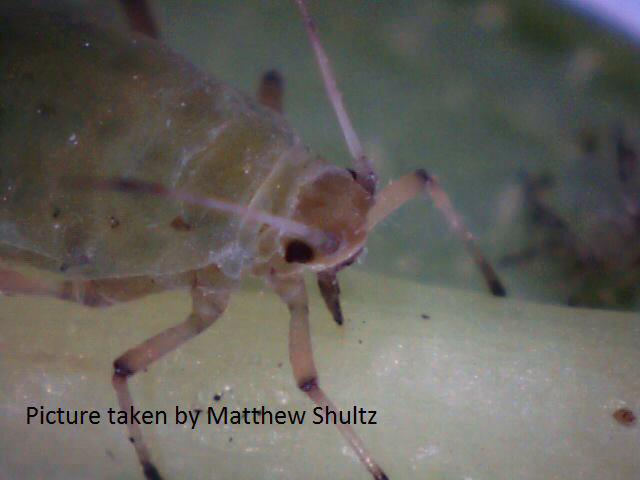
Some insect species feed on foliage, some on twigs and branches, some flowers, fruits, and some even feed on plant roots. Most species are host specific and only feed on one or two different types of plants. However, Aphids, also known as Plant Lice, feed on just about any type of plant under the sun. Both coniferous (cone bearing seed plants) and deciduous (seasonally shed their leaves), if they can get some sap out of the plant, Aphids have no preference.
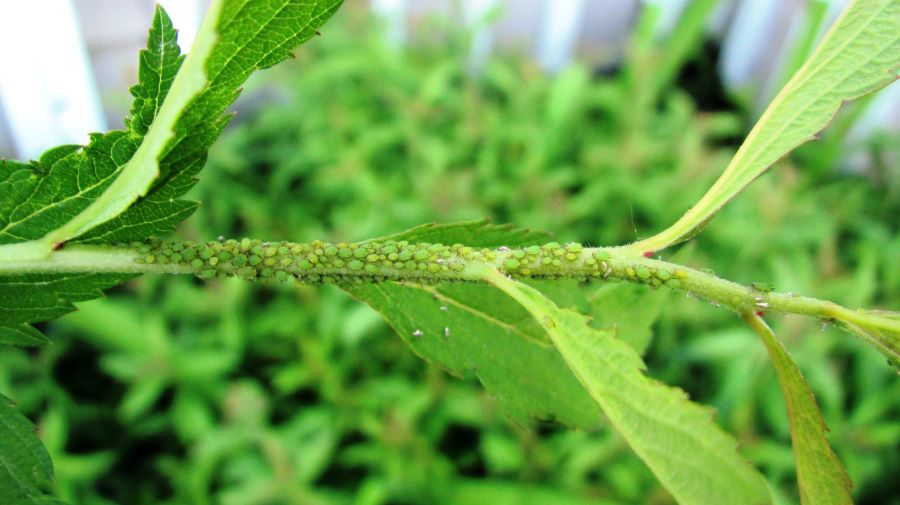 Aphid colony close-up
Aphids make up an extremely large family of insects that feed on plants, due to their ability to multiply at an alarming rate. These soft bodied insects are a nightmare to horticulturalists around the world. Aphids are relatively small in size, the largest are about 6 mm in length, but all can be seen by the naked eye. The insects are oval to pear shaped and have two appendages coming out of the rear of their bodies called cornicles.
Aphids have a sucking mouthpart that looks like a long needle when seen under a microscope, which is used to extract nutrients and sap from their host plant. The process of extraction causes the host to produce distorted growths wherever they are bitten, as well as a sugary byproduct called “honeydew.” If honeydew accumulates, it grows a fungus called sooty mold, turning leaves and branches black.
Typically waiting out the winter as fertilized eggs, they hatch early in the growing season, though they can be active year-round in the greenhouse setting. All aphids without wings are females who use parthenogenetic reproduction, which means they don’t need to mate to reproduce. Therefore, populations are known to explode literally overnight if the environmental conditions are right. They give birth to live babies, giving Aphids the ability to get to work infesting and spreading over plants right from the get-go. Males are the only type of Aphids with wings and are responsible for moving colonies from one host plant to the next.
Aphids are no joke and can seriously do a number on plants. But there are ways to prevent their spread. Use chemicals such as Marathon, Safari, Flagship, Abamectin, Avid, Talstar, Sevin, Acephate, and horticultural soaps/oils to treat. There are many native biological enemies of these pests such as green lacewings, lady beetles, and parasitic wasps, which also assist in prevention. However, utilizing one of the products listed is the safer and more controllable way to protect your plants from Aphids.
This article draws on facts and information originally gathered by Matthew Shultz in a 2013 study on Aphids.
Related Resources

In addition to being the nation’s largest distributor of branded fungicides, herbicides, and insecticides, Harrell’s produces custom-blended fertilizers, specialty liquids, and wetting agents. Additionally, Harrell’s is the exclusive US owner, formulator, and distributor of all POLYON® branded products.
TEAM HARRELL'S
STAY EQUIPPED
Never stop learning. Access FREE continuing education courses from Harrell’s.
LET'S GROW
PRESS RELEASES
PRESS RELEASES
STAY EQUIPPED
Never stop learning. Access FREE continuing education courses from Harrell’s.
LET'S GROW