

Harrell's HydroMAX® SurfaceRx™ Trial
2/11/2026 - By Dr. Raymond Snyder
Study: Effect of SurfaceRx™
Location: Blacksburg, Virginia
Collaborator: Xunzhong Zhang, Ph.D. Virginia Tech – xuzhang@vt.edu
Date: June – August 2022
Details: Wetting agents are one measure adopted by over 90% of golf facilities for water management. Adding wetting agents can reduce the surface tension of water and water repellency, allowing the wetting agents to enter the hydrophobic soil medium and thereby facilitate water infiltration. However, due to the variation in soil and turf, especially in the thatch layer, soil moisture status may vary in different spots/areas of the putting greens even after wetting agent applications, resulting in dry spots and decline in turf quality and uniformity, especially during summer stress. Turfgrass may improve plant water relations and drought tolerance through osmotic adjustment. The objective of this study is to evaluate effects of SurfaceRx and osmotech applied alone at low rate on turf quality, physiological fitness, and root growth in creeping bentgrass putting greens during summer stress.
The study was carried out on the creeping bentgrass putting greens at Virginia Tech Turfgrass Research Center in Blacksburg, VA. There were 4 treatments with 4 replications. Plot size was 5 x 6 ft. Regular mowing and irrigation were performed. A randomized block design was used.
The Treatments
1. Fertilized Control at 0.15 lb N sq ft biweekly
2. Osmotech at 0.25 oz/1000 sq ft/month + fertilized control
3. SurfaceRx™ at 5 oz/1000 sq ft/month.
All treatments had the same fertility with fertilizer applied the day following application of treatments.
Irrigation of 0.125” and up to 0.25” water was provided and the amount of irrigation water was controlled not to cause puddling.
All treatments had the same fertility (applied bi-weekly at 0.15 lb N/1000 ft2) with fertilizer (28-8-18) applied the day following application of treatments.
The trials lasted for 12 weeks from June 8 through August 31 with a total of 3 treatment applications.
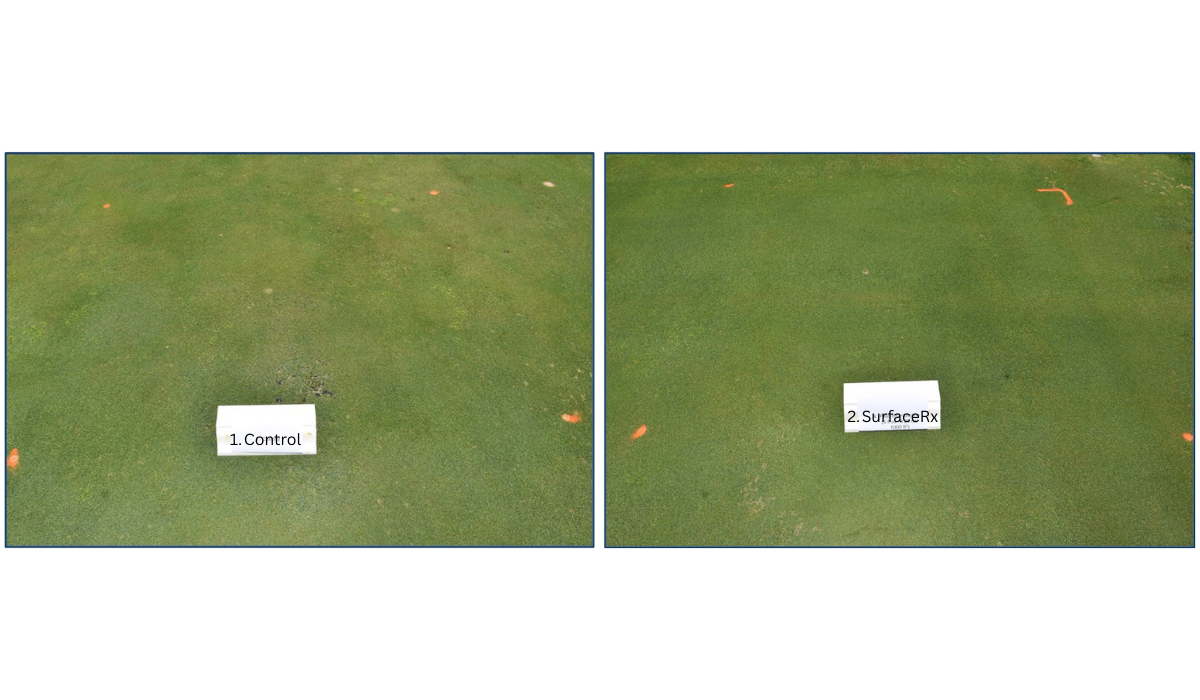
The Results
The following measurements took place at day 0, 14, 28, 42, 56, 70, and 84 after initial treatments (additional measurements on photochemical efficiency and VWC took place during 2 dry-down cycles June 21 to June 30; July 11 to July 20:
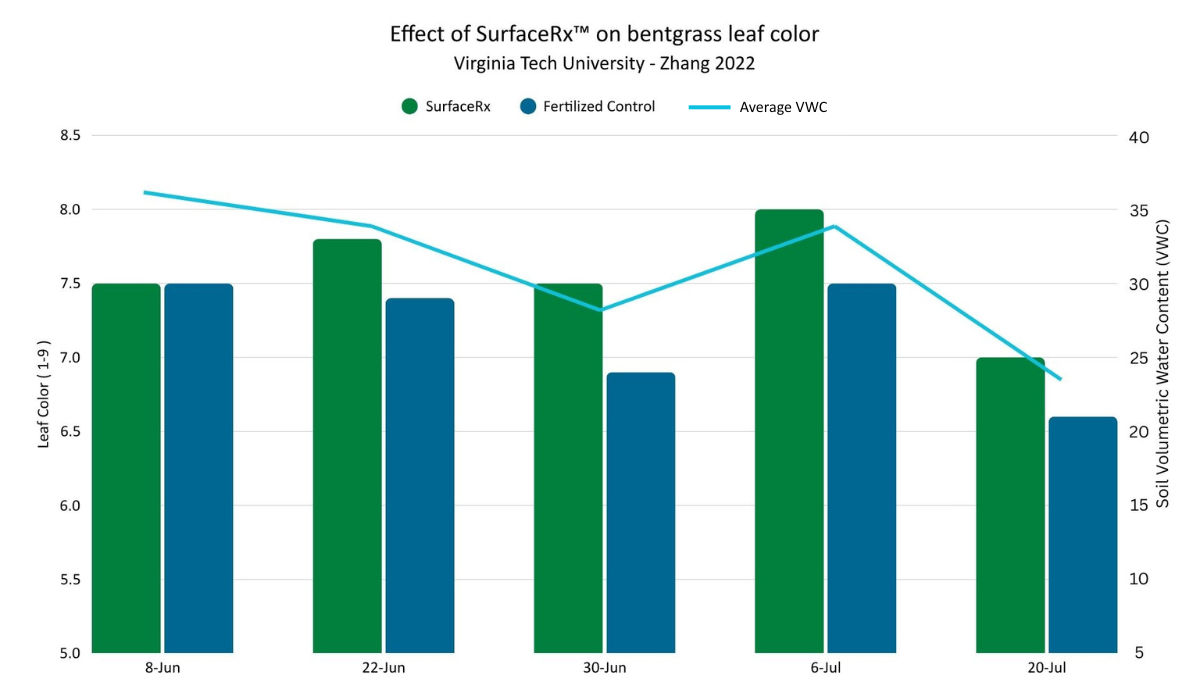
Leaf color. Leaf color was rated biweekly on a visual scale of 1–9 with 9 indicating the dark green color and 1 indicating brown color.
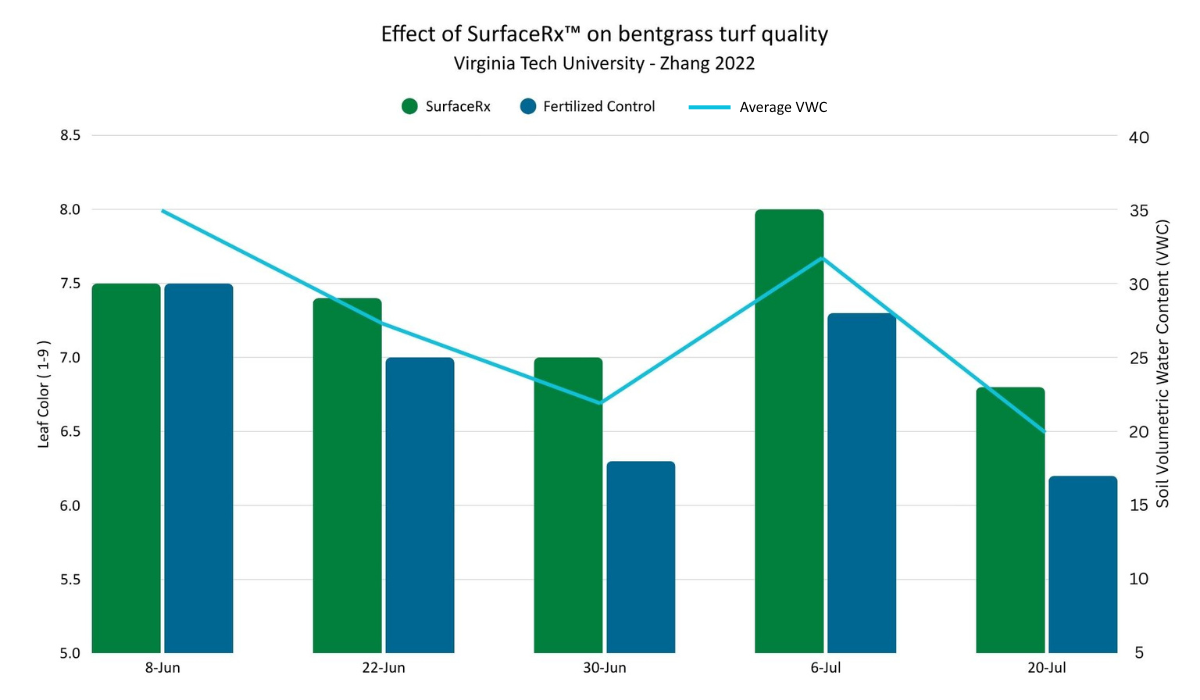
Turf quality. Turf quality was rated biweekly on a visual scale of 1-9 with 9 indicating the best quality and 6 being the minimum acceptable quality.
Volumetric water content (VWC). The volumetric water content was measured with TDR350 regularly every 2 weeks as stated previously. In addition, in June and July, irrigation was withheld for about 9 days to allow gradual decline of the soil water content, inducing significant decline in leaf color and turf quality.Additional volumetric water content was measured at June 22, June 25, June 28, June 30, July 10, July 13, July 16, and July 20. The irrigation resumed after day 9. Three readings of VWC were collected from each plot and the average was used for statistical analysis. There was no significant difference in VWC between the treatments. The VWC was reduced from about 35% to 21% in the 1st dry-down cycle and from about 38% to 20% in the 2nd dry-down cycle.
Photos were taken to document the treatment effects on turf quality during the trial.
Connect with Us to Learn More
We’re constantly working on new studies to improve the effectiveness of our products, so if you have any questions or would like to learn more about our products and how they work, feel free to reach out. Connecting with your Harrell’s Rep is the best way for you to learn more and receive tailored solutions for all of your agronomic needs.
Related Resources

In addition to being the nation’s largest distributor of branded fungicides, herbicides, and insecticides, Harrell’s produces custom-blended fertilizers, specialty liquids, and wetting agents. Additionally, Harrell’s is the exclusive US owner, formulator, and distributor of all POLYON® branded products.
TEAM HARRELL'S
STAY EQUIPPED
Never stop learning. Access FREE continuing education courses from Harrell’s.
LET'S GROW
PRESS RELEASES
PRESS RELEASES
STAY EQUIPPED
Never stop learning. Access FREE continuing education courses from Harrell’s.
LET'S GROW