

Bringing the Best Out of the Best: COVID-19 Forces Supers to Switch Up their Swing
5/6/2020 - By William Buehn
As the nation continues to adapt under the grip of the coronavirus, our way of life has changed in a way never seen before. Social distancing—a term previously unheard of—now clutters our conversations and directs our day-to-day routines. Remote operations are challenging businesses’ IT infrastructures like never before, restaurants are continuously creating new ways to safely deliver to their customers, and people are left with a limited lunch-only menu for entertainment. On that menu, one of the sellout dishes (just behind ‘going for a walk’) has consistently been golf. It’s outside, social distance-friendly, and for the courses that have remained open, it’s a great way to get a taste of ‘normal.’ However, while some courses are seeing this surge of play, others have been forced to close down to guests. No matter the case, one thing holds true across the board; we may be on a nationwide social sabbatical, but the turfgrass is still growing.
So, how have superintendents continued to manage their facilities during these times, especially when their staff is undoubtedly trimmed down due to safety or budgetary constraints? Not surprisingly, many have successfully relied on one of the industry standards—innovation. Supers are getting creative across the country, solving their problems in ways they probably hoped they’d never have to, but still solving them, nonetheless.

Eric Thompson, General Manager of Royce Brook Golf Club, mowing fairways to help out the team
In this unprecedented situation, “Everyone’s scenario is a little different…you have to do what you can do, control what you can control, and do your best,” says Phil Juhring, Superintendent of Royce Brook Golf Club in Somerset County, New Jersey. Juhring, whose been managing Royce Brook’s extensive 36 holes and 400 acres with only one assistant and one mechanic for over a month now, says “I felt overwhelmed at first, and sort of even hopeless, but I realized pretty quickly that I can’t worry about it every day.” Normally, Juhring would have two assistants, two mechanics and about a dozen others to help him maintain the facility, but due to his course being closed for play by state guidelines, he’s been forced to cut back to a skeleton crew. Fortunately, he’s got great people around him.
Over the past month, it wouldn’t have been a surprise for Juhring to see his General Manager out mowing their 70 acres of fairways, a fellow superintendent out lending a hand, or even his brother (another super) on the sprayer helping out with a PGR application. Juhring’s Harrell’s rep, Eric Shilling, has even offered several times to come out and help aerify or mow roughs, but Juhring hasn’t taken him up on it just yet. He’s doing what he can to make the most of every minute too, including everything from removing the rakes and course accessories to combining his full pre-emergent plan into a single app to couple with a heavy PGR spray. He’s also eliminated the step cut along the fairways, adding “It’s one less job, one less machine, a couple less hours each week…If you save an hour here or there, it all adds up. It’s an hour more spent mowing rough or doing something else.”
For Kenneth Clayton, Superintendent of Houston Oaks Golf Course in Paris, Kentucky, his coronavirus curveball has looked a little different than Juhring’s. Although Clayton is only dealing with about half the acreage, he and only four others are maintaining a facility that has remained open for play throughout all of this—and they’re seeing busier days than ever. So, on top of having to think outside the box to manage his turf without any of his seasonal staff, he’s also been forced to get creative to keep up with the club’s top-to-bottom tee sheets. Couple all that with an unseasonably warm March, and PGRs have become one of his closest allies. Just like Juhring, he’s doing what he can to make the most of his manpower. He’s really trying to focus on controlling the growth and reducing mowing. At the same time, he’s got to consider playability for the golfers. For him, it seems like every time they get a warm day, everybody goes golfing. He says, “We’re running a smaller staff, and going ‘how do we handle this if we’re busier than ever?’ But that’s pretty much what being a superintendent is. It’s going with the punches and problem solving and making adjustments and just getting stuff done.”
 Houston Oaks Golf Course in Paris, Kentucky
Also like Juhring, Clayton has removed all the accessories from the course, including rakes, ball washers, coolers, etc. to try to make mowing as efficient as possible. This allows him to mow faster, but he’s also trying to focus on mowing less often. To do that, he’s keeping a close eye on his clippings. He’s measuring the clippings from his greens every day, and if they don’t show significant growth (which they haven’t recently due to a couple cold snaps), then he’s just rolling the greens and monitoring the growth. He’s keeping it simple, adding “We’re not out there wasting time mowing a green when it doesn’t need to be mowed.” 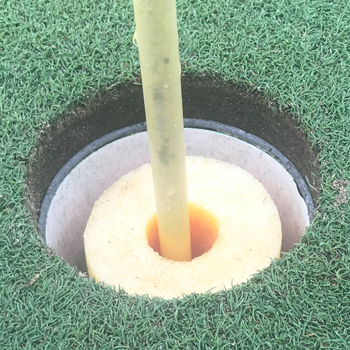
One of the biggest challenges for Clayton has been keeping up with the fluidity of the situation. With things changing on daily basis, it’s been a tall order just to stay on top of the latest state and federal guidance. Do we have to shut down? Did that Governor’s update mean that people can hit the links? Do we need to buy pool noodles? These kinds of considerations have become all too common for Clayton throughout all this. Fortunately, he and a handful of other Bluegrass GCSAA superintendents have been supporting each other through a group text, continually bouncing ideas and interpretations back and forth to come up with the best management strategies. They’ve used the thread as a sounding board to discuss governmental guidance and new implementation practices, like whether to go pin out, cup upside down, or pool noodle in. Clayton—with the player’s safety and customer experience in mind—opted for the small section of pool noodle around the pin in the bottom of the cup. This clever technique eliminates the touch point, but still lets the ball fall slightly into the cup to preserve that feeling of sinking the putt. Otherwise, it would kind of be like fishing without a hook, playing pool with no pockets, or launching a three-pointer at a bare backboard. It’s modified tactics like these that (while hopefully not forever) serve well to underscore the innovative spirit found in our golf course superintendents.
Regardless of whether courses are open or closed, they’re all having to take a few extra steps to keep their crews healthy and safe. Ross Miller, Superintendent of Country Club of Detroit, and his management aren’t taking this task lightly. With his course closed for play, Miller is operating with about 25% of his typical staff and taking every precaution to keep them safe. Early on, foreseeing what was likely to come, Miller and his management developed a detailed plan to prevent health hazards to the crew. Since then, they’ve been implementing daily health checks for each crewmember, including a pre-clock-in hand wash, health screening questionnaire, and an infrared thermometer temperature check. Each crewmember has their own cart, which is cleaned three times a day, and they’re operating with split crews—one crew works 10-hour shifts Monday through Wednesday and the other takes Thursday to Saturday. They’re also staggering lunches and cleaning all common hard surfaces, like countertops or refrigerators, twice a day. Miller understands that he needs to maintain the world class playing conditions that Country Club of Detroit is known for, but at the same time, he’s not taking any chances with his crew. For him, “what truly makes the club is the staff. So, we’ve got to take care of the people that take care of us.” His club agrees too, setting aside a relief fund for the staff and helping staff members manage temporary financial hardships like vehicle payments, insurance payments or living arrangements.
Now, as light slowly starts to leak through the wall at the end of the proverbial tunnel, hopefully more and more courses will continue to safely open back up for play. It won’t happen all at once, and things certainly won’t be the same as they were before, but it’s a start. Many of these new strategies will remain in the superintendent playbook for the foreseeable future, and there’s no doubt that more changes are still to come. Because when the all-you-can-eat buffet of entertainment starts to open back up, golf will still be served up family style, and courses will likely be busier than ever. Supers will have their work cut out for them, but that’s nothing new. As a community of problem solvers, supers will always take challenges like these and look at them through the lens of opportunity, viewing them simply as a chance for innovation.
Related Resources

In addition to being the nation’s largest distributor of branded fungicides, herbicides, and insecticides, Harrell’s produces custom-blended fertilizers, specialty liquids, and wetting agents. Additionally, Harrell’s is the exclusive US owner, formulator, and distributor of all POLYON® branded products.
TEAM HARRELL'S
STAY EQUIPPED
Never stop learning. Access FREE continuing education courses from Harrell’s.
LET'S GROW
PRESS RELEASES
PRESS RELEASES
STAY EQUIPPED
Never stop learning. Access FREE continuing education courses from Harrell’s.
LET'S GROW