

Using Sulfur to Reduce Soil pH in Established Turfgrass
8/9/2022 - By Dr. Raymond Snyder
Study: Using Sulfur to Reduce Soil pH in Established Turfgrass
Location: Bear
Lakes Country Club in West Palm Beach
Collaborator:
George Snyder, Ph.D.
Date: May
26, 2022
Agricultural
sulfur (S) is used for reducing soil pH. However, numerous authorities have
cautioned against using it in established turfgrass because turfgrass may be
damaged. Rieke (1970) reported injury and loss of bentgrass turf from an
application of 60 pounds S per 1000 sq ft. Maximum rates of only ½ pound per
1000 sq ft have been recommended on putting greens (McCarty, 2001), and this
author and others (Beard, 2002; Shaddox and Sartain, 2008) have suggested
application rates of 10 pounds or less per 1000 sq ft for other established
turfgrass. Reicher (2022) has stated that S is ineffective for reducing the pH
of turfed soils because of the low rates that must be used.
Methods and
Materials
An unreplicated
exploratory sulfur-rate study was conducted at the Bear Lakes Country Club in
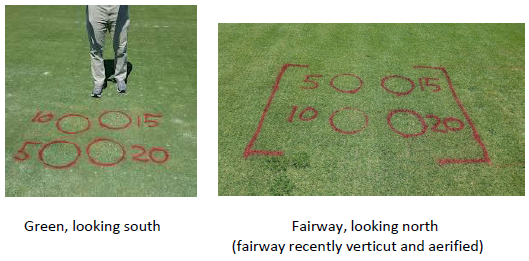
West Palm Beach. On May 26, 2022, S rates of 0, 5, 10, 15, and 20 were applied
on a Tifeagle bermudagrass green, and on a Celebration bermudagrass tee. Based
on 0–2-inch soil samples, both appeared to be constructed with sand, meeting
USGA specifications for putting green mixes (USGA, 1993). The green contained
2.1% (by weight) organic matter, and the tee contained 4.6%. The plots were a
one-foot diameter circle, except for the 0 rate, which was an untreated area
immediately adjacent to the circular plots. A granular 90% S source was used
(Tiger 90CR. Tiger Sul Products LLC. Shelton, CN).
The product
application rates were 1.98, 3.96, 5.94, and 7.91 g per plot for the 5-, 10-,
15-, and 20-pounds S per 1000 sq ft treatments, respectively. Mowing and
irrigation were conducted by the golf course according to their schedules. Between
the second and third week after application, the green was core aerified and top-dressed.
Some S may have been displaced from the plots by these operations. However,
after the first-week observation, considerable rainfall occurred on June 4th
(4.6 inches at nearby Palm Beach International Airport), which should have
dispersed the S granules and moved them into the turfgrass cover.
Plots
were examined and photographed weekly. In the fourth week, 15, 2-inch deep by
¾-inch diameter soil samples were extracted and analyzed for pH and S extracted
with pH 4.8 ammonium acetate.
Results and
Discussion
No
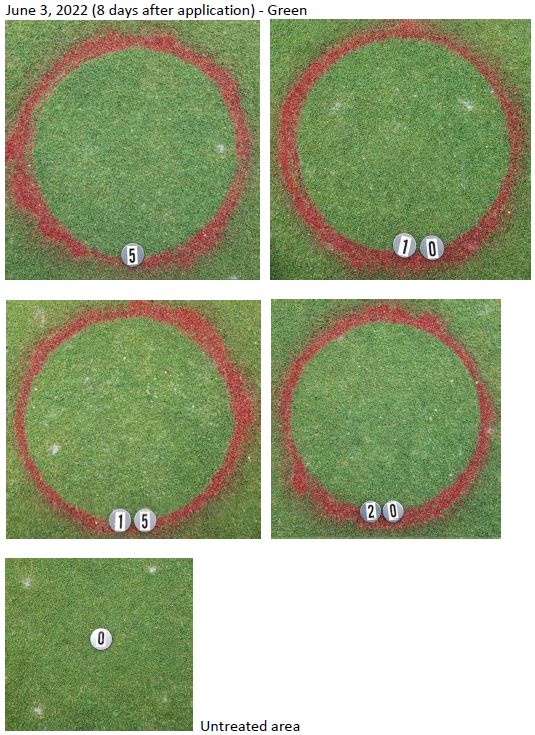
grass discoloration or damage was observed in any of the plots on any of the
observation dates (attached photographs). Soil pH was reduced from 7.0 to 6.3
on the green, and from 6.6 to 5.3 on the tee at the highest S application rates
(Table 1).
Conclusion:
Sulfur
application rates up to 20 pounds per 1000 sq ft did not damage bermudagrass
turf on a green or a tee, but pH was substantially reduced.
Table
1. Soil pH and extractable soil S four weeks
after sulfur applications.
|
Location |
S rate (lbs./1000 sq ft) |
pH |
Soil S (lbs./acre) |
|
Green |
0 |
7.0 |
21 |
|
|
5 |
6.8 |
38 |
|
|
10 |
6.7 |
48 |
|
|
15 |
6.4 |
60 |
|
|
20 |
6.3 |
66 |
|
Tee |
0 |
6.6 |
13 |
|
|
5 |
6.3 |
45 |
|
|
10 |
5.9 |
96 |
|
|
15 |
5.4 |
201 |
|
|
20 |
5.3 |
225 |
Literature Cited
Beard,
J. B. 2002. p. 157 In Turf Management for Golf Courses, 2nd
Ed. Ann Arbor Press, Chelsea, MI.
McCarty,
L. B. 2001. p. 92-93 In Best Golf Course Management Practices. Prentice
Hall, Upper Saddle River, NJ.
Reicher,
Z. 2022. Sulfur is not effective for lowering the pH of turfed soils. https://turf.purdue.edu/sulfur-is-not-effective-for-lowering-ph-of-turfed-soils/
Rieke,
P. E. 1970. Soil pH for turfgrasses. p. 212-220 In Proc. 1st
Int. Turfgrass Res. Conf, Harrogate, England.
Shaddox,
T. W., and J. B. Sartain. 2008. Soil Testing and Interpretation for Florida
Turfgrass. https://edis.ifas.ufl.edu/pdf/SS/SS31700.pdf
USGA
Green Section Record, March/April 1993
Related Resources

In addition to being the nation’s largest distributor of branded fungicides, herbicides, and insecticides, Harrell’s produces custom-blended fertilizers, specialty liquids, and wetting agents. Additionally, Harrell’s is the exclusive US owner, formulator, and distributor of all POLYON® branded products.
TEAM HARRELL'S
STAY EQUIPPED
Never stop learning. Access FREE continuing education courses from Harrell’s.
LET'S GROW
PRESS RELEASES
PRESS RELEASES
STAY EQUIPPED
Never stop learning. Access FREE continuing education courses from Harrell’s.
LET'S GROW