

Spray Tank Adjuvants – 5 Tips to Make Sure Products Are Working as They Should
5/2/2023
Liquid fertilizers, herbicides, fungicides, and insecticides are a significant line item in most green-industry operating budgets. Billions of dollars are invested by manufacturers worldwide to identify, develop, and launch products to address challenges faced by today’s growers. Regardless of the investment along the manufacturer-to-end-user distribution chain, it can all be for naught if the label instructions directing adjuvant use are disregarded as unimportant information.
5 Adjuvant Tips to Maximize Product Efficacy
At its simplest, adjuvants are materials added to a spray tank to make products more effective. These include liquid fertilizers, herbicides, fungicides, insecticides, nematicides, or anything else which uses water as a delivery system. Although active ingredients are, for the most part, highly effective at producing their intended effect, active ingredients face significant challenges from plants and water alike to maximize efficacy.
Relatively speaking, adjuvants are more affordable than their active ingredient tank mix partners. Considering the amount invested in fertility and active ingredients by the average green-industry facility, using the appropriate adjuvant as instructed by the product label is an important step to maximizing this investment. Here are 5 tips for maximizing product efficacy through appropriate adjuvant use:
1. Proper Adjuvant Use Starts with Water Quality – pH
It all starts with water quality when it comes to any liquid spread, and pH is one of the most vital components to take into consideration. pH is a measure of the acidity of a solution. Measured on a scale of 1-14, 7 is neutral, <7 is acidic, and >7 is alkaline. Pure water has a pH of 7, however, carrier water used for spray applications is never pure. As water moves through the ground and into lakes, reservoirs, underground aquifers, or other collection areas it tends to pick up the characteristics of the soil it filters through.
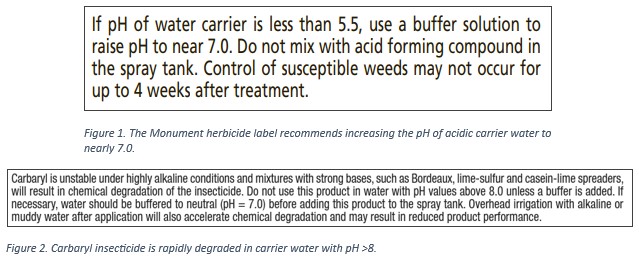
It's good practice to know the pH of carrier water used for spray applications and important to note that carrier water pH can change over time. An effective pH meter can be purchased for less than $50.00 and allows for checking carrier water pH regularly. When pH is determined to be out of the target range, buffer solutions such as Harrell's pH Buffer should be used to bring carrier water pH back into the target range.
pH buffers should be added before active ingredients are in a spray tank. This ensures the carrier water will not promote rapid degradation of the active ingredient(s), maintaining efficacy. It is good practice to re-test spray tank carrier water after a pH buffer is added to ensure the carrier water is within the target range.
2. Adjuvant Water Quality Continued – Hardness
Water hardness is a measure of the calcium and magnesium concentration in water. Hardness is generally reported in parts per million (ppm) on water test results and can be antagonistic to pesticide efficacy when >200 ppm. Hard water antagonism is commonly associated with weak acid herbicides, or herbicides which have a slight negative charge when carrier water pH is >7, typical of water with elevated hardness.
Examples of weak acid herbicides include glyphosate, 2,4-D, and dicamba. Since calcium and magnesium are cations and carry a positive charge, the negative charge of weak acid herbicides can combine with calcium and magnesium, rendering the active ingredient less effective. If poor broadleaf weed control is observed following the application of a potent broadleaf herbicide, hard water antagonism might be to blame.
Ammonium sulfate (AMS) is typically recommended to address hard water antagonism. Once dissolved in a spray tank the AMS molecule separates into its respective ammonium and sulfate components. Ammonium binds with the active ingredient and sulfate binds with calcium or magnesium to neutralize the effects of hard water, acting as a sacrificial molecule of sorts.
Harrell's Herbicide Activator is an all-in-one solution to supply both ammonium sulfate and a non-ionic surfactant without the hassle of dissolving spray-grade ammonium sulfate.
3. Some Active Ingredients Have a Tough Time Getting Inside the Target Plant
Surfactants are a class of adjuvants that manipulate how a spray solution interacts with and behaves on the applied surface, such as the leaf surface of a target weed.
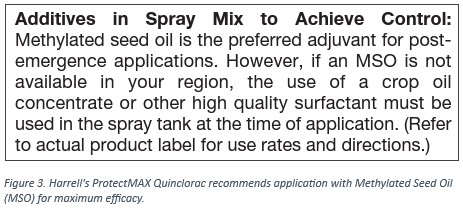
One of the top reasons herbicide applications fail is the inability of an active ingredient to cross the target weed cuticle to reach the active site within the weed. If a pesticide label recommends including a surfactant as part of the product tank mix, the manufacturer likely observed during the development process that the surfactant improves the efficacy of the product. Not all surfactants are equal.
The chemical characteristics of the active ingredient and product formulation dictate which surfactant is best. A surfactant such as Harrell’s Methylated Seed Oil (MSO) is highly effective at helping active ingredients translocate across the wax-like cuticle of a target weed whereas the same surfactant does a poor job of helping spray droplets spread across a leaf surface. Alternatively, Harrell’s Activator + SA is exceptional at improving spray droplet spread characteristics but is not as effective as MSO at enhancing cuticle penetration.
If a product requires a surfactant to maximize efficacy, it will be recommended on the product label (Figure 3).
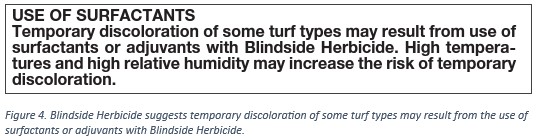
Many products are preformulated with the appropriate surfactant or recommended against their use altogether (Figure 4). As always, read the product label for specific recommendations.
4. Don’t Get Burned by Off-target Herbicide Drift
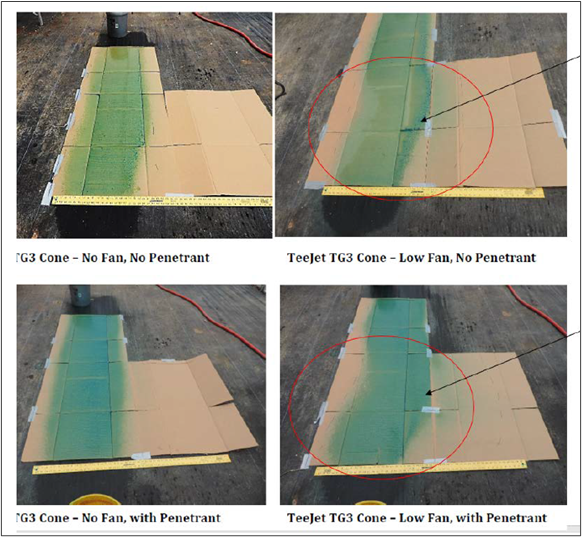
Off-target injury caused by herbicide drift is a major concern, especially during hot and windy conditions that promote active ingredient volatilization and movement. Some surfactants, such as Harrell's Nonionic Penetrant Plus are formulated with a drift control agent to minimize off-target movement. The drift control agent increases the viscosity of the spray solution, reducing the number of micro-sized droplets that are prone to volatilization.
NOTE: It’s good practice to maintain buffer areas between application areas and sensitive areas per label guidelines, however, a drift control agent can act as additional insurance against off-target movement.
5. Add a Little Plant Health to Your Surfactant Program
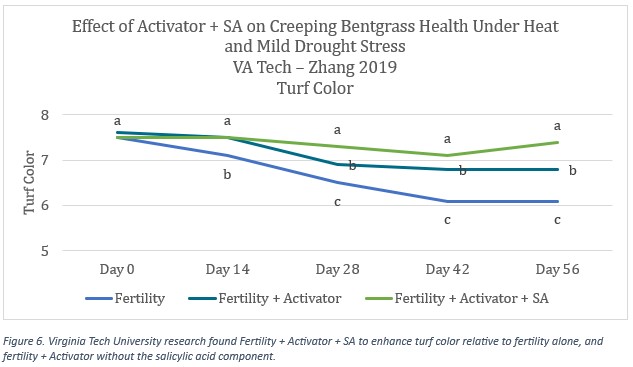
Salicylic acid upregulates natural defense mechanisms within a turf plant when included as part of a spray-applied application. When combined with a non-ionic surfactant, Harrell's Activator + SA is an affordable way to introduce a plant health component into every application that benefits from a non-ionic surfactant. Research at Virginia Tech University found Activator + SA to enhance turfgrass color compared to fertility alone, and fertility plus Activator without the salicylic acid component.
Your Harrell’s Rep Has the Right Recommendations for You
Adjuvant selection and use can be overwhelming. Product options are plentiful and their associated marketing claims are often extravagant. Your Harrell’s rep is an outstanding resource to rely on for selecting the right surfactant for the right use and identifying issues associated with carrier water that may lead to less-than-desirable results. Next time you’re filling up a spray tank, think to yourself, am I doing everything the water and the product needs to maximize efficacy?
Related Resources

In addition to being the nation’s largest distributor of branded fungicides, herbicides, and insecticides, Harrell’s produces custom-blended fertilizers, specialty liquids, and wetting agents. Additionally, Harrell’s is the exclusive US owner, formulator, and distributor of all POLYON® branded products.
TEAM HARRELL'S
STAY EQUIPPED
Never stop learning. Access FREE continuing education courses from Harrell’s.
LET'S GROW
PRESS RELEASES
PRESS RELEASES
STAY EQUIPPED
Never stop learning. Access FREE continuing education courses from Harrell’s.
LET'S GROW