

Silicon Benefits for Turfgrass | Field Study Update Summer 2022: Bentgrass – Bermudagrass
12/27/2022 - By Dr. Raymond Snyder
A field study was conducted on both bentgrass and bermudagrass
based on the beneficial effect of potassium silicate observed in Dr. Xunzhong Zhang's growth chamber study. The objective was to determine if
regular applications of potassium silicate in a field setting have the same
plant health benefits observed in the growth chamber study.
Silicon Benefits on Turfgrass: Field Study - Roots
The following measurements took place
in both field studies at day 0, 14, 28, 42, 56, 70, and 84 after initial
treatments (additional measurements took place during two dry-down cycles as
described below):
·
Turf quality:
Turf quality was rated biweekly on a visual scale of 1-9 with 9 indicating the
best quality and 6 being minimum acceptable quality.
·
Leaf color:
Leaf color was rated biweekly on a visual scale of 1 – 9 with 9 indicating the
dark green color, and 1 indicating brown color.
·
Photochemical
efficiency (PE): The PE was measured biweekly with a chlorophyll fluorometer based
on the Fv/Fm, which is the ratio of variable chlorophyll fluorescence (Fv) to
maximum chlorophyll fluorescence (Fm). Leaves were dark-adapted for 15 minutes
before each measurement; three readings were collected from each plot and the
average was used for statistical analysis.
·
Leaf chlorophyll
content:
Leaf samples were collected biweekly, and chlorophyll content was determined
using spectrophotometer method (Zhang et al., 2005).
·
Leaf carotenoids
content: Leaf
samples were collected biweekly and carotenoids content was determined using
spectrophotometer method (Zhang et al., 2005).
·
Leaf antioxidant
superoxide dismutase (SOD) activity: Leaf samples were collected biweekly,
and the SOD activity was analyzed according to the method as described by Wu et
al. (2017).
·
Leaf Si content: Leaf
Si content was extracted and analyzed according to the method by Elliott and
Snyder (1991) with minor modifications.
·
Root characteristics
and biomas: At the end of the trial, 4 root samples (1.9 cm diameter and
15.24 cm deep) were collected from each plot and washed and root dry weight was
determined after the samples were dried at 70 ᵒC for 72 h. The root length,
root diameter, root surface area, and root volume were analyzed using WinRhizo
technology. Briefly, after fine cleaning of each root sample, the sample from
each plot was divided into multiple subsamples. Each subsample was scanned
using WinRhizo and all root morphological parameters were generated and
analyzed.
·
Root viability.
Root viability was analyzed using TTC method (Zhang et al., 2021). Root
viability is a good indicator of root function.
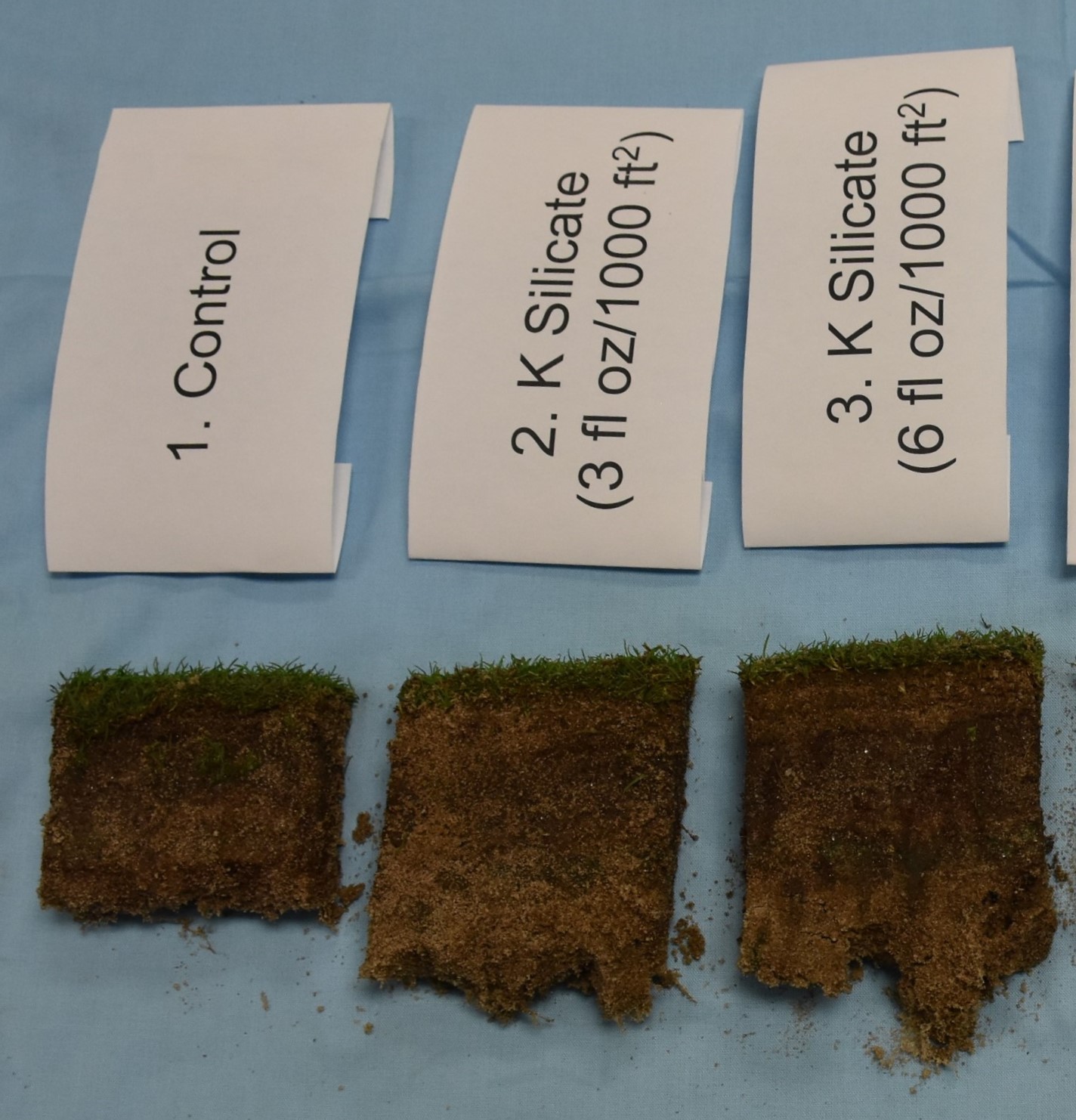
Silicon Benefits on Turfgrass: Bentgrass – Root Length and Mass
This study was carried out on the creeping bentgrass putting
greens at Virginia Tech Turfgrass Research Center in Blacksburg, VA. The trial
included three treatments with four replications. The plot size is 5 x 6 ft.
Regular mowing and irrigation were performed. A randomized block design was
used.
Treatments:
1. Fertilized Control (0.15 lb N/1000 ft2
biweekly)
2. K silicate 3 fl oz per 1000 sq ft biweekly +
fertilized control
3. K silicate 6 fl oz per 1000 sq ft biweekly +
fertilized control
The trial lasted for 12 weeks from
June 8 through August 31 and a total of 6 treatment
applications.
Results
Potassium silicate applied at 6 fl oz
per 1000 sq ft biweekly increased turf quality on June 30, July 6, July 12,
August 17, and August 31.
Potassium silicate applied at 6 fl oz
per 1000 sq ft biweekly increased leaf color on June 30, July 6, July 12, July
20, August 17, and August 31.
Potassium silicate applied at 6 fl oz
per 1000 sq ft biweekly increased chlorophyll content on July 20, August 3,
August 17, and August 31.
Potassium silicate applied at 6 fl oz
per 1000 sq ft biweekly increased leaf silicon content on August 3, August 17,
and August 31.
Potassium silicate applied at 6 fl oz
per 1000 sq ft biweekly increased root biomass, length, surface area, volume,
and viability.
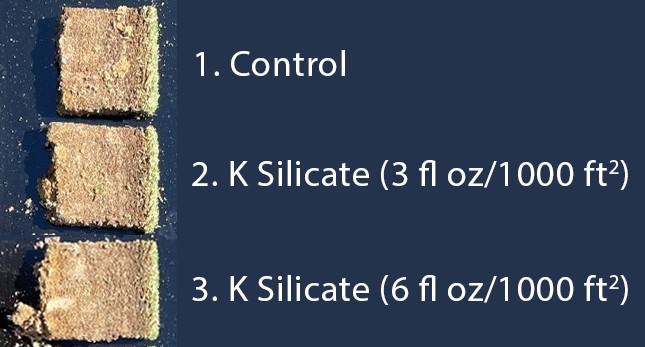
Silicon Benefits on Turfgrass: Bermudagrass – Root Length and Mass
This study was carried out on the ultradwarf bermudagrass putting
greens at the Independence Golf Course Research Putting Greens in Richmond, VA.
The trial included three treatments with four replications. The plot size is 6
x 6 ft. Regular mowing and irrigation were performed. A randomized block design
was used.
Treatments:
1. Fertilized Control (0.15 lb N/1000 ft2
biweekly)
2. K silicate 3 fl oz per 1000 sq ft biweekly +
fertilized control
3. K silicate 6 fl oz per 1000 sq ft biweekly +
fertilized control
The trial lasted for 12 weeks from
June 3 through August 26 and a total of 6 treatment
applications.
Results
Potassium silicate applied at 6 oz/1000 sq ft biweekly improved
turf quality on two observation dates, July 15 and August 26.
Potassium silicate applied at 6 oz/1000 sq ft biweekly improved
leaf color on three observation dates, July 15, August 17, and August 26.
Potassium silicate applied at 6 oz/1000 sq ft biweekly increased
chlorophyll content on two observation dates, July 29 and August 26.
Potassium silicate applied at 6 oz/1000 sq ft biweekly increased
leaf silicon content on four dates, July 1, July 29, August 12, and August 26.
Potassium silicate applied at 6 oz/1000 sq ft biweekly increased root
biomass, length, volume, and viability.
Your Harrell’s Rep and Directors of Agronomy Are Here to Help
Our Directors of Agronomy at Harrell's are always working with our
partner researchers to find solutions for our customers’ toughest problems and
to improve the efficacy of current formulations. To stay up to date on all of
the TurPh.Dudes’ research projects, check out our blog page.
If you have any questions about any of the research presented here
or how you can develop an agronomic plan for your turf, reach out to your local Harrell's Rep.
Related Resources

In addition to being the nation’s largest distributor of branded fungicides, herbicides, and insecticides, Harrell’s produces custom-blended fertilizers, specialty liquids, and wetting agents. Additionally, Harrell’s is the exclusive US owner, formulator, and distributor of all POLYON® branded products.
TEAM HARRELL'S
STAY EQUIPPED
Never stop learning. Access FREE continuing education courses from Harrell’s.
LET'S GROW
PRESS RELEASES
PRESS RELEASES
STAY EQUIPPED
Never stop learning. Access FREE continuing education courses from Harrell’s.
LET'S GROW