

Turf Management Basics - Silicon: A Beneficial Element
11/4/2021 - By George Snyder, Ph.D & Xunzhong Zhang, Ph.D
A Surface-Area Defense System
As stated in the Handbook of Turfgrass Management and Physiology (CRC Press, 2008), silicon (Si) appears to be essential for certain plants, such as rice (Oryza sativa L.) and Equisetum sp. L. [1], but probably not for warm season turfgrasses. Nevertheless, some warm season turfgrasses have been shown to respond favorably to Si fertilization. Silicon is naturally absorbed by plants from soil as monosilicic acid, Si(OH)4. Although Si is not considered to be a macronutrient, the content of Si in some plants can be in the range of certain macronutrients. However, the Si content of most turfgrass leaf tissue is much lower than that of rice, for example, generally ranging between 0.5 and 1.6 % by weight. Silicon is transported from roots via active transport primarily to leaves, where it forms deposits that help stabilize cell wall and lignin polymers [2]. Because the deposits take time to develop, they are most prominent on older leaves. Cell walls of grass roots, stems, and inflorescence can also accumulate Si [3]. These Si deposits are commonly found where their presence acts as a surface-area defense system (on leaf and stem hairs, and on the outer epidermal walls).
Silicon & Water Stress
The location of the Si deposits aid in coping with water stress. Plants become more drought tolerant because the location of Si deposits reduces cuticle transpiration losses and strengthens cell walls to prevent the xylem from collapsing. In addition, location of Si deposits guards against the establishment of foliar fungal disease pathogens.
Silicon & Disease Control
Silicon fertilization has been shown to be an effective means of controlling common diseases on warm season turfgrasses. In both greenhouse and field studies, Si reduced the progression of gray leaf spot, caused by Magnaporthe grisea, on St. Augustine grass [4,5]. Tifway bermudagrass has also been documented to show a greater resistance to bermudagrass leaf spot caused by Bipolaris cynodontis when fertilized with calcium silicate slag [6]. While warm season turfgrass' responses to Si fertilization have been demonstrated in greenhouse and field trials [7], research has not progressed to the point that routine Si fertilization practices have been established.
Silicon & Heat and Drought Stress
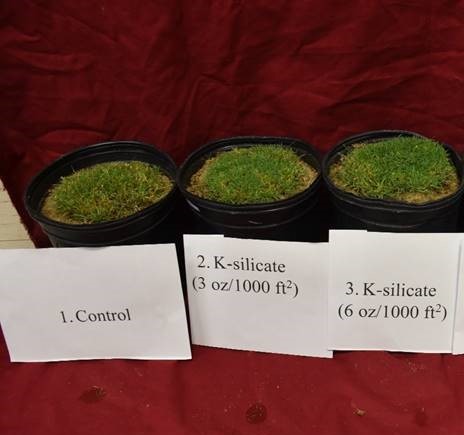
Recent growth chamber study by Dr. Xunzhong Zhang at Virginia Tech has shown that foliar application of potassium silicate of Harrell’s source biweekly at 3 and 6 fl oz/1000 ft2 improved:
- leaf color,
- photochemical efficiency,
- chlorophyll and carotenoids, and
- antioxidant superoxide dismutase (SOD) activity relative to the fertilized control in creeping bentgrass under mild heat and drought stress conditions.
When measured at 56 days of stress treatment, application of K-silicate at 6 fl oz/1000 ft2 increased:
- leaf color rating by 7.8%,
- total chlorophyll content by 20.8%, and
- SOD activity by 42.6% relative to the fertilized control.
In addition, application of K-silicate increased root viability of creeping bentgrass under mild heat and drought stress conditions.
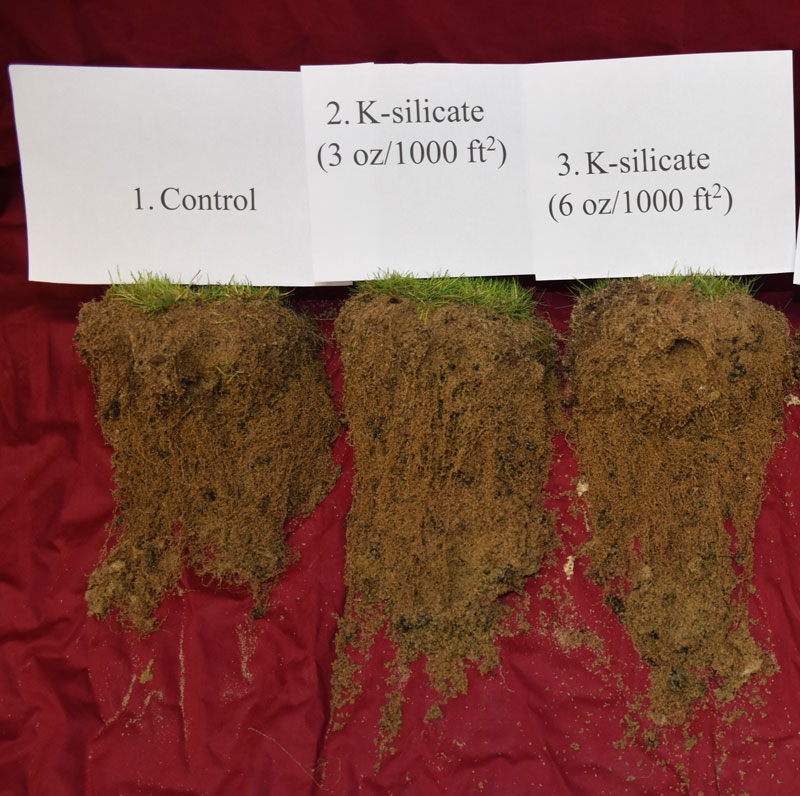
In conclusion, this research suggests that Si fertilization may improve cool season turfgrass persistence during summer stress.
Literature Cited
1. Taiz, L. and Zeiger, E. Plant Physiology, 3rd Ed. Sinauer Associates, Inc. Sunderland, MA, 2002.
2. Marschner, H. Mineral Nutrition of Higher Plants, 2nd Ed. Academic Press, London, 1995.
3. Salisbury, E B. and Ross, C. W. Plant Physiology, 4th Ed. Wadsworth, Inc., Belmont, CA, 1992.
4. Datnoff, L. E. and Nagata, R. T. Influence of silicon on gray leaf spot development in St. Augustinegrass. Phytopathology 89:S19, 1999.
5. Brecht, M. 0., Datnoff, L. E., Kucharek, T. A., and Nagata, R. T. 2004. Influence of silicon and chlorothalonil on the suppression leaf spot and increase plant growth in St. Augustinegrass. Plant Dis. 88:338-344, 2004.
6. Datnoff, L. E. and Rutherford, B. A. Accumulation of silicon by bermudagrass to enhance disease suppression of leaf spot and melting out. USGA Turfgrass Environ. Res. (online) 2(18):1-6, 2003.
7. Datnoff, L. E. Silicon in the life and performance of turfgrass. Applied Turfgrass Science (online) doi:l0.l094/ATS-2005-0914-0l-RV
Related Resources

In addition to being the nation’s largest distributor of branded fungicides, herbicides, and insecticides, Harrell’s produces custom-blended fertilizers, specialty liquids, and wetting agents. Additionally, Harrell’s is the exclusive US owner, formulator, and distributor of all POLYON® branded products.
TEAM HARRELL'S
STAY EQUIPPED
Never stop learning. Access FREE continuing education courses from Harrell’s.
LET'S GROW
PRESS RELEASES
PRESS RELEASES
STAY EQUIPPED
Never stop learning. Access FREE continuing education courses from Harrell’s.
LET'S GROW