

Why Sedge Control Matters
7/22/2025 - By Mike Hess
In the summertime, there are plenty of things for turf managers to be thinking about. Proper watering, managing nutrition and growth with increased turf traffic, heat stress, disease pressure, and of course, weeds. More specifically, taking care of troublesome sedges in your turf will take care of one big headache, and we have the identification tips and product recommendations that can help you do just that.
Sedge Control – Identification
Sedges are known around the world as one of the most troublesome weeds in all kinds of landscapes. That being said, identifying a plant as a sedge may be easy, however identifying the specific sedge species can prove challenging. The main things to look for to identify a weed as part of the sedge family are their triangular and solid stems, as well as their leaves arranged in three ranks around the stem, with their ligules fused to the leaf base.
Unlike leaves which are visually similar amongst many sedge species, there is great diversity in the appearance of sedge flowers. Because of this, flowers are often required to differentiate between sedge species. When flowering, they have a green, yellow, brown, or black color and look spiky. Sedges prefer to grow in aquatic or damp areas. Look out for areas that tend to collect water or drain more slowly than others.
Sedge Control – Why it’s Important
Aside from the fact that sedges are weeds and are generally unsightly growing alongside your normal grasses, sedges spread very quickly and can outcompete turfgrass, impacting overall health and appearance. Their ability to reproduce above and below ground makes them exceedingly difficult to get rid of. Here are some tips and product recommendations that can help.
Sedge Control Tips for Eradication
Herbicide use is the best way to not only control, but to permanently eradicate sedges. Below you will find a helpful table that details which herbicides to use against sedges, what types of grass the product can be applied on, use sites, and HRAC codes.
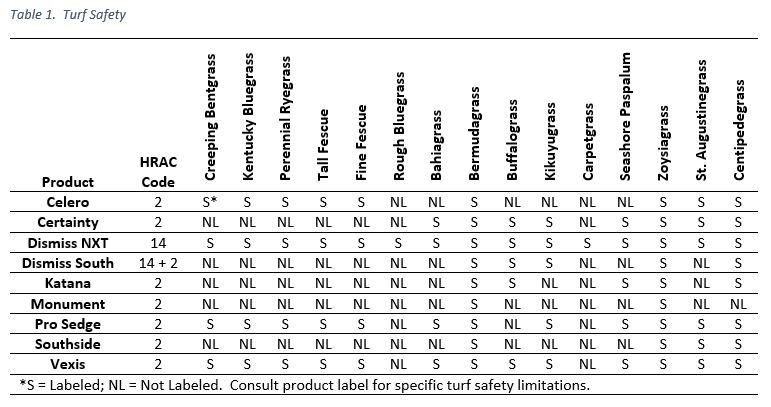
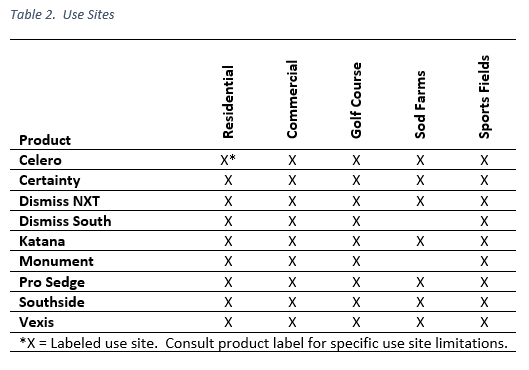
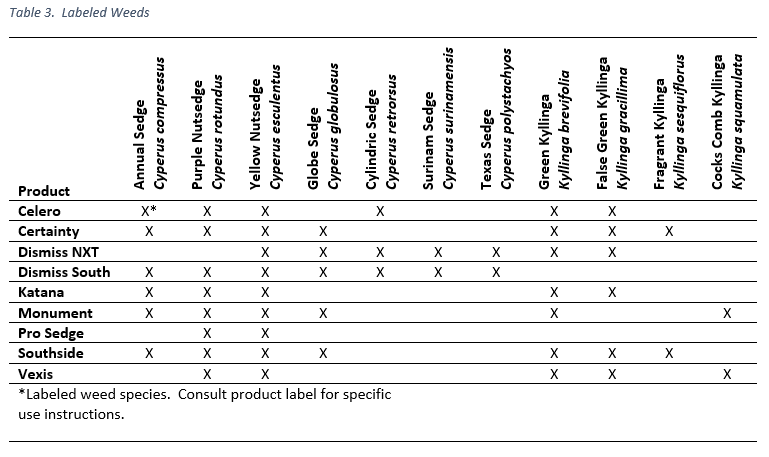
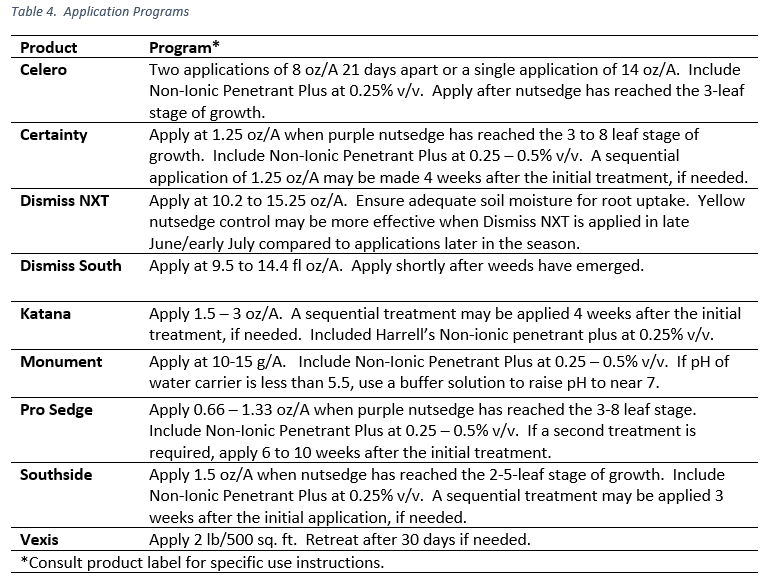
Make sure you apply the proper herbicides when sedges are in their growth phase and before they begin seeding. It is also important to mention how vital it is to maintain proper cultural practices, such as watering, mowing heights, and fertility, to complement your prevention program.
Your Harrell’s Rep is Your Best Resource
If you need help identifying sedges in your turf or homing in on what product(s) might be best for you to apply, reach out to your local Harrell’s Representative today. They are your best resource for diagnosing and treating any problems you’re seeing on the course. Connect with them here.
Related Resources

In addition to being the nation’s largest distributor of branded fungicides, herbicides, and insecticides, Harrell’s produces custom-blended fertilizers, specialty liquids, and wetting agents. Additionally, Harrell’s is the exclusive US owner, formulator, and distributor of all POLYON® branded products.
TEAM HARRELL'S
STAY EQUIPPED
Never stop learning. Access FREE continuing education courses from Harrell’s.
LET'S GROW
PRESS RELEASES
PRESS RELEASES
STAY EQUIPPED
Never stop learning. Access FREE continuing education courses from Harrell’s.
LET'S GROW