

Quality Water, Quality Results
9/22/2025
Water quality’s significant effect on turfgrass performance cannot be overstated, regardless of how well-rounded an agronomic program may be. A few of the effects may include:
- Extremely high or low pH values can antagonize pesticide efficacy and limit nutrient availability.
- High soluble salt content may impede plant growth by limiting plant water uptake.
- High sodium content may disperse soil particles, rendering a fast percolation rate to a drip.
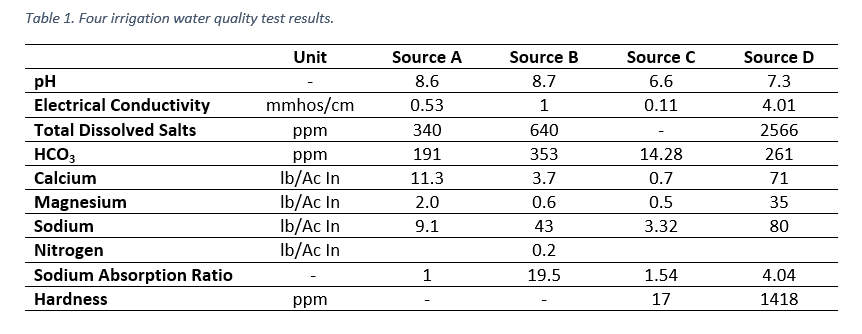
Here we take a look at four actual water test results from around the country – a water quality “shoot off” of sorts (Table 1). The courses, locations, and testing labs are omitted.
pH Balance Supports Quality Water
Potential of Hydrogen, or pH, is a measure of the acidity or basicity of a solution. The effects of pH have a wide range, with a suitable water pH value promoting nutrient availability and facilitating optimum pesticide performance. Alternatively, water pH values outside the optimum range can have the exact opposite effect, wreaking havoc on an agronomic program.
Soil nutrient availability for turfgrass is maximized when soil pH falls within the range of 5.5 – 6.5. Regular use of irrigation water tends to move soil pH in the direction of water pH over time, especially in soils with low buffering capacity, potentially limiting soil nutrient availability.
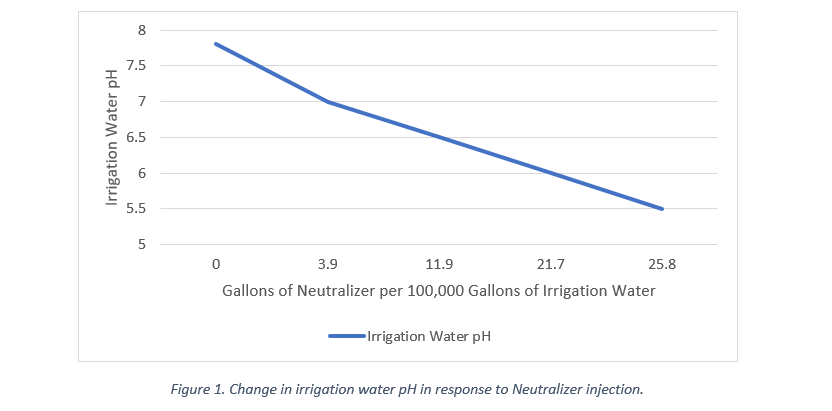
Thankfully, irrigation water pH can be lowered through additives, with acid injection being the most common method. Harrell’s Neutralizer is a sulfuric-acid urea solution that will lower water pH when injected into irrigation water at an appropriate rate. What is the appropriate rate? Every water source is different.
A Harrell’s Territory Manager is the right resource to determine the appropriate Neutralizer injection rate to adjust pH for a specific water source. The image below is an example of an irrigation water sample that was treated with different rates of Neutralizer to determine the effect of a range of injection rates on water pH. In this example, 21.7 gallons of Neutralizer per 100,000 gallons of water is required to lower the pH of the source to 6.0.
In the four-sample comparison above, all pH values are high or are leaning on the high side of the acceptable range. Source C is the closest to the ideal range at 6.6 and is the winner of the pH competition. In a practical sense, acid injection would be of limited benefit for this source compared to the significant pH improvement which could be achieved by injecting Neutralizer into source A or B.
Irrigation Alkalinity Impedes Water Infiltration
The sum of carbonates (CO3-2) and bicarbonates (HCO3-) is reported as total alkalinity. Generally, bicarbonates are more prevalent. High alkalinity values typically correlate with high irrigation water pH and indicate a water source will resist adjustment to a lower pH following treatment with an acid injection product, such as Neutralizer. In addition, alkalinity plays an important role in soil water infiltration.
During periods of hot, dry weather, irrigation may be relied on as the sole source of water to keep turf hydrated. In the case of irrigation water with high alkalinity, bicarbonate and carbonate anions react with free calcium and magnesium in the soil to form insoluble salts, which appear visually as a white crust on the soil surface. The crust will reduce water availability to the turf by slowing water infiltration through the soil surface.
Similar to directly addressing irrigation water pH, irrigation alkalinity is best addressed by injecting an acidic product such as Harrell’s Neutralizer into irrigation water. If acid injection is not possible, a sprayable product such as Harrell’s Soil Surge may be utilized to directly introduce an acidic material to the soil surface. While not as potent as Neutralizer, Soil Surge is an acidic urea formulation that is non-phytotoxic when applied to turf and is less corrosive to spray equipment. Irrigation following the Soil Surge application will enhance efficacy and improve safety.
Bicarbonates present minimal issues when the concentration in irrigation water is less than 90 ppm, but they become somewhat problematic when between 90 and 500 ppm, and are significantly problematic when greater than 500 ppm. In the four-sample comparison, all except for sample C fall within the somewhat problematic range. Generally, bicarbonates within the 90-500 ppm range can be managed if compounding issues, such as high Sodium Absorption Ratio (SAR), are not present.
Water Salinity Can Reduce Drought Symptoms
Salinity may be reported as Total Dissolved Salts (TDS) or Electrical Conductivity (EC). Total Dissolved Salts are reported in parts per million (ppm), and EC is reported in decisiemens per meter (dS/M) or millimhos per centimeter (mmhos/cm). High salinity levels have the potential to antagonize the uptake of nutrients and induce drought symptoms during periods of high soil moisture content.
Salinity provides the first example of differences in laboratory reporting in our four-sample comparison. All samples report EC. However, one sample, Source C, does not report TDS. Although EC and TDS are essentially the same, it is not uncommon for testing labs to report both or emit one.
Irrigation salinity becomes problematic when measured EC values are above 1.5 dS/m (1 dS/m = 640 ppm). In this example, all but Source D are below the threshold. Salinity levels, such as those found in Source D, will become problematic during periods of drought when irrigation is relied on as the main source of water. Turf may exhibit symptoms of drought even though irrigation is applied regularly.
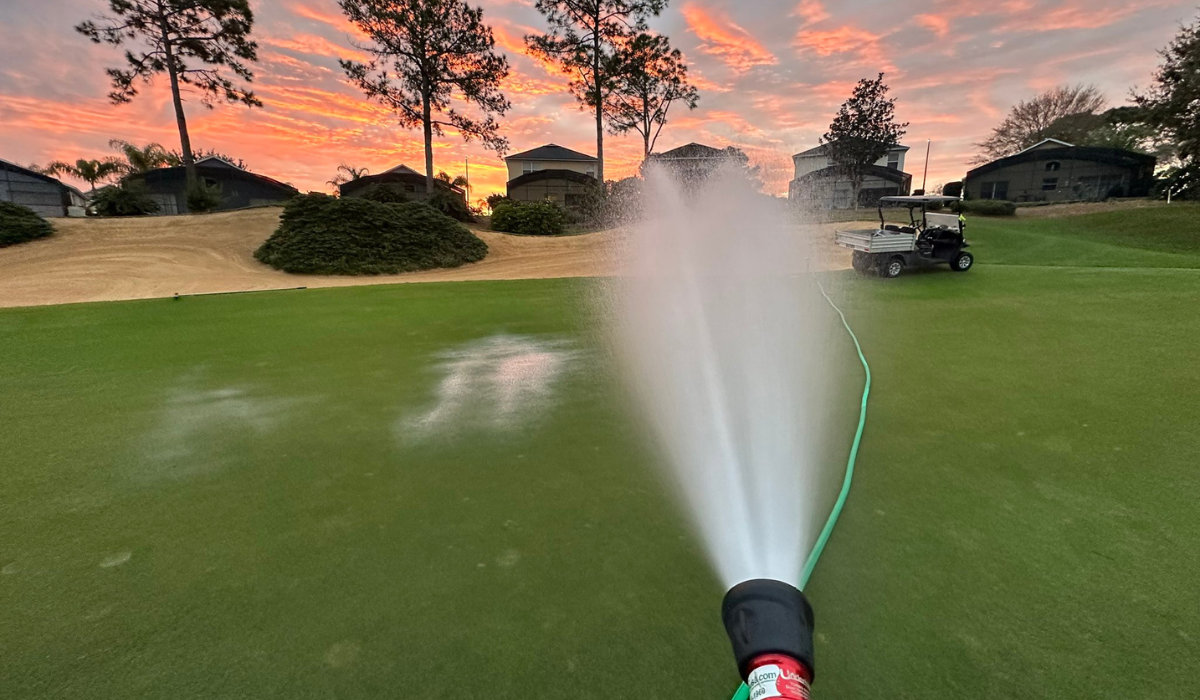
High salinity irrigation water is best managed by regular rootzone flushing with an alternative water source or rainfall. Sandy soils are best suited to cope with high salinity irrigation water, as percolation rates are naturally high and can be readily flushed.
The use of wetting agents such as Harrell’s HydroMAX® SurfaceRx™ encourages water movement through a root zone, promoting the leaching of accumulated salts. Recently, research has shown that the application of EarthMAX can further aid in turfgrass tolerance to salt stress. You can read more about this here: Study: EarthMAX® Organic Mitigates Salinity Stress & Increases Root Biomass Over Time.
Sodium Absorption Ratio (SAR) in Water
Salinity and sodium are often thought of as one and the same. Although sodium is often present as a salt in water as sodium chloride, it is not the only salt captured in a measurement of total salinity. However, it is important to understand how much sodium is present in water relative to other cations, specifically calcium and magnesium.
The sodium adsorption ratio, or SAR, indicates the ratio of sodium to calcium and magnesium. Because sodium is a large molecule, relatively speaking, and has a low charge density, it tends to disperse soil particles when it is the dominant cation in a soil profile. This effect inhibits water movement in soils by clogging pore space.
Irrigation water with SAR values >10 is generally considered high-sodium water. As a rule, if SAR is ten times greater than EC, then sodium levels in an irrigation source are high enough to cause soil to disperse or deflocculate. In the four-sample comparison, only Source B has a SAR >10 at 19.5. Additionally, the SAR of 19.5 is more than ten times greater than the sample EC of 1, indicating this water source has a high potential to slow water infiltration and percolation.
Regular application of calcium-containing materials such as Harrell’s Cal Plus or CalMAX G supplies calcium to offset high sodium levels and should be included as part of an agronomic program challenged with high sodium water.
Water Nutrient Content
Granular and liquid fertilizer applications are obvious sources of turf nutrition, but what about the often-overlooked third source, irrigation water?
Depending on the source, irrigation water can contain limited nutrients, such as Source C in the four-sample comparison, or can be a significant contributor to turf nutrition, such as Source D. For example, consider how much calcium would be applied during a growing season for Source C and D.
For easy math, if 1 inch of irrigation water were applied weekly for 20 weeks, Source C would apply 14 pounds per acre of calcium. Source D would apply 1,420 pounds per acre of calcium.
Either value should be considered when planning agronomic inputs.
Reach Out to Your Harrell’s Rep
Water is a foundational component of any agronomic program, but it is often overlooked. Taking time this season to get to know your water and taking the appropriate steps to optimize it for turf management will pay dividends in quality, playability, and resilience.
Every source is different, and the ideal source is rare and location-dependent. Unfortunately, most facilities do not have an option to use an alternative water source. I encourage you to have a conversation with your Harrell’s representative about your strategy for addressing water quality for the upcoming growing season.
**Always read and follow label instructions. Not all products are registered in all states.
Related Resources

In addition to being the nation’s largest distributor of branded fungicides, herbicides, and insecticides, Harrell’s produces custom-blended fertilizers, specialty liquids, and wetting agents. Additionally, Harrell’s is the exclusive US owner, formulator, and distributor of all POLYON® branded products.
TEAM HARRELL'S
STAY EQUIPPED
Never stop learning. Access FREE continuing education courses from Harrell’s.
LET'S GROW
PRESS RELEASES
PRESS RELEASES
STAY EQUIPPED
Never stop learning. Access FREE continuing education courses from Harrell’s.
LET'S GROW