

Powdery Mildew Disease Spotlight
9/28/2022 - By Scott Renfro
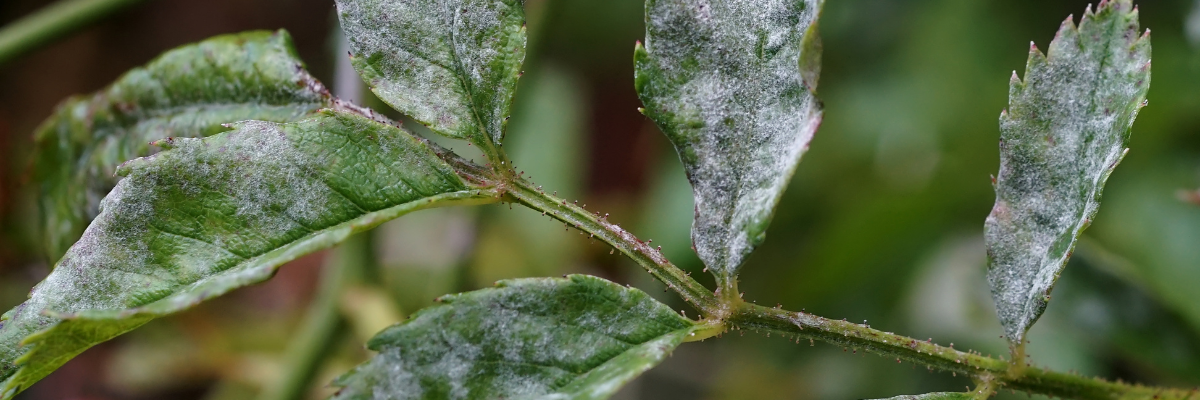
Disease Highlight: Powdery Mildew (Microsphaera and Erysiphales)
The most common powdery mildew species found in
western Oregon and Washington is Erysiphe azalea (formerly Microsphaera
azalea). Typically, it is more prevalent on deciduous azaleas than
evergreen azaleas and occurs during the summer months. Powdery mildew is
obligately parasitic, which means they require a living host to reproduce.
Powdery Spores
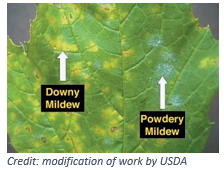
They reproduce by asexual and sexual spores. Conidia are the asexual spores that tend to be the most frequently observed symptom since they display the characteristic white powdery spots on both sides of the leaves and stems which can sometimes be confused with downy mildew. They are spread by wind and can be formed within 3-7 days after infecting the host plant. When conditions favor high humidity and moderate temperatures, rapid reproduction will occur during the summer months.
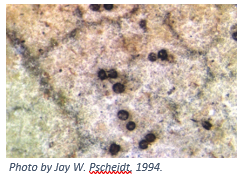
Black, Spherical Spores
Sexual spores, called chasmothecia, are small,
black and spherical in appearance. They are typically found on the underside of
the leaves and during the fall months, numbers can increase exponentially and
overwinter in the form of dormant mycelium within buds of infected plants.
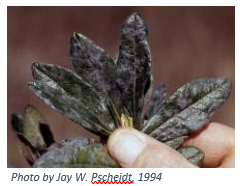
Controlling Powdery Mildew
Cultural control of powdery mildew can be achieved by reducing the relative
humidity, avoiding heavily shaded areas and minimizing excessive Nitrogen
fertilizer applications. The most effective cultural control is providing
adequate spacing of plants to provide good air circulation and plant-resistant
varieties. Powdery mildew is also easily controlled by the application of
numerous fungicides. Here is a list of the ones I find most effective:
·
Microthiol Disperss at 5 lbs/100 gal water. Also
controls mites, leaf spots, and Botrytis blight. Group M2 fungicide. 24-hr
reentry.
·
Broadform at 2 to 4 fl oz/100 gal water. Group 7 + 11 fungicide. 12-hr
reentry.
·
Eagle
20 EW at 6 to 12 fl oz/100 gal water. Group 3 fungicide.
24-hr reentry.
·
Orkestra at 6 to 8 fl oz/100 gal water. Group 7 + 11 fungicide. 12-hr
reentry.
·
Torque at 4 to 10 fl oz/100 gal water. Group 3 fungicide. 12-hr
reentry.
·
Postiva at 10 to 16 fl oz/100 gal water. Group 3 + 7
fungicide. 12-hr reentry.
·
Cease (Bacillus subtilis strain QST 713) at 2 to
8 quarts/100 gal water. Efficacy in the Pacific Northwest is unknown. 4-hr
reentry.
·
Zerotol at
1 gal/100 gal water. Group NC fungicide. 0-1 hr reentry. Best curative approach
especially on loading dock before shipping.
Fluoxastrobin SC at 1 to 4 fl oz/100 gal water. Group 11 fungicide. 12-hy reentry.
If you have any questions
regarding any of the products or disease(s) mentioned, please reach out to your local Harrell's rep.
Related Resources

In addition to being the nation’s largest distributor of branded fungicides, herbicides, and insecticides, Harrell’s produces custom-blended fertilizers, specialty liquids, and wetting agents. Additionally, Harrell’s is the exclusive US owner, formulator, and distributor of all POLYON® branded products.
TEAM HARRELL'S
STAY EQUIPPED
Never stop learning. Access FREE continuing education courses from Harrell’s.
LET'S GROW
PRESS RELEASES
PRESS RELEASES
STAY EQUIPPED
Never stop learning. Access FREE continuing education courses from Harrell’s.
LET'S GROW