

Harrell'sMAX® Potassium Silicate Effect on Creeping Bentgrass
1/24/2023 - By Dr. Raymond Snyder
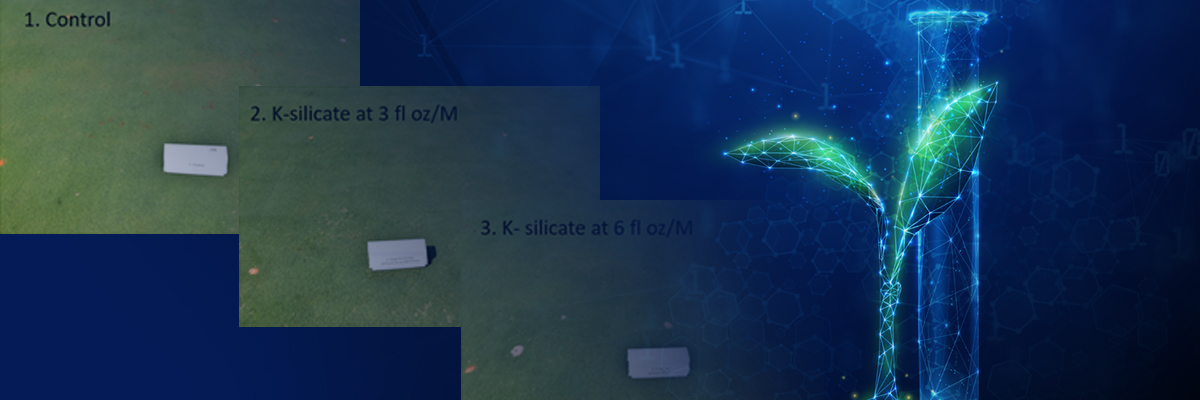
Study: Evaluating
effect of potassium silicate for improving creeping bentgrass putting green
quality, physiological fitness, and root growth during Summer drought stress.
Location: Virginia
Tech Turfgrass Research Center, Blacksburg, VA.
Collaborator: Xunzhong
Zhang, Virginia Tech University
Date: June
8, 2022 – August 31, 2022
Details: This
study was carried out on the creeping bentgrass putting green at Virginia Tech
Turfgrass Research Center. A randomized
block design with 4 replications was used.
Plot size was 5 x 6 ft. Regular
mowing and irrigation were performed.
The rate of N fertilization (soluble 28-8-18) was the same across all
treatments. Treatments were applied
biweekly. The trial lasted for 12
weeks. Data collection occurred at day
0, 14, 28, 42, 56, 70, and 84 days after initial treatments. From June 21 to June 30 and from July 11 to
July 20 irrigation was withheld to allow for gradual decline of soil water
content, inducing decline in leaf color and turf quality. At the beginning, mid, and end of each
dry-down cycle, turf quality and leaf color were rated, and photochemical
efficiency was measured. Irrigation was
resumed at the end of each dry-down cycle.
Treatments:
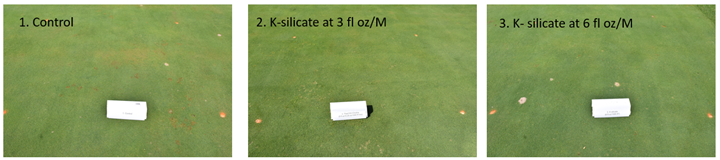
1.
Fertilized
control (0.15 lb N per 1000 sq ft biweekly)
2.
Potassium
silicate 3 fl oz per 1000 sq ft + fertilized control
3.
Potassium
silicate 6 fl oz per 1000 sq ft + fertilized control
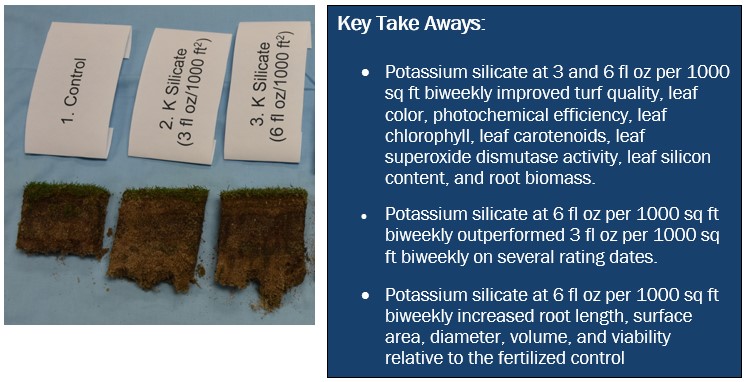
Results: The results of this study suggest that
potassium silicate, especially high-rate potassium silicate, may improve
bentgrass turf quality and Summer stress tolerance by improving photosynthetic
function (higher photochemical efficiency and chlorophyll content), antioxidant
capacity (higher carotenoids content and superoxide dismutase activity), and
greater root system and viability. In
addition, exogenous silicon application may improve Summer stress tolerance by
increasing leaf endogenous silicon level after multiple applications.
Related Resources

In addition to being the nation’s largest distributor of branded fungicides, herbicides, and insecticides, Harrell’s produces custom-blended fertilizers, specialty liquids, and wetting agents. Additionally, Harrell’s is the exclusive US owner, formulator, and distributor of all POLYON® branded products.
TEAM HARRELL'S
STAY EQUIPPED
Never stop learning. Access FREE continuing education courses from Harrell’s.
LET'S GROW
PRESS RELEASES
PRESS RELEASES
STAY EQUIPPED
Never stop learning. Access FREE continuing education courses from Harrell’s.
LET'S GROW