

Monitoring Spray Coverage with Water Sensitive Paper
8/31/2021
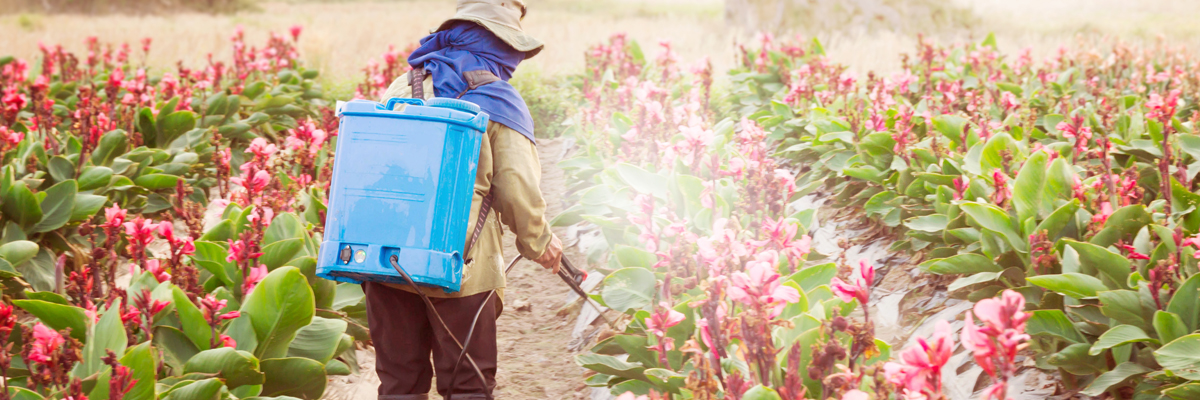
Spraying your crops is routine for many growers, but how often do you evaluate your spray coverage?
Applying crop protection products is costly, considering the time, labor, materials, personal protective equipment (PPE) and energy required. When the sprays are effective, we consider this an important investment in the health of our crops. If we do not get effective coverage due to under or over application, this investment can turn to waste. Using too much product can be detrimental to your crop and pocketbook, while too little can be ineffective.
How do we assess the effectiveness of our spray applications? How do you know if your sprays are really hitting the target?
- Perhaps you stop periodically while spraying to look for wet foliage.
- Maybe you plan to return once the spray dries to look for residue.
It is often difficult to measure without using a visual tool to quantify spray effectiveness. Water Sensitive Paper is a great tool to check coverage of spray products.
Water Sensitive Paper allows you to quickly and easily assess your spray coverage. Sensitive to moisture, the yellow paper turns blue wherever spray reaches it allowing for quick and easy spray visualization. You can achieve several goals with this monitoring tool, including:
- Indicate spray coverage
- Indicate droplet size and uniformity
- Indicate whether there is any off-target application (drift)
- Assess employee effectiveness
How to Use Water Sensitive Paper
Determine your objectives and make a plan before you start. Use a map of the area which will be sprayed. Label the map with unique codes that correspond to where you are going to place the papers. Write the numbers on the back of each paper so you can see where they came from after they are collected. You may make a change and want to see how it affects coverage. It’s very easy to mix up the papers if you haven’t record everything clearly.
To avoid smudging, always handle the paper by the edges. We recommend using tweezers and/or wearing gloves when handling the paper as moisture from your fingers can activate the paper.
Once you are ready to begin, identify the areas you would like to check and deploy the Paper. Depending on the type of spray application, you can either clip or staple them to branches, leaves or vines; attach them to stakes for field spraying; or for aerial spraying, attach the paper to blocks spaced at intervals.
After setting the cards in place and spraying the area, wait until the paper is dry, collect and analyze.
How to Evaluate the Paper
A visual inspection gives you a general overview of your spray application:
Overdosing is indicated by heavily covered paper without distinct droplets, appearance of running liquid.
Underdosing has the appearance of sporadic, minimal blue specks.
Off-target – the paper placed outside the application area should show no droplets, this is especially important with herbicide applications. To minimize spray drift, use a drift reducer like Harrell’s Penetrant Plus.
Counting the drops is another simple but more accurate method of evaluating your spray coverage. The following are standards you can use for comparison:
- 20-30 droplets per cm² for insecticides
- 20-30 droplets per cm² for pre-emergent herbicide liquids
- 30-40 droplets per cm² for post-emergent herbicides
- 50-70 droplets per cm² for fungicides
Phone applications like SnapCard can be used to quantify the percent coverage.
Coverage is especially important with some of the softer products that must directly contact the target pest organism to be effective.
You can also place small cards inside the crop canopy to do spot checks of employee’s work. At one of the operations I worked with, an employee mistakenly applied a herbicide instead of a fungicide. The employee was fired. Not because of the mix-up, but because every other bench of plants was burned by the herbicide. The employee was only spraying half of the greenhouse. Using this type of spot check can make sure your entire crop is treated.
“Spray and Pray” isn’t good enough when your high value crop is at stake. Use a proactive approach with the right tools to help ensure success.
Related Resources

In addition to being the nation’s largest distributor of branded fungicides, herbicides, and insecticides, Harrell’s produces custom-blended fertilizers, specialty liquids, and wetting agents. Additionally, Harrell’s is the exclusive US owner, formulator, and distributor of all POLYON® branded products.
TEAM HARRELL'S
STAY EQUIPPED
Never stop learning. Access FREE continuing education courses from Harrell’s.
LET'S GROW
PRESS RELEASES
PRESS RELEASES
STAY EQUIPPED
Never stop learning. Access FREE continuing education courses from Harrell’s.
LET'S GROW