

Agronomic Alert – Gray Leaf Spot
7/7/2021 - By Dr. Paul Giordano
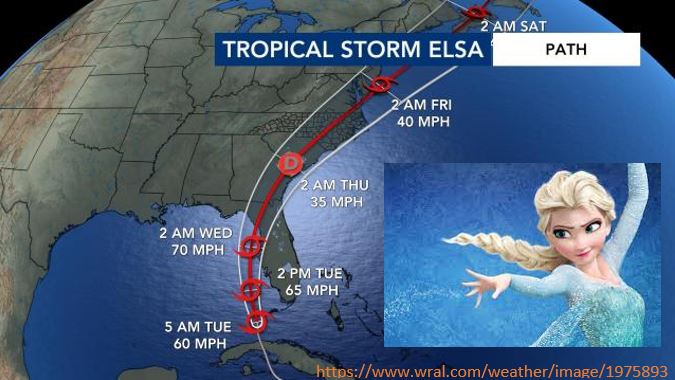
With summer in full swing, high heat and humidity are ripping through the northern tier of the country. Extreme summer weather conditions, elevated turf stress, and tropical storm Elsa moving north make for a perfect recipe for early gray leaf spot (GLS) pressure. Hot, humid weather with extended dew periods and frequent thunderstorms favor infection of perennial ryegrass and tall fescue fairways, intermediates, and roughs in much of the eastern half of the country. Now is the time to prepare and protect turf from this often-devastating disease.
What to look for:
- Gray leaf spot will initially appear as tiny brown/black spots that enlarge and become oval or elongated on the leaves of perennial ryegrass or tall fescue (Image 1).
- These spots then progress into tip dieback or scorched blades of turf, often curled or crooked at the ends (Image 2).
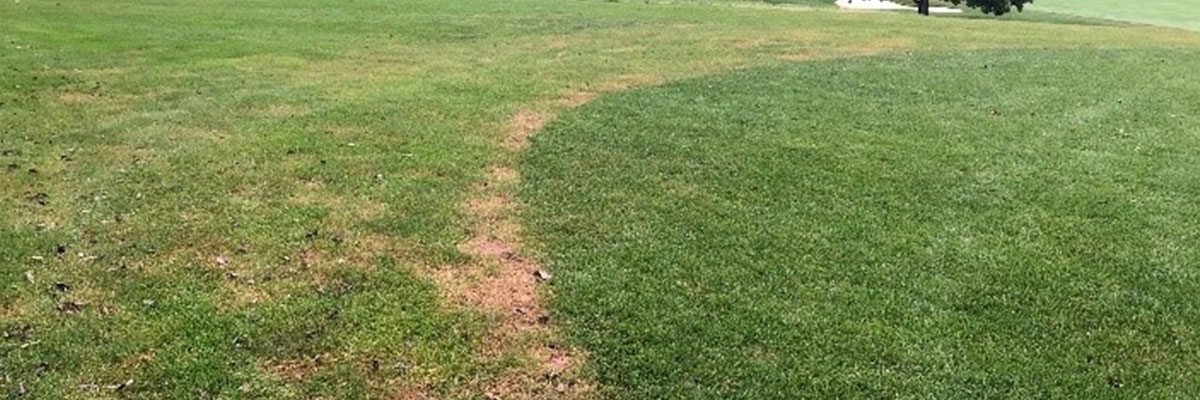
- Stand symptoms can often resemble droughty turf with irregular wilting and decline (Image 3). Because GLS is most severe during warm, humid weather it is often mistaken for Pythium blight on perennial ryegrass fairways and intermediate rough areas.
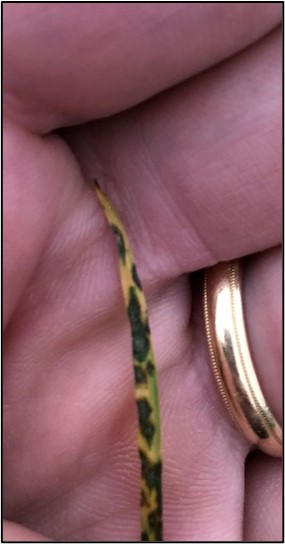 | 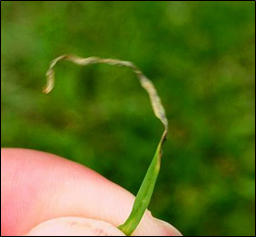 | 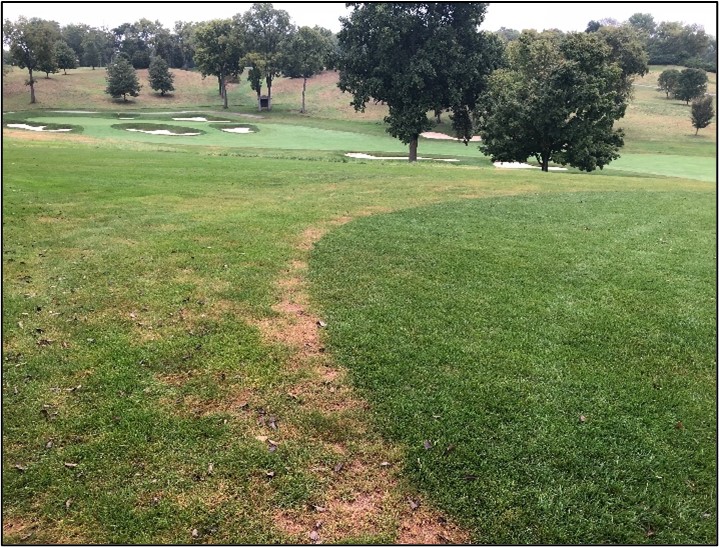 |
| Image 1. Leaf symptoms of gray leaf spot on perennial ryegrass (Photo credit: Bayer) | Image 2. Progressed leaf symptoms of gray leaf spot on perennial ryegrass with tip dieback and “shepherds crook” decline (Photo credit: Michigan State University) | Image 3. Stand symptoms on a mixed stand of tall fescue and perennial ryegrass. Note the unaffected area of newly laid sod with superior genetic resistance (Photo credit: Bayer) |
Management of gray leaf spot:
- Preventative control with fungicides is critical in areas with traditional gray leaf spot activity. Getting out early ahead of the disease is justified since GLS can quickly devastate large areas disrupting play and requiring expensive and time-consuming overseeding efforts
- Like all diseases, early fungicide applications when inoculum levels are low are critical for long-term control. Ensuing applications should be made at 14-21 day intervals, with tighter intervals during conducive weather
- Late-July to early-August is when applications typically should begin, but may need to be moved up a week or two during hot humid summer stretches
- Since infections begin in roughs, consider an additional pass or two in the roughs when treating fairways
- Once epidemics start and turf damage can be seen, curative control is difficult and usually only marginally effective. A combination of DMIs, QoI’s, chlorothalonil, and thiopanate methyl should be used at higher rates and shorter intervals to limit damage
- In areas where GLS is common, some strains have shown resistance to the strobilurin class of chemistry (QoI fungicides). Keep this in mind when making applications and don’t rely exclusively on one class of chemistry for control
- Some newer fungicides that have hit the market have shown excellent control of gray leaf spot in trials and should be considered as part of your overall disease management program in late summer/fall.
- Densicor (Bayer) – a new DMI fungicide with excellent activity on some difficult diseases including gray leaf spot, Microdochium patch, and anthracnose.
- Rayora (FMC) – another new DMI with good control of key summer diseases like dollar spot and brown patch, as well as gray leaf spot activity
- Posterity XT (Syngenta) – three active ingredients that provide broad spectrum control of most cool-season diseases and deliver multiple modes of action against GLS
Top Options for Gray Leaf Spot Control
Product | Rate/1000 ft2 | Notes |
0.196 fl oz | Use as a preventive approach starting in late July/early August. Applications will also cover a broad spectrum of other summer diseases | |
Thiophanate-methyl | 4 fl oz | A top performing product on GLS. Rotate or tank mix in with DMI or QoI applications for superior control |
3 fl oz | Keep in rotation as preventive, broad spectrum fungicide against GLS and many other diseases | |
Tebuconazole | *see label for details as rates vary among products | Strong DMI with broad spectrum control of many diseases. Consistently a top performer on GLS as a standalone or tank mix |
1.4 fl oz | Combine with chlorothalonil or T-methyl for superior control | |
Chlorothalonil | 3.6 fl oz | Use as a tank mix/rotational component in programs against chronic gray leaf spot outbreaks |
Related Resources

In addition to being the nation’s largest distributor of branded fungicides, herbicides, and insecticides, Harrell’s produces custom-blended fertilizers, specialty liquids, and wetting agents. Additionally, Harrell’s is the exclusive US owner, formulator, and distributor of all POLYON® branded products.
TEAM HARRELL'S
STAY EQUIPPED
Never stop learning. Access FREE continuing education courses from Harrell’s.
LET'S GROW
PRESS RELEASES
PRESS RELEASES
STAY EQUIPPED
Never stop learning. Access FREE continuing education courses from Harrell’s.
LET'S GROW