

POLYON® Fertilizer Improves Corn Crop Production
7/9/2025 - By Dr. Tom Reed
Nitrogen is essential for plant growth and has many important functions for plants, including the production of chlorophyll and proteins. Corn (Zea mays) is a nitrogen-demanding crop, and in previous studies, Harrell’s Blog | Agronomic Insights & Industry News, POLYON fertilizer has been proven to be able to deliver yields in corn at reduced nitrogen rates. A University of Florida study further established POLYON benefits in corn production when it evaluated the Impact of Polymer-Coated Controlled-Release Fertilizer on Maize Growth, Production, and Soil Nitrate in Sandy Soils.
Objective of the POLYON® Study
The objectives of this study were to measure the effects of controlled release fertilizer (CRF) on corn crop production and nitrate leaching potential. In this study, six nitrogen (N) fertilizer treatments were investigated, including a control treatment of no N (0 lb. N/ac), four CRF (POLYON® 43-0-0) treatments (150, 200, 250, and 300 lb. N/ac), and a conventional (CON) fertilizer treatment of 240 lb. N/ac (current UF/IFAS-recommended N rate of fertilizer for irrigated corn). The CRF banded two inches on both sides of the seeds at a depth of two inches at the time of planting.
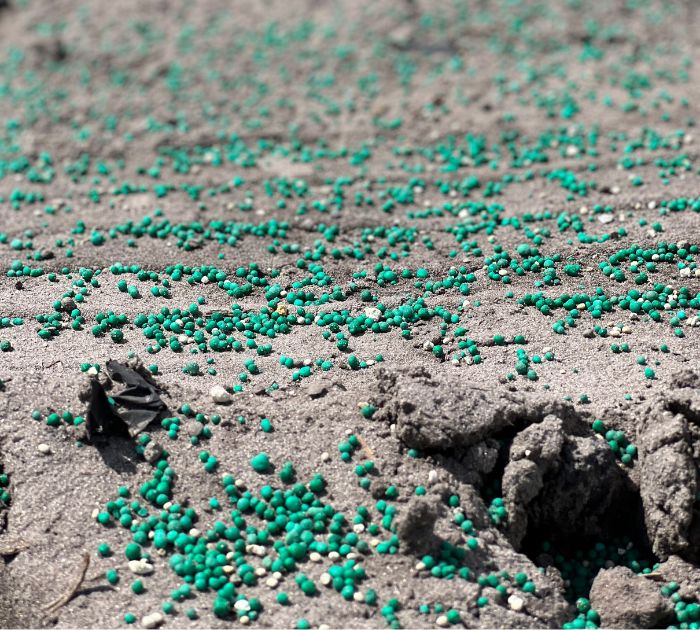
A starter liquid fertilizer (23-9-0) application (30 lb. N/ac) was applied using a double disc opener at 2 in. deep and 2 in. to the side of the row at planting, across the CRF and CON treatments. The starter fertilizer was applied to ensure a full and even plant stand. The CON program had 210 lb. N/ac applied throughout the growing season based on growth stage needs (V4, V8, V10, V12, V14, VT, and R1-R2). The rest of the management was similar across treatments. This trial was a randomized complete block design repeated over two seasons (2022 and 2023).
Results of the POLYON® Study
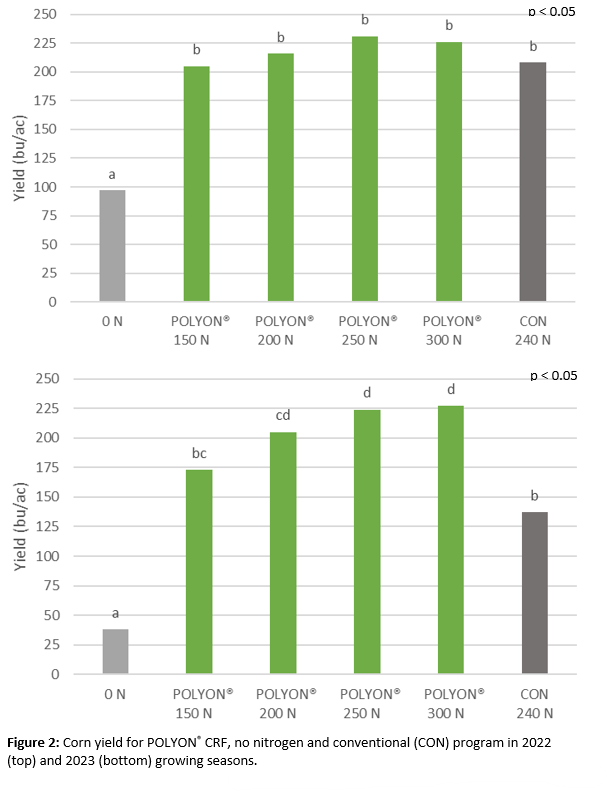
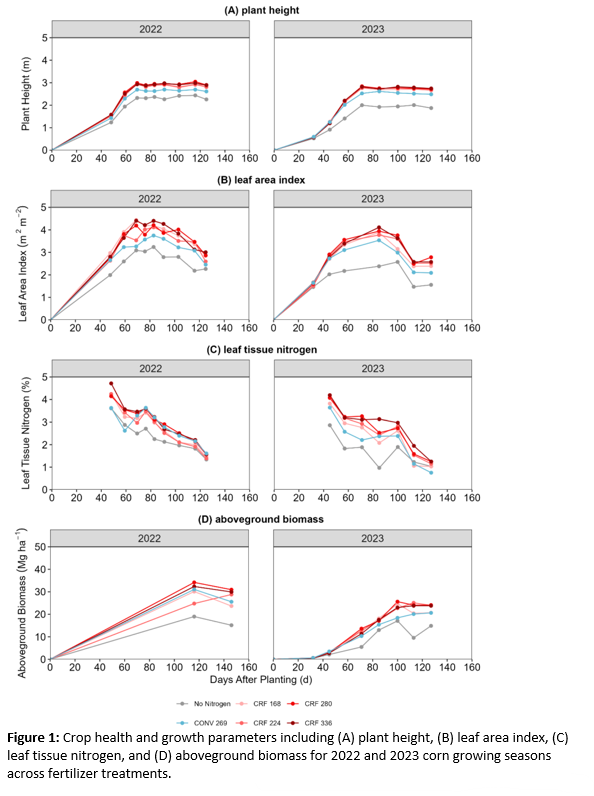
All POLYON® CRF treatments, including the lowest rate produced yields, leaf tissue N concentrations, plant heights, aboveground biomass, and leaf area index, significantly (p < 0.05) greater than or equal to the CON fertilizer treatment. There is a general trend of increasing CRF rates leading to increasing crop growth in both the 2022 and 2023 seasons (Figure 1).
The plant height and LAI for the CRF treatment were 9% and 12% greater in 2022 and 5% and 11% greater in 2023 than the CON treatments at the R3 growth stage. The CRF continuous release mechanism allowed for greater N availability to the crop than the CON fertilizer treatment. This highlights the ability of the CRF treatments to provide enough N to the crop at CRF rates below the CON fertilizer treatment rate.
The CON fertilizer treatment resulted in increases in late-season movement of soil NO3-N into highly leachable areas of the soil profile, while none of the POLYON® CRF treatments did. POLYON® CRF across rates increased yield by 5% and 51% compared to the CON program in 2022 and 2023 growing seasons, respectively (Figure 2). The results of this two-year study suggest that polymer-coated CRFs can achieve desirable crop growth, crop health, and production goals, while also having the potential to reduce the late-season leaching potential of NO3-N.
Connect with Us to Learn More
We’re constantly working on new studies to improve the effectiveness of our products, so if you have any questions or would like to learn more about our products and how they work, feel free to reach out. Connecting with your Harrell’s Rep is the best way for you to learn more and receive tailored solutions for all of your agronomic needs.
Related Resources

In addition to being the nation’s largest distributor of branded fungicides, herbicides, and insecticides, Harrell’s produces custom-blended fertilizers, specialty liquids, and wetting agents. Additionally, Harrell’s is the exclusive US owner, formulator, and distributor of all POLYON® branded products.
TEAM HARRELL'S
STAY EQUIPPED
Never stop learning. Access FREE continuing education courses from Harrell’s.
LET'S GROW
PRESS RELEASES
PRESS RELEASES
STAY EQUIPPED
Never stop learning. Access FREE continuing education courses from Harrell’s.
LET'S GROW