

POLYON® Controlled-Release Fertilizer Improves Labor Efficiency
3/25/2024 - By Dr. Jeff Atkinson

Golf Course Superintendents and Lawn Care Operators are
certain to have at least one thing in common, their largest single expense is
labor. According to the U.S. Bureau of Labor Statistics, total compensation for all hourly workers increased by 4.1%
over 12 months, ending in December 2023. Some might say that 4.1% is a low
estimate for an industry often competing with non-green industry jobs that
offer more comfortable working conditions and are less physically demanding.
If the cost of labor is rising and the availability of
quality labor is decreasing, something must be done. Product selection and
application provide opportunities to minimize wasted labor hours while
enhancing the quality of the final product. So, what are a few examples of how
product selection can enhance labor efficiency?
Reconsider Fertilizer Blend Ingredients for Labor Efficiency
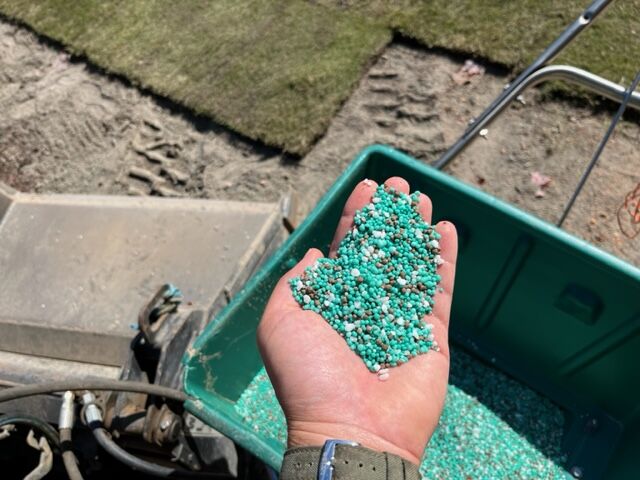
Everyone wants to get what they pay for. But what if I told
you that a 50-pound bag of fertilizer does not always contain 50 pounds of
fertilizer? For example, let’s say a bag of fertilizer claims to have a 10-0-0
analysis: 10% nitrogen, 0% phosphorus, 0% potassium, and for example’s sake, no
micronutrients. The nitrogen source urea is 46% nitrogen. If urea is used to
supply nitrogen in the 10-0-0 blend, then 10.9 pounds of a 50-pound bag of this
hypothetical fertilizer bag is urea, and the rest is filler. A material that
supplies no nutrient content or value to a fertilizer blend.
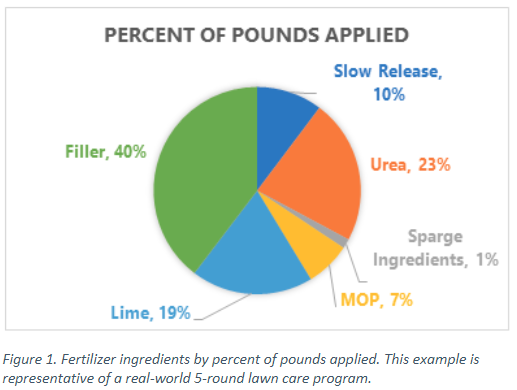
A real-world example is described in Figure 1. The data
summarizes a 5-round, granular-only, lawn care program. The blends were each
formulated with a similar set of ingredients: a slow-release nitrogen source,
raw urea, muriate of potash, lime, sparged pesticides, and filler. When the
amount of each ingredient was added together across the entire program it was
determined that 40% of the total volume of applied material was filler. Considering
it takes the most valuable resource of an operation, labor, to apply the 40% of
wasted product, it becomes clear that a cheap bag of fertilizer blended with a
significant component of filler has very real, hidden, costs.
This doesn’t have to be the case. Fertilizer blends can be
formulated to minimize filler, ensuring the value of the fertilizer blend and
the associated application labor expense is maximized.
Sparging Decreases Applications and Improves Labor Efficiency
Spray tank mixing is a common strategy used to apply
multiple liquid-applied products in a single application to maximize labor
efficiency. Fertilizer sparging is a technique that attaches a thin coating of material to the
exterior of a fertilizer substrate. Common sparging agents include the
preemergence herbicides Barricade®, Dimension®, Echelon®, and
StayGuard®, and the insecticides Acelepryn®, Talstar®, and Merit®.
Similar to tank mixing, fertilizer sparging facilitates the
application of two or more agronomic inputs with a single application.
Harrell’s One Shot combination products allow for the application of fertility,
Dimension® preemergence herbicide, and Acelepryn® insecticide all in a single
application.
An exceptional example of an efficient fertilizer blend
provides adequate controlled release nitrogen to last through a growing season,
supplements other deficient macronutrients, provides season-long preemergence
crabgrass control, and season-long grub control all in a single application.
Application of this type of formulation optimizes the labor efficiency of
granular applications.

Controlled Feeding, Consistent Growth, Improved Labor Efficiency
Can a POLYON fertilizer blend be formulated to last 8 weeks?
Yes.
Can a POLYON fertilizer blend be formulated to last 6
months? Yes.
A unique characteristic of POLYON is the degree of control
over nutrient release longevity which is achieved by adjusting the POLYON
coating thickness during the manufacturing process. Materials designed to
release nutrients over a long period will have a thicker coating relative to
those designed to release nutrients over a short period. A turfgrass manager
can achieve a target growth response over a specific period by considering
POLYON application rate, coating thickness, and application timing – a task any
Harrell’s Territory Manager is willing to help with.
POLYON consistently releasing a small dose of nutrients over
time results in healthier plants that are more able to withstand both biotic
and abiotic stressors. As a result, POLYON-treated turf maintains optimal color
over an extended period. One way to look at the efficiency of labor inputs is
the days of greening provided by the input. When considered in this way, the
value of long-term feeding and greening response following a POLYON application
becomes clear.
Lower Environmental Losses While Improving Labor Efficiency
A quick Google of “fertilizer” and “environment” is a clear
indication of the impact inefficient fertilizer application can have on our
environment and the land we steward. According to the EPA, one pound of nitrous
oxide (N2O)
lost to the atmosphere has an equivalent greenhouse effect to 265 pounds of
carbon dioxide (IPCC 2013).
Nitrogen volatilization, leaching, and denitrification can each be minimized by
product selection and proper application.
Peer-reviewed research is available on the subject of
fertilizer, environmental impacts, and potential mitigation solutions. Braun
and Bremer (2018) investigated the influence of irrigation amount and nitrogen
fertilizer form on nitrous oxide emissions across 24 months. In the study, the
researchers evaluated ‘low’ and ‘medium’ irrigation, or replacement of 33% or
66% reference evapotranspiration, respectively, and compared N2O
emissions amongst plots that received no fertility, or 2 lb N/1000 sq. ft./year
with either urea or polymer coated urea. Results from the study indicate
reducing irrigation can mitigate N2O loss by 6% while utilizing a
polymer-coated urea such as POLYON can reduce environmental N2O loss
by up to 20%.
A second study compared N2O emissions amongst a
variety of slow-release, controlled-release, and enhanced-efficiency fertilizer
technologies (Gillette et al., 2016). Included in the study were methylene
urea, stabilized urea, and polymer-coated urea. Polymer-coated urea, such as
POLYON, emitted 70 and 75% less N2O than stabilized urea and
methylene urea, respectively, under golf course fairway conditions. Other
examples could be referenced concerning reducing losses through leaching or
volatilization, each of which supports the use of POLYON for minimizing
environmental losses of applied nutrition.
When considered through the lens of program efficiency,
environmental losses may be a significant invisible cost. Nitrogen, or other
nutrients, lost to the environment provide zero agronomic benefit while
increasing the environmental and financial cost of maintaining healthy turf.
Reach Out to Your Harrell’s Representative
POLYON® controlled-release fertilizer has proven itself as a valuable technology over the years, but
likely never as valuable as it is today. If you are interested in enhancing the
efficiency of your fertilizer program to maximize personnel and material
resources, I encourage you to catch up with your Harrell's Territory Manager. Their knowledge and expertise are only a phone
call away.
Products mentioned and their trademarking companies:
Barricade® - Syngenta
Dimension® - Corteva
Echelon® - FMC
StayGuard® - Nufarm
Acelepryn® - Syngenta
Talstar® - FMC
Merit® - Bayer
Related Resources

In addition to being the nation’s largest distributor of branded fungicides, herbicides, and insecticides, Harrell’s produces custom-blended fertilizers, specialty liquids, and wetting agents. Additionally, Harrell’s is the exclusive US owner, formulator, and distributor of all POLYON® branded products.
TEAM HARRELL'S
STAY EQUIPPED
Never stop learning. Access FREE continuing education courses from Harrell’s.
LET'S GROW
PRESS RELEASES
PRESS RELEASES
STAY EQUIPPED
Never stop learning. Access FREE continuing education courses from Harrell’s.
LET'S GROW