

POLYON® Controlled-Release Fertilizer Artichoke Studies
3/1/2023 - By Dr. Tom Reed
POLYON® Controlled-Release
Fertilizer Artichoke Studies
Studies: Globe
artichoke variety trials using POLYON® controlled-release fertilizer in northeast
Florida; POLYON® controlled-release fertilizer compared to injected liquid
fertilizer program.
Location: Hastings,
FL
Collaborator: Prissy
Fletcher (UF|IFAS Hastings Agriculture and Extension Center)
Date: 02/2023 – (Trial Data Period: 09/2019
- 05/2020, 10/2020 - 05/2021)
Conclusion: These
studies trialed POLYON® controlled-release fertilizer (CRF) on
artichoke production. Globe artichokes are being evaluated as an alternative
crop in Northeast Florida and have a five-to-six-month production cycle, with
planting in the fall and harvest in the spring for this region. The compact edible
buds are harvested and additional bud flowering could be utilized in the cut
flower industry. Harrell’s 16-6-11
NPK+ POLYON® fertilizer was applied in these studies.
2019-2020 (Variety Trial).
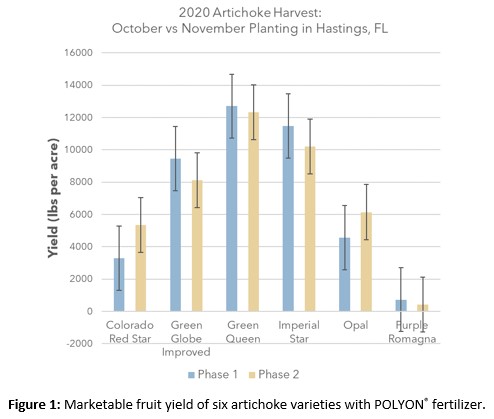
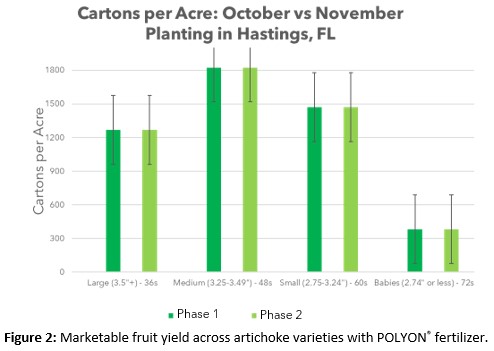
The 16-6-11 CRF was applied at 250 lb/ac preplant. There were four replications for both planting dates of October 7 (Phase 1) and November 11 (Phase 2) for all six varieties. Total trial size was 0.5 ac and was conducted on a black plasticulture system with double-line drip irrigation. The trial had greater than or equal to marketable yield for varieties compared to trial done with conventional material the previous season. The highest yielding variety produced greater than 12000 lb/ac. Across all varieties greater than 1200 cartons/ac were produced for each of small, medium, and large sizes (Figures 1 and 2). The trial demonstrated that a single POLYON® fertilizer application can be utilized to grow an artichoke crop.
2020-2021 (CRF vs Liquid Fertilizer).
The
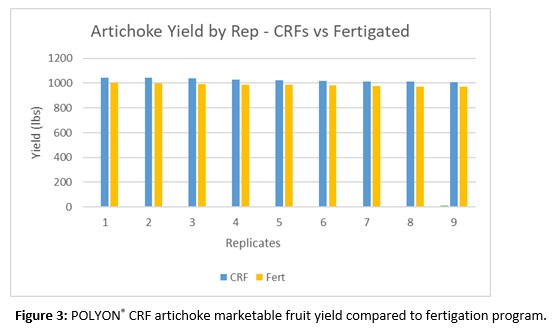
POLYON® 16-6-11 NPK+ CRF was compared to the injected liquid
fertilizer at the same nutrient rates. The POLYON® fertilizer treatment
had greater marketable yield (25-50 lb/sampled area) than the fertigated
treatment across all nine replications of the trial (Figure 3). POLYON®
fertilizer had greater yields than the fertigated plots for all four yield sizes.
Different end users may prefer different sizes of artichokes. Potential growers
in the area would rather have single preplant application product than do
repeated fertigation events, according to the collaborating researcher.
Related Resources

In addition to being the nation’s largest distributor of branded fungicides, herbicides, and insecticides, Harrell’s produces custom-blended fertilizers, specialty liquids, and wetting agents. Additionally, Harrell’s is the exclusive US owner, formulator, and distributor of all POLYON® branded products.
TEAM HARRELL'S
STAY EQUIPPED
Never stop learning. Access FREE continuing education courses from Harrell’s.
LET'S GROW
PRESS RELEASES
PRESS RELEASES
STAY EQUIPPED
Never stop learning. Access FREE continuing education courses from Harrell’s.
LET'S GROW