

Harrell's Root Health Program - Plant Health Input "Modes of Action"
3/21/2024 - By Dr. Raymond Snyder

Turf managers have been using plant
health inputs for years as they have observed their value when included in
their agronomic programs. Turf manager plant response observations include
increased turf color/quality, drought tolerance, heat stress tolerance, and
improved root characteristics. The timing, positioning, and implementation of
plant health inputs by turf managers have been instinctual and accurate, even
without scientific confirmation of each input's direct value.
More recently, scientific support for
the utilization of plant health inputs is increasing. Dr. Xunzhong Zhang, a professor at Virginia Tech University, has scientifically documented plant
health inputs such as humic/fulvic acid, seaweed extracts,
mycorrhizae,
and amino acids as eliciting desirable plant health responses, especially when
turf is under stress. These beneficial plant health responses have occurred in
both growth chamber and field studies in warm and cool season turfgrass types. Perhaps
not surprisingly, the scientifically documented beneficial plant responses
corroborate the anecdotal value observed by turfgrass managers for years.
Plant Inputs “Modes of Action”
The scientific
body of work may help to further optimize the utilization of plant health
inputs due to a greater understanding of how each input functions. Each plant
health input has a specific “mode of action” that contributes to overall plant
health, especially when the plant is under stress. As in weed or disease
management, proper utilization of each input’s mode of action, and the
utilization of multiple modes of action, may help to increase the effectiveness
of plant health input programs. The net effect of “stacking the technology”
based on a multiple mode of action program, might provide an overall better
plant health condition relative to relying on a single plant health input.
Plant Inputs – Stacking the Technology
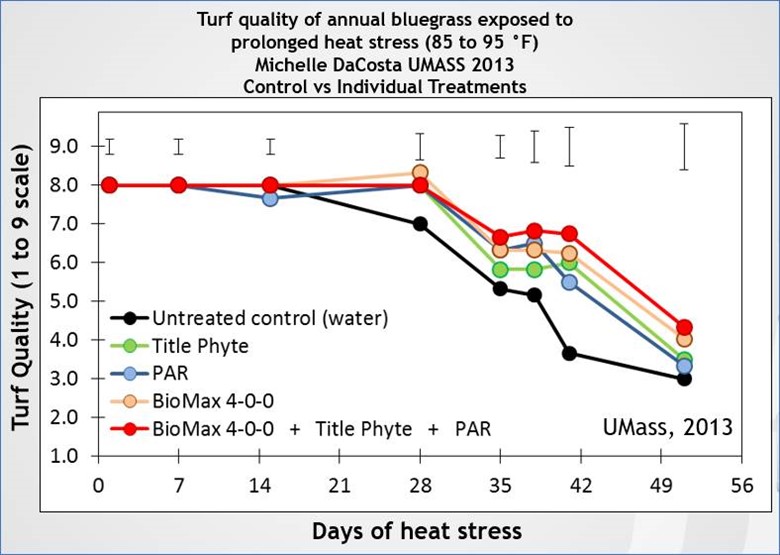
An example of
“stacking the technology” was observed in work we conducted with Dr. Michelle
DaCosta. Over the course of this experiment, we found that the best-performing
treatment was the combination of several modes of action, especially when the
number of heat stress days increased up to day 42. In this case, the
combination of a phosphite, seaweed extract,
fulvic acid, and pigment
resulted in higher quality turf more than any of the treatments by themselves.
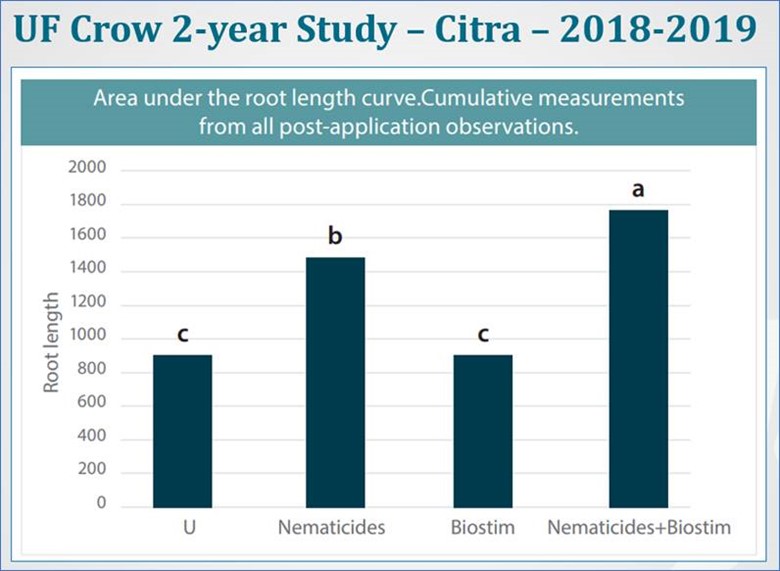
Another example utilizing multiple
modes of action is work conducted by Dr. Billy
Crow in which nematicides were combined with three plant health input
products in an attempt to further improve the plant response associated with
nematicides by themselves. After this two-year field study, the greatest root
length was observed when nematicides were combined with plant health inputs
relative to the untreated control, plant health inputs, and nematicides.
Positive Plant Health Response to Inputs
The scientific
evidence associated with positive plant health responses to inputs containing
microbial populations is expanding through recent efforts. For example,
research work conducted at Virginia Tech University demonstrated that regular
inputs of EarthMAX® Organic, to saline stress bentgrass increased leaf color, chlorophyll content,
photochemical efficiency, and root characteristics. Furthermore, Virginia Tech
University also conducted research work applying azospirillum brasilense to
bentgrass under mild heat/drought stress and observed increased turf quality,
leaf color, photochemical efficiency, chlorophyll content, and root
characteristics.
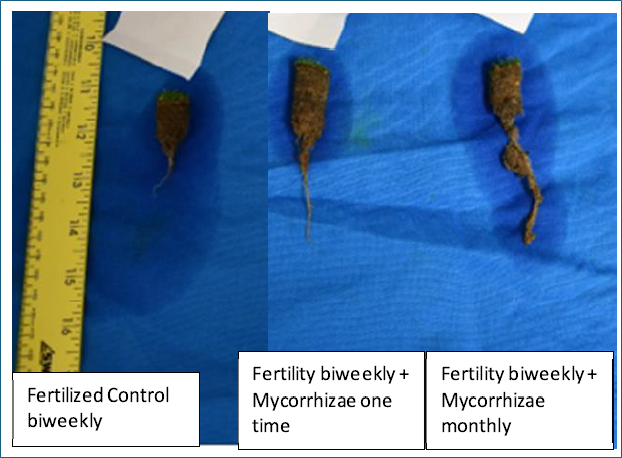
Finally, as noted above, monthly
inputs of mycorrhizae can also improve plant health characteristics such as leaf color, photochemical
efficiency, and root characteristics as demonstrated in a bentgrass field study
at Virginia Tech University. Scientific work conducted more recently may
demonstrate that the incorporation of multiple plant health modes of action,
including those that contain verified microbial species, are beneficial and
should be considered when creating agronomic programs.
Learn More from Your Harrell’s Rep
In summary, turf managers have
long used plant health inputs to increase turfgrass health based on their own
experiences. Scientific research supports turfgrass manager's observations
relative to plant health input use, and this research may also provide a
greater understanding of each plant health’s input role in promoting turfgrass
health. To learn more and figure out what combinations of plant health inputs
work best for you, reach out to your local Harrell's Rep.
Related Resources

In addition to being the nation’s largest distributor of branded fungicides, herbicides, and insecticides, Harrell’s produces custom-blended fertilizers, specialty liquids, and wetting agents. Additionally, Harrell’s is the exclusive US owner, formulator, and distributor of all POLYON® branded products.
TEAM HARRELL'S
STAY EQUIPPED
Never stop learning. Access FREE continuing education courses from Harrell’s.
LET'S GROW
PRESS RELEASES
PRESS RELEASES
STAY EQUIPPED
Never stop learning. Access FREE continuing education courses from Harrell’s.
LET'S GROW