

What if We Used Nitrogen More Efficiently?
2/6/2020 - By Dr. Jeff Atkinson

The USDA estimates we apply ~26,000,000,000 pounds of nitrogen annually1 across all crops in the United States. One estimate suggests up to 23.1% of nitrogen applied as granular urea to a Kentucky bluegrass lawn can be lost to volatilization2. Twenty-three percent! A recent study3 described a model which estimates human-influenced nitrous oxide (N2O) emissions from the world’s streams and rivers have increased 4-fold between 1900 and 2016, in large part to agricultural nitrogen use.
So, what if we used nitrogen more efficiently?
A recent study conducted by Harrell’s own Dr. Raymond Snyder, in collaboration with researchers from the University of Florida aimed to evaluate nitrogen loss by leaching following application of Nitrogen in the form of raw urea or in the form of POLYON® Controlled-Release Fertilizer.
The study treatments were as follows:
- Nontreated
- POLYON® 41 applied at 5 lb N/1000 sq ft – single application
- Urea applied at 1 lb N/1000 sq ft – weekly throughout the study
As seen below in figure 1, the study demonstrated that a single application of POLYON® fertilizer at 5 lbs N/1000 sq ft reduced nitrogen leaching throughout the study compared to weekly applications of raw urea. In fact, very little (no statistical significant) difference in leaching could be measured between the POLYON® treatment and the nontreated.
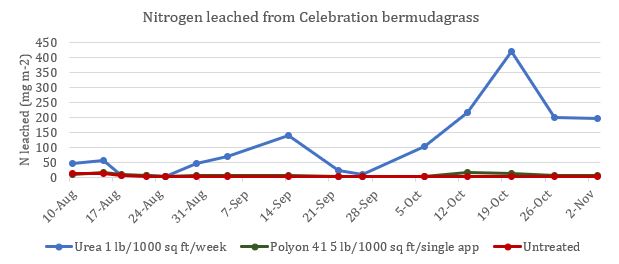 Figure 1. Nitrogen leached from Celebration bermudagrass. University of Florida. Dr. Travis Shaddox-FLREC June 2017.
So you’re probably saying, “good story, but there was more nitrogen applied in the raw urea treatment than the POLYON® treatment, so of course there’s more leaching.”
This study wasn’t all about nitrogen loss. It was also about performance. The core objectives of the study were to:
- Evaluate environmental benefits as described above
- Evaluate effects on bermudagrass grow-in
Figure 2 demonstrates that not only did POLYON® 41 applied a 5 lbs leach less, it also resulted in more rapid bermudagrass establishment.
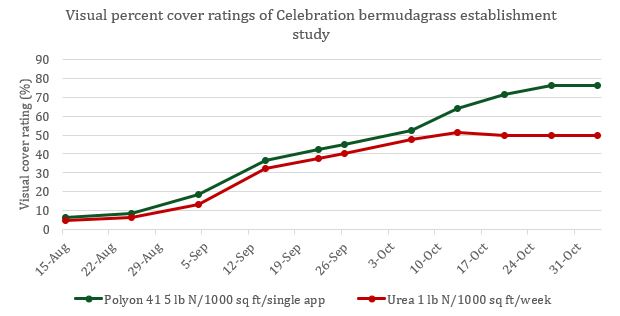 Figure 2. Visual percent cover ratings of Celebration bermudagrass establishment study. University of Florida. Dr.Travis Shaddox-FLREC June 2017.
Bringing it all together, POLYON® 41 limited nitrogen leaching compared to raw-urea, established a stand of bermudagrass more rapidly, and involved less labor in terms of multiple fertilizer applications. Lower environmental impact + less labor + better results, I think most folks would take that. As you’re planning for the 2021 growing season, keep POLYON® in mind as an easy way to use nitrogen more efficiently while shrinking your facility’s environmental footprint.
References:
- Click here to view the USDA Fertilizer Use and Price
- Schlossberg, MJ; BA McGraw; KR Hivner. 2018. Comparing Closed Chamber Measures of Ammonia Volatilization from Kentucky Bluegrass Fertilized by Granular Urea. Journal of Environmental Horticulture. 36: 85-91.
- Yao, Y; H Tian; H Shi; S Pan; R Xu; N Pan, J Canadell. 2020. Increased global nitrous oxide emissions from streams and rives in the Anthropocene. Nature Climate Change. 10: 138-142.
Related Resources

In addition to being the nation’s largest distributor of branded fungicides, herbicides, and insecticides, Harrell’s produces custom-blended fertilizers, specialty liquids, and wetting agents. Additionally, Harrell’s is the exclusive US owner, formulator, and distributor of all POLYON® branded products.
TEAM HARRELL'S
STAY EQUIPPED
Never stop learning. Access FREE continuing education courses from Harrell’s.
LET'S GROW
PRESS RELEASES
PRESS RELEASES
STAY EQUIPPED
Never stop learning. Access FREE continuing education courses from Harrell’s.
LET'S GROW