

New Year, New You
2/2/2021 - By JJ Jansen
Yes, we have all heard of the term New Year, New You. We are now a month into 2021 and hopefully if you made a New Year’s resolution you are still sticking to it. The most common resolutions are a better diet and more exercise. By staying consistent with these two things, you will not only increase your overall well-being, but also increase your brain function, energy levels, and reduce your risk of high blood pressure, high cholesterol, and heart disease. Change will not happen overnight and developing a plan and routine is crucial in this newfound healthy living journey you may be on.
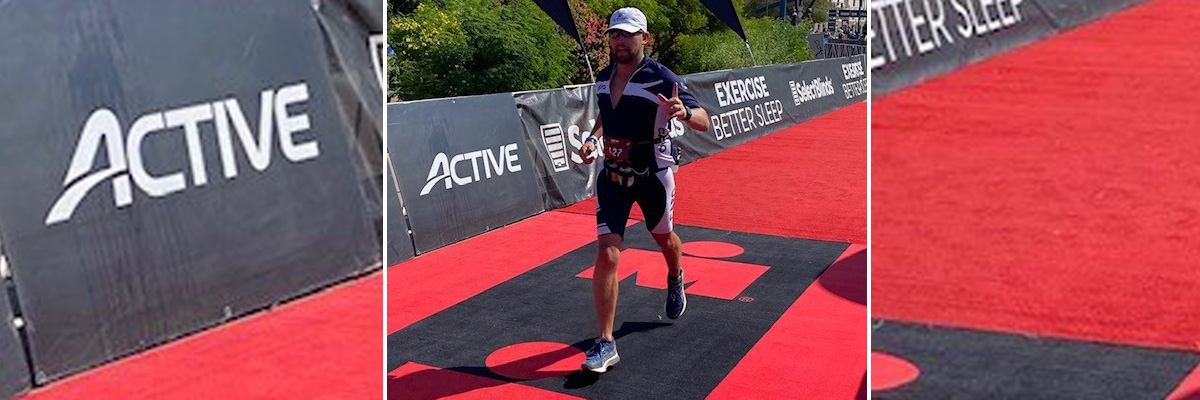
This past year, one of our fellow Harrell’s employees, Kendall Wiley (Territory Manager for Golf in Oklahoma) decided to take his exercise to a new level and attempt his first ever half Ironman Triathlon. Read below as Kendall and I talk about his journey to get there and the obstacles he faced.
What was your background in running/long distance training?
Growing up I was athletic and played sports, but wrestling was my main focus. After college I got a job and my priorities shifted to work and I started to get out of shape. In 2007, I decided to start running to get back in shape and lose a little weight. Turns out I really enjoyed running and started to run a few local 5k races and the following year completed a 10k race. A couple of years later I started running some half-marathons and then eventually completed 3 full marathons.
What made you decide to try a longer endurance race like an Ironman?
In 2014, after we had completed a marathon, my friend and I decided we wanted to challenge ourselves a little more and complete an Ironman triathlon (2.4-mile swim, 112-mile bike ride, and 26.2 mile run). Before we decided which race we were going to sign up for that year, I went on a snow skiing trip in Colorado during spring break. While skiing, I fell and severely broke my leg. I had to be carted off the slope and driven to the hospital by ambulance. At the hospital, I had to have surgery immediately and have metal plates and screws put in my leg—which are still there today. After surgery, the surgeon told me that I would probably never be able to run due to the severity of the break.
Fast forward a couple of years later and after rehabbing my leg, I would still attempt a couple of times a year to go run and test it out to see if I still could. It would still hurt pretty bad, but each time I would go run, the easier it got. About a year and half ago I went out and ran 2 miles and it felt decent. A couple of days later I tried it again, this felt a little better, and tried it again 3 days later and there were no issues. After building some confidence back, I called the same friend to see if he had any interest in still competing in an Ironman. We both decided to and agreed that a half Ironman triathlon (1.2-mile swim, 56-mile bike ride, and 13.1-mile run) would probably be best. We signed up for one that would take place in October 2020 in Tempe, AZ.
Tell me about how you prepared for the Ironman.
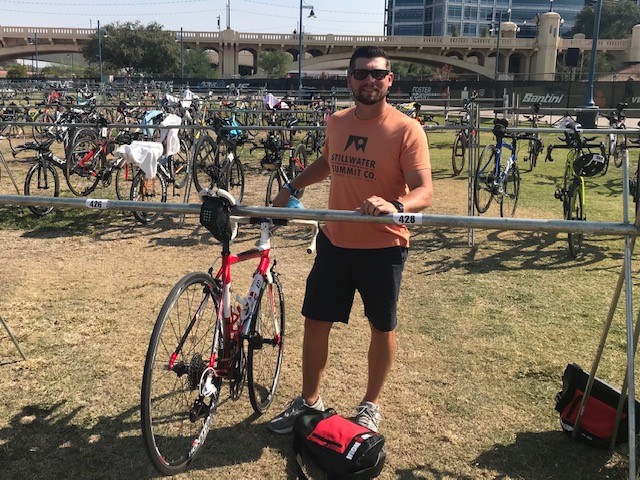
The first thing we did was hire a coach who laid out a 12-week plan to have us peaking on race day. It would start out with smaller distances and eased into longer distances each week. Each week our coach would give us a plan that included swimming, running, and biking sessions. I would show up to the local YMCA at 6 a.m. every morning and scheduled it to where on Monday and Friday I would swim laps, Tuesday, Wednesday, and Thursday would be focused on running or biking each morning. I was able to shower there and head to work after my training sessions. Our weekends were focused on longer training sessions that took about 3-4 hours and would mix in longer distance runs, bike rides, and even swimming at a local lake. Swimming was the one part of all this I was nervous about as I had never really swum competitively before.
Did the pandemic impact your training in any way?
COVID never really affected my training. Our gyms did have to shut down in Oklahoma but were back open in time for the 12-week training schedule.
Was the race in Arizona ever rescheduled or cancelled during all this?
Most of the races that were scheduled for 2020 did get cancelled, but the one we had signed up for was one of the very few that did not cancel. We knew during training that it was a possibility and was always in the back of our head. We still had to train and assume that it was going to take place. There were preliminary actions put into place at the event. All attendees were required to wear a mask unless you were actively competing, and everyone tried to socially distance. You had assigned times to pick up your registration packet and even starting times were staggered to avoid large crowds.
What was the biggest challenge you faced during the race?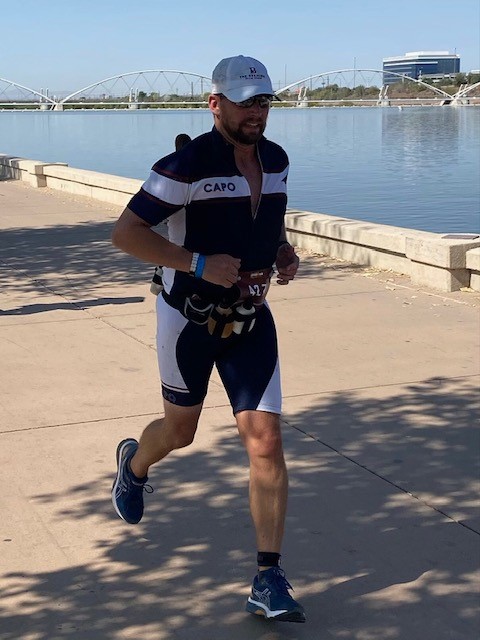
When signing up for these events it shows the average air and water temperature for when the race is scheduled. For this race, mid-October in Tempe, AZ, the average air temperature was supposed to 85 degrees. The day we showed up, 2 days before the event, the temperature was 104 degrees and race day temperature was 102 degrees. The conditions were extreme for that time of the year, so I really had to focus on hydration during the race. I had to almost double my intake during the race from what I was used to during my training sessions. I rotated between water, Gatorade, and an electrolyte blend to help with hydration.
I must give huge thank you to a fellow Harrell’s coworkers, Robert Gonzales (Territory Manager for Golf in Colorado) for helping me out. Robert has completed several marathons and Ironman’s and without him I would not have been able to be as successful as I was. He really helped me with what to expect during the race, what specific foods to eat, and when to eat them. My goal for the race was a sub-6-hour time and I ended up finishing at 5 hours and 57 minutes.
What advice would you give someone wanting to try any type of race for the first time?
Do not be scared and always try to challenge yourself. If you have never run a 5K, go sign up for it—or if you have done some running, push yourself and sign up for a half marathon. Start training for it and work towards that goal.
Any plans for another one or possibly a full Ironman?
Yes, not sure which one yet. The longer runs still do give my leg some issues and I would really like to do a full Ironman.
Related Resources

In addition to being the nation’s largest distributor of branded fungicides, herbicides, and insecticides, Harrell’s produces custom-blended fertilizers, specialty liquids, and wetting agents. Additionally, Harrell’s is the exclusive US owner, formulator, and distributor of all POLYON® branded products.
TEAM HARRELL'S
STAY EQUIPPED
Never stop learning. Access FREE continuing education courses from Harrell’s.
LET'S GROW
PRESS RELEASES
PRESS RELEASES
STAY EQUIPPED
Never stop learning. Access FREE continuing education courses from Harrell’s.
LET'S GROW