

New Year, New Opportunities: Efficient Resource Use in a Resource Limited Market
1/12/2022 - By Dr. Jeff Atkinson
The factors which contribute to shortages are well documented elsewhere, no need to revisit them. However, the challenges are real, so what can be done to address them?
Strategies for tight resources and thin labor
Across the turf management industry strategies to supplement tight resources are numerous. Automated mowing, adjusting standards of course care, sharing labor amongst courses, and sharing labor amongst departments are a sample of strategies our industry has adopted, but what else factors into the equation? Certainly, technologies which maximize the benefit of labor and material resources have never been more important. Consider a few ways POLYON® controlled-release fertilizer can help optimize your available labor and material resources through 2022:
- Two (or Three)-for-One Applications: As a general rule there are two ways fertilizers and plant protectants are applied to turf: First, liquid spray and granular spread. It is a common practice to mix several liquid products in a spray tank to maximize labor efficiency, so why not do the same with a granular fertilizer blend? All too often granular fertilizer programs are designed to address only the nitrogen, phosphorus, and potassium component of a fertility program although there can be tremendous value in applying other required nutrients to address soil fertility needs. For example, say a soil test result suggests soil magnesium is deficient. One could spray magnesium to supplement turf nutrition, which will work, but will not have an appreciable effect on soil magnesium reserves. In other words, a spray application will address the short-term deficiency symptom, but will not fix the underlying cause. In many cases, especially on greens, multiple granular applications will be applied through the season to supplement specific soil nutrients. Alternatively, why not create a custom fertilizer blend to address all soil nutrient needs with a single application?
- A common tip: replace the filler in a fertilizer blend with gypsum or lime.
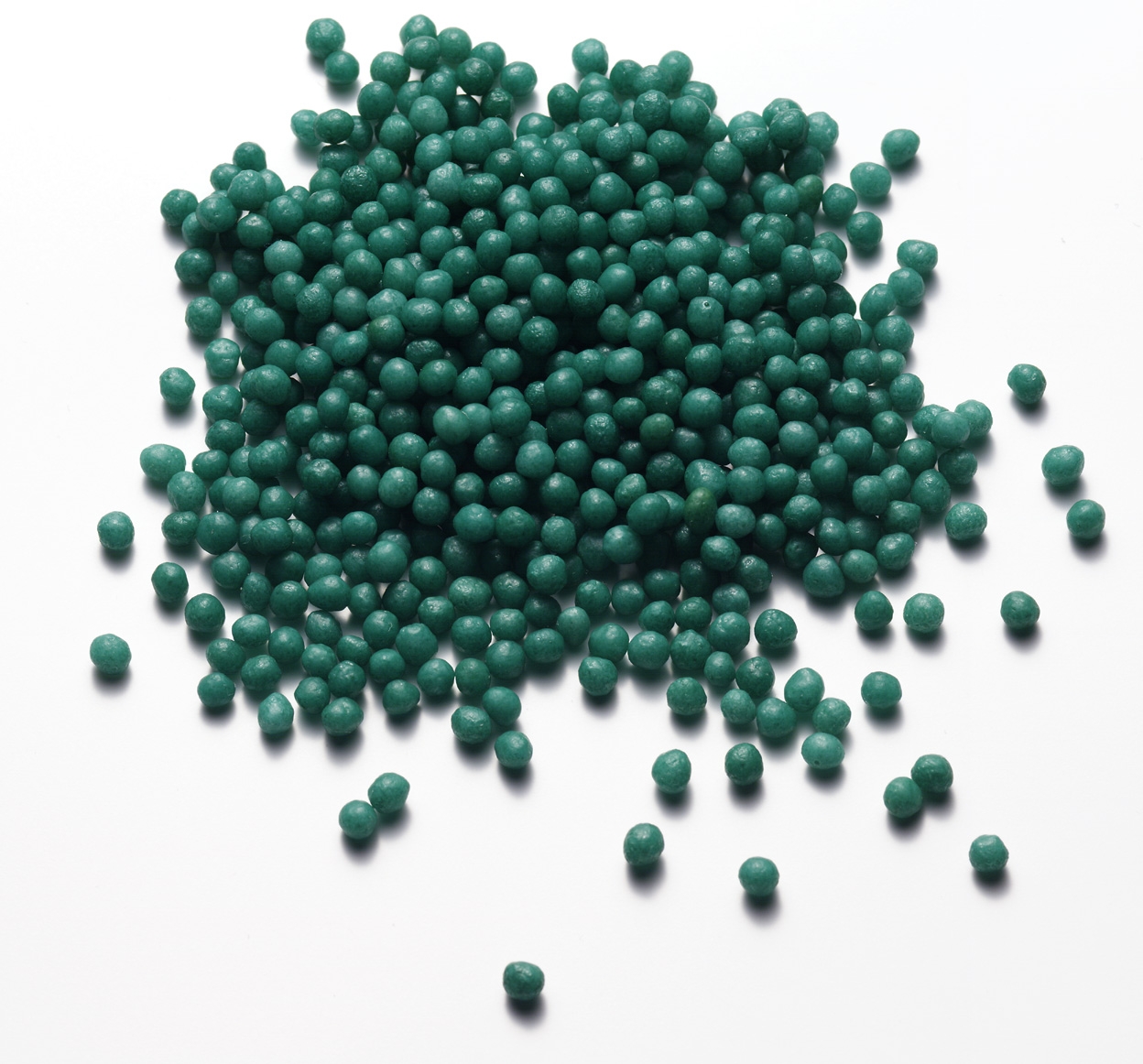
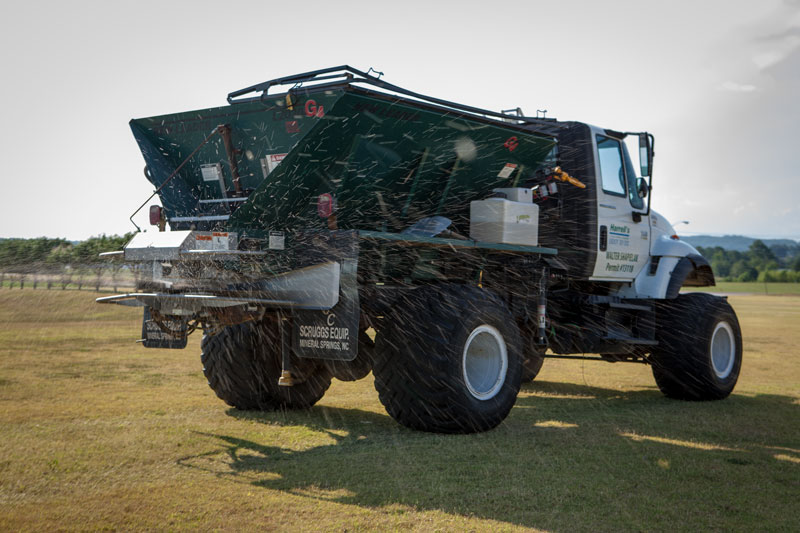
Secondly, consider how granular fertilizer applications fit into a pesticide program. Can the two applications be combined to create a single efficient nutrient + pesticide application? Harrell’s custom blending and pesticide sparging options are endless and certainly an effective tool to enhance labor efficiency.
- Controlled Feeding, Minimized Labor Input: Can a POLYON® fertilizer blend be formulated to last 8 weeks? Yes. Can a POLYON® fertilizer blend be formulated to last 6 months? Yes. A unique characteristic of POLYON® is the degree of control over longevity which is achieved by adjusting the POLYON® coating thickness. By utilizing blends with more thickly coated POLYON®, more nutrients per acre can be applied which will be released in a controlled fashion over time without risking turf injury while minimizing the total number of applications required across a growing season. It’s imperative to rely on your Harrell’s rep’s local knowledge and expertise to identify or custom blend the correct formulation of POLYON® for a specific area and program objectives. The possibilities and solutions available to turf managers through Harrell’s custom blending is extensive and suited to address almost any agronomic scenario.
- Reduced Environmental Losses: A quick google search of “fertilizer” and “environment” is a clear indication of the impact inefficient fertilizer applications can have on our environment and the land we steward. According to the Environmental Protection Agency (EPA), one pound of nitrous oxide (N2O) lost to the atmosphere has an equivalent greenhouse effect as 300 pounds of carbon dioxide. Nitrate (NO3) losses through leaching increase the likelihood of negative health effects associated with excessive nitrate concentrations in drinking water.
Several peer-reviewed research papers are available on the subject of fertilizer, environmental impacts and potential mitigation solutions. Braun and Bremer (2018) evaluated the influence of irrigation amounts and nitrogen fertilizer forms on N2O emissions across a 24-month period. In the study the researchers evaluated ‘low’ and ‘medium’ irrigation, or replacement of 33% or 66% reference evapotranspiration, respectively, and compared N2O emissions amongst plots which received no fertility, or 2 lb N/1000 sq. ft./year with either urea or polymer coated urea. Results from the study indicate reducing irrigation can mitigate N2O loss by 6%, while utilizing a polymer coated urea such as POLYON® can reduce environmental N2O loss up to 20%.
A second study compared N2O emissions amongst a variety of slow release, controlled release and enhanced efficiency fertilizer technologies (Gillette et al., 2016). Included in the study were methylene urea, stabilized urea and polymer coated urea. In the study, polymer coated urea, such as POLYON®, emitted 70 and 75% less N2O than stabilized urea and methylene urea, respectively, under golf course fairway conditions.
- Efficient Use of Raw Materials: Environmental loss of applied nutrients is important in the lens of environmental protection and quality, but it also has a direct impact on the realized value of applied fertilizer in terms of turf growth and quality. In the current market environment of commodity fertilizers doubling in cost, compared to this time last year, utilizing technologies which maximize plant availability while minimizing environmental losses is more important than ever. Considering the examples above, the upfront price of POLYON® may be more expensive than unprotected or alternative fertilizer technologies per pound of nutrient, however the realized value of POLYON® is likely greater once reduced environmental losses and efficient plant utilization is considered. As the old adage goes, 'you get what you pay for.'
2022 is certain to bring on a unique set of challenges for turf managers to conquer. POLYON® has proven itself as a valuable technology over the years, but likely never as valuable as it is in today’s world. If you are interested in enhancing the efficiency of your fertilizer program to maximize personnel and material resources, I encourage you to catch up with your Harrell’s rep’s. Their knowledge and expertise are only a phone call away.
References
Braun RC, DJ Bremer. 2018. Nitrous Oxide Emissions from Turfgrass Receiving Different Irrigation Amounts and Nitrogen Fertilizer Forms. Crop Science 58:1-14
Environmental Protection Agency. 2021. Overview of Greenhouse Gases. https://www.epa.gov/ghgemissions/overview-greenhouse-gases#nitrous-oxide. Accessed 3 Jan 2022.
Gillett, KL, Y Qian, RF Follett, and S Del Grosso. 2016. Nitrous oxide emissions from a golf course fairway and rough after application of different nitrogen fertilizers. Journal of Environmental Quality 45: 1788-1795.
Related Resources

In addition to being the nation’s largest distributor of branded fungicides, herbicides, and insecticides, Harrell’s produces custom-blended fertilizers, specialty liquids, and wetting agents. Additionally, Harrell’s is the exclusive US owner, formulator, and distributor of all POLYON® branded products.
TEAM HARRELL'S
STAY EQUIPPED
Never stop learning. Access FREE continuing education courses from Harrell’s.
LET'S GROW
PRESS RELEASES
PRESS RELEASES
STAY EQUIPPED
Never stop learning. Access FREE continuing education courses from Harrell’s.
LET'S GROW