

Negate the Nematodes by Focusing on Root Health
4/2/2024 - By Dr. Paul Giordano
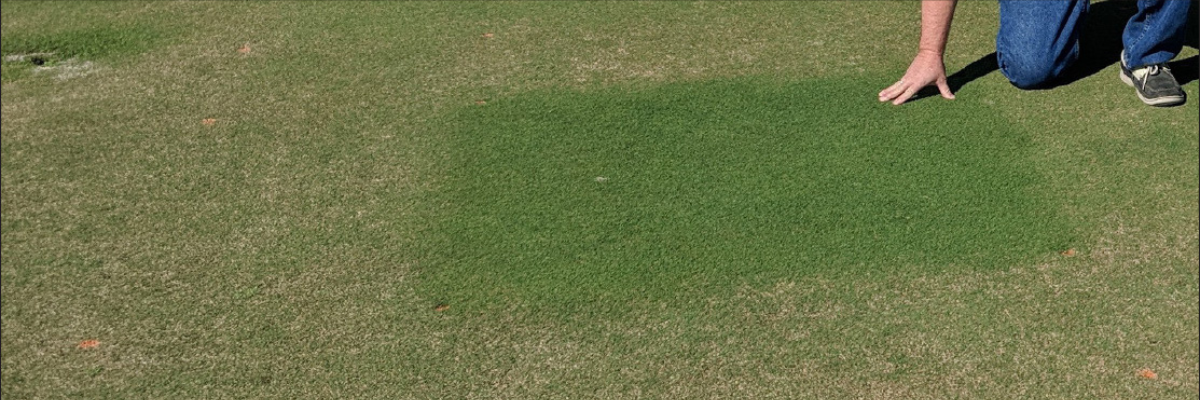
It's no secret that spiking weather patterns have a significant effect on turfgrass root
systems throughout the growing season. In certain geographies, excessive
moisture followed by extended drought conditions wreaks both abiotic and
biotic havoc on turf stands. Such weather conditions open up turfgrass to vulnerability to other detrimental stressors.
That being said, it would be impossible to ignore plant
parasitic nematodes, which often play a significant role in compromising
turfgrass root systems and serve as both primary and secondary contributors to
larger issues of root disease and dysfunction.
Nematode Prevention Can Be Complicated
Winning the belowground battle against nematodes can be
complicated and often requires a balanced approach that includes cultural,
chemical, and nutritional strategies. Because populations are dynamic, species
are divergent, and life cycles fluctuate throughout the season, a proactive and
integrated control program is often necessary.
This coupled with the fact that nematodes are frequently
found in association with other root diseases such as Pythium root rot,
summer patch, or take-all root rot - it’s clear that a holistic approach that
balances pathogen control with root growth and health is needed.
Nematode Prevention | University of Florida Research
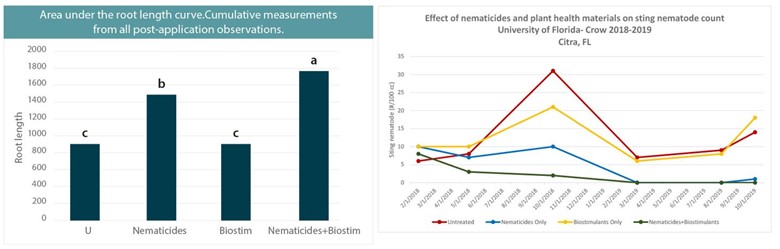
Harrell’s has worked with leading nematologist Dr. Billy Crow
at the University of Florida over the last several years to evaluate the effect
of different control products. The products were evaluated alone or in
combination with proven soil amendment and root health products on overall
nematode control and turfgrass health.
A key finding from this work showed that the inclusion of biostimulants,
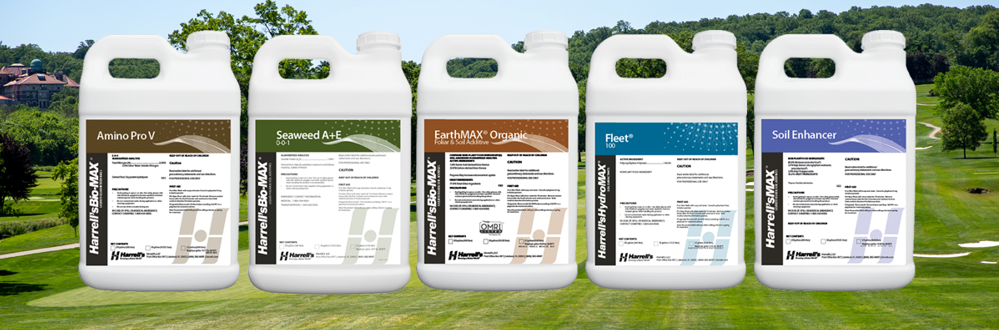
like seaweed extracts (found in Seaweed
A+E among other Harrell’s solutions),
fulvic and humic acids (found in Root
Enhancer), and beneficial growth-promoting microorganisms (found in EarthMAX
Organic) all play a significant role in optimizing conditions for root
health and growth when used in combination with an effective nematicide program
and a high quality penetrating wetting agent like Fleet.
Nematode Prevention | Treatment Methods
Treating nematodes is usually done most effectively during
the spring and early summer when plant parasitic populations typically begin to
grow and proliferate.
As shown below in the program implemented throughout the
Harrell’s/UF research study, more severe infestations with multiple species
such as lance, sting, and root-knot require season-long applications to keep
populations in check. Rotating through
effective nematicides while incorporating effective fungicides and root
health supplements has been shown to be the best strategy for optimal control
and turf quality.
Application
|
Month
|
Controls + Harrell’s Root
Health Program
|
|
1
|
March
|
Indemnify®
Fleet®
EarthMAX® Organic
|
Seaweed Extract
Root Enhancer
|
2
|
April
|
Indemnify®
|
Seaweed Extract
|
3
|
May
|
Divanem®
Velista®
Acelepryn®
Fleet®
|
EarthMAX® Organic
Seaweed Extract
Root Enhancer
|
4
|
June
|
Divanem®
Velista®
Acelepryn®
Fleet®
|
EarthMAX® Organic
Seaweed Extract
Root Enhancer
|
5
|
July
|
Divanem®
Velista®
Acelepryn®
Fleet®
|
EarthMAX® Organic
Seaweed Extract
Root Enhancer
|
6
|
August
|
Divanem®
Velista®
Acelepryn®
Fleet®
|
EarthMAX® Organic
Seaweed Extract
Root Enhancer
|
7
|
September
|
Indemnify®
Fleet®
EarthMAX® Organic
|
Seaweed Extract
Root Enhancer
|
8
|
October
|
Indemnify®
Fleet®
EarthMAX® Organic
|
Seaweed Extract
Root Enhancer
|
Product
|
Rate
|
Indemnify®
|
17.1 oz/ac
|
Divanem®
|
12 oz/ac
|
Velista®
|
22 oz/ac
|
Acelepryn®
|
8 oz/ac
|
Fleet® (w/ Divanem®)
|
2 gal/ac
|
Fleet® (w/ Indemnify®)
|
1 gal/ac
|
EarthMAX® Organic
|
5 gal/ac
|
Seaweed Extract
|
1 gal/ac
|
Root Enhancer
|
1 gal/ac
|
Seasonal Nematode Prevention
Spring and fall are both great times to put a primary focus
on root growth and the health of intensively maintained turf stands. Cool-season
grasses such as Poa annua and creeping bentgrass are pushing new growth and
recovery from either summer or winter stress. The moderate soil temperatures
tend to trigger carbohydrate and resource allocation to belowground tissues,
preparing turf for summer performance or winter dormancy.
Conversely, root growth is not necessarily optimal in
warm-season grasses like bermudagrass, seashore paspalum, and zoysiagrass in
the spring and fall timeframe. The cooler weather often results in a slow, but
steady retraction of root systems which can allow nematode damage to be more
pronounced. Using Harrell’s products that aid in root growth, density, and function
throughout the growing season can help to maintain overall turfgrass health
during what is often peak play (and stress) through cooler times of the year.
Reach Out to Your Harrell's Rep!
For more information on nematode prevention, building up your roots, preparing for fall/spring or any other inquiries, reach out to your local Harrell's rep! They're here to help.
Related Resources

In addition to being the nation’s largest distributor of branded fungicides, herbicides, and insecticides, Harrell’s produces custom-blended fertilizers, specialty liquids, and wetting agents. Additionally, Harrell’s is the exclusive US owner, formulator, and distributor of all POLYON® branded products.
TEAM HARRELL'S
STAY EQUIPPED
Never stop learning. Access FREE continuing education courses from Harrell’s.
LET'S GROW
PRESS RELEASES
PRESS RELEASES
STAY EQUIPPED
Never stop learning. Access FREE continuing education courses from Harrell’s.
LET'S GROW