

Mole Cricket Types, Life Cycles, and Control
4/14/2022

Mole crickets rank among the most problematic insect pests in turfgrass management.
Digging and mounding its way through the southeastern United States, this pest continues to be a most unwelcome guest on many golf courses and manicured turf landscape areas. While several species of mole crickets can be found in North America, three major species are the primary cause of concern - the Tawny mole cricket (Neoscapteriscus vicinus), the Southern mole cricket (Neoscapteriscus borellii), and the Short-winged mole cricket (Neoscapteriscus abbreviatus).
Mole Cricket Types
Tawny Mole Cricket - moderately long forewings and long hind wings. It has a yellowish-brown body, and a dark pronotum (plate-like structure covering the thorax).
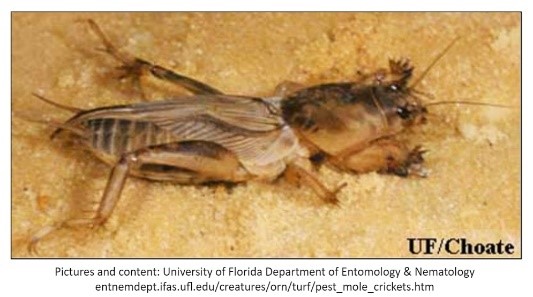
Southern Mole Cricket - long hind wings that extend beyond the tip of the abdomen, broad and rounded at the tips. It is brown in color, with the dorsal surface of the pronotum usually quite dark.

Short-winged Mole Cricket - Forewings are shorter than the pronotum and cover the hindwings which are very small. The body is mostly whitish or tan in color although the pronotum is brown and mottled with darker spots.

Mole Cricket Life Cycle
Seasonal mole cricket activity varies depending on location and temperature fluctuations. A general guideline to the annual mole cricket life stages in the southeastern United States is as follows.
Large nymphs and adults overwinter during colder months (October - March). In the spring, adults emerge, take flight, and begin mating. Males locate a suitable site with proper moisture and ideal soil to build their “calling chambers”.
Around dusk, males begin chirping to call prospective females to mate. Females fly in and land near the chamber to mate with the male. They feed and tunnel into the area for about two weeks. Egg-laying occurs shortly after mating throughout April and May. Eggs take around 20-30 days to develop before hatching - usually between May and July. In the summer months, young nymphs make their way toward the surface and eventually become very active feeders on crops and turfgrass roots.
Most of the significant damage due to feeding occurs in the late summer through fall (August - October). Once the cool weather of the fall sets in, mature nymphs/young adults begin the overwintering process by burrowing deeper into the soil profile.

Mole Cricket Scouting and Monitoring
Monitoring mole cricket populations and life stages can help determine the best timing for control. Soap flushes can be very useful for this purpose. A common method of soap flushing uses a mix of two tablespoons of lemon-scented dish detergent mixed into one gallon of water.
After mixing gently to reduce foaming, pour the mixture on turf areas where tunnels are visible. If two or more mole crickets come to the surface within 3 minutes, control options should be considered.
To better understand application timing for young, more susceptible nymph populations, the abdomen of female mole crickets can be opened to view egg development. If eggs are detected, it should be noted so that applications can be timed around early egg hatch which will render the best results.
Mole Cricket Control
Determining whether to treat for mole crickets is based on several factors. Tolerance or damage thresholds are usually the most important consideration. The destructive nature of their tunneling, the extensive damage caused directly by mole cricket feeding, and the secondary damage caused by larger animals foraging for mole crickets does a number on any surface. Due to this, population thresholds of mole crickets on high-value surfaces like putting greens, tees, and fairways are usually close to zero.
The optimal timing for applying a control product in most situations is during the early hatch period. Effective insecticides applied in the spring/early summer will help to control not only the current season’s population, but also reduce the re-infestation the following spring by controlling young nymphs emerging from the recent hatch.
When using insecticides, it is recommended to apply products in the late afternoon or evening for best results.
Mole crickets are most active at night and will more likely come into contact/ingest the product shortly after it is applied in the evening. Many different insecticides across several classes of chemistry are available that offer effective control of mole crickets. Each of these products/active ingredients have strengths and weaknesses depending on how and when they are applied.
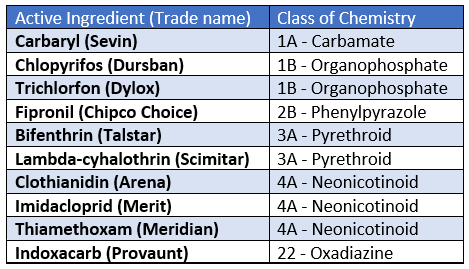
For instance, fipronil (Chipco Choice) is a highly effective solution with a very long residual of control (15-20 weeks). However, fipronil requires a specific type of slit application and is relatively costly compared to many other solutions.
Less expensive products like neonicotinoids (imidacloprid, clothianidin) and synthetic pyrethroids (bifenthrin, lambda-cyhalothrin) can be effective alone or in combination and are more easily applied through traditional spray application equipment.
These products must be applied at high water volumes and watered into the soil immediately after application and can offer a moderate level of residual control (8-10 weeks).
Contact products like trichlorfon and acephate are shorter-lived but can be effective if applied while mole crickets are active near the surface. Baits can also be effective and include products with the active ingredients carbaryl, chlorpyrifos, and indoxacarb.
Table 1. Select insecticides for mole cricket control in turf
As with any turfgrass pest, experience, and site knowledge is imperative for successful management. Understand the species you may be dealing with and the typical life cycle in your area to best plan your control strategy.
As always, your local Harrell’s territory representative is ready to help with practical advice, reliable service, and industry-leading products with your success in mind.
Related Resources

In addition to being the nation’s largest distributor of branded fungicides, herbicides, and insecticides, Harrell’s produces custom-blended fertilizers, specialty liquids, and wetting agents. Additionally, Harrell’s is the exclusive US owner, formulator, and distributor of all POLYON® branded products.
TEAM HARRELL'S
STAY EQUIPPED
Never stop learning. Access FREE continuing education courses from Harrell’s.
LET'S GROW
PRESS RELEASES
PRESS RELEASES
STAY EQUIPPED
Never stop learning. Access FREE continuing education courses from Harrell’s.
LET'S GROW