

Maximizing Product Performance
5/10/2022 - By Dr. Paul Giordano
Plant protectants and other turf health products make up a significant portion of a golf course or lawn care company’s operating budget. They are also investments that pay dividends when used properly, by improving the playability, aesthetic value, and overall health/performance of the plants and surfaces to which they are applied.
But are we always getting the MOST out of these products? Are they getting on or into the plant the way they should? Are they targeting the proper part of the plant or soil environment? Are they at high enough concentrations to deliver the desired effect? Below is a quick rundown of key things to keep in mind to help optimize your product performance.
The Right Rate
Most products have a rate range that often leaves the end-user with a decision to make. A general rule of thumb for plant protection products (fungicides, herbicides, insecticides) is when using them in a preventive manner, the low-to-mid labeled rates will typically suffice. Conversely, if using products in a curative manner, when disease, weed, or insect infestations are further progressed, higher rates will be required for adequate control. Product rate will often correlate directly with the longevity of performance - thus, the higher the rate, the longer the control or effect will last. This, however, is not a hard and fast rule, especially when it comes to products like growth regulators, where increasing product rate increases regulation intensity but does not necessarily extend growth suppression duration.
Human error often comes into play when we discuss product rates as well. Although it may be a lot easier to simply add “a couple of glugs” to the spray tank, precise measurement (and double-checking your math) on each product helps to ensure performance and limit over/under application mistakes.
Equipment and Output
Once in the spray tank or spreader, your products are further subjected to application variables that can affect their overall performance. From equipment calibration to nozzle selection, the tools we use to apply plant health products are a critical piece of optimizing their efficacy.
It goes without saying that proper calibration of spray and spreader equipment is paramount to getting the most out of your products. Calibration should be done at least once per season but may be required more frequently depending on the frequency of use and specific circumstances. Many different strategies exist depending on the type of equipment being used, but a great comprehensive resource on application equipment calibration from Purdue University can be found here - Calibrating Turf Sprayers and Spreaders.
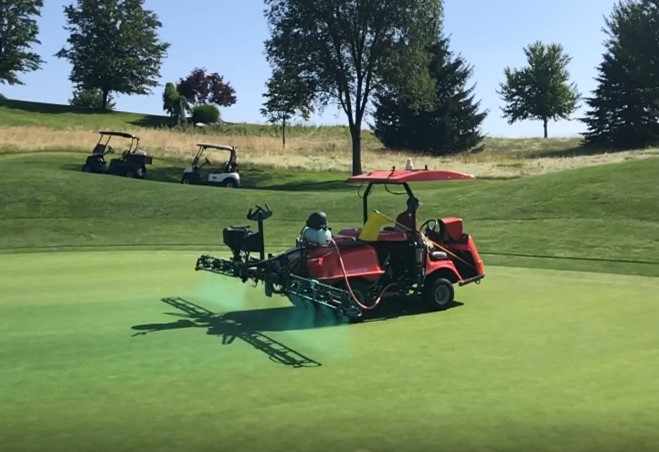
For liquid applications, the different components of the spray tank can have positive or negative impacts on one another. For instance, certain insecticides, as well as other pesticidal products, are subject to what’s known as alkaline hydrolysis - a process by which the pH of the carrier water can negatively affect the stability of the product and degrade the pesticide to a non-toxic or inactive form. A good overview of alkaline hydrolysis and the effect on various common pesticides can be found here.
The key takeaway - check your spray tank pH often and understand the effect of this pH on the products you are using. If needed, use a tank buffering agent like Harrell’s SprayMAX pH buffer to stabilize the spray solution, and make sure to apply the pesticides as soon as possible after mixing.
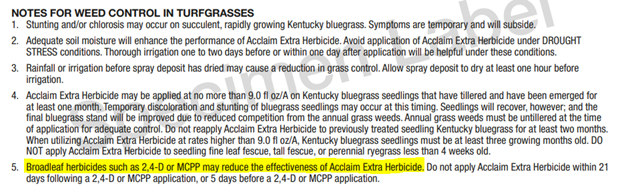
In some cases, antagonism can occur between products when mixed in the same spray tank. While this is relatively rare, product labels will usually indicate the antagonist(s) and provide specific instructions on proper use. See the example below from the Acclaim Extra herbicide label:
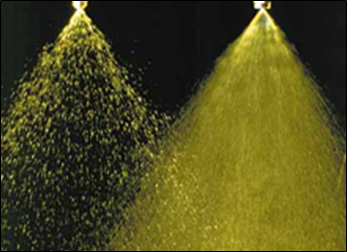
Now that we are ready to spray, it helps if we have the correct delivery mechanism for accurate application. Nozzle selection is yet another controllable variable that turf managers must consider when optimizing the performance of their products. The nozzle is a major factor in determining the amount of spray applied to an area, uniformity of application, coverage obtained on the target surface, and amount of potential drift. While some products may specify nozzle type and carrier volume for best results, not all do. It’s important to select the proper nozzle for the job to be done. This will vary depending on the target (turf plant, broadleaf weed, subsurface pest, soil drench) and spray equipment specifications such as boom height, spacing, and pressure. Here’s a great reference from Virginia Tech University on nozzle selection and sizing.
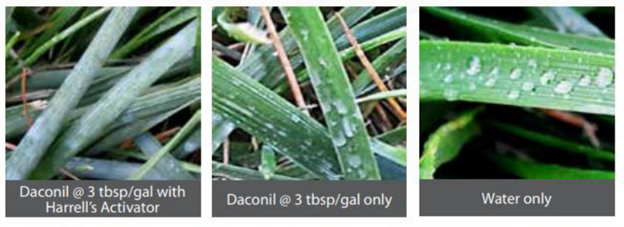
Aside from nozzle selection and applying in optimal weather conditions, there are some products we can include in the tank that not only help to reduce off-target drift of our plant health products, but can optimize their performance in many ways. Adjuvants like methylated seed oil (MSO), non-ionic surfactants, penetrants, and activators are commonly used in both agricultural and turf application settings. Which adjuvant to choose is often dictated by the specific product label. Most pesticide products will indicate specific types of adjuvants recommended to optimize efficacy.
For example, many herbicides targeting larger, more established weeds in turfgrass will recommend MSO or a crop oil concentrate to help the herbicide product penetrate the waxy cuticle of the plant. Other products may recommend a non-ionic penetrant or activator to break the surface tension of the water droplets and aid in coverage/deposition onto the turf canopy. Harrell’s has a complete lineup of adjuvants within the SprayMAX® portfolio of products. The product catalog contains excellent information on exactly how and where to use each of the individual solutions.
Proper Placement
Let’s say you want to control a soil-borne, root-infecting disease. You choose the appropriate fungicide, mix it up into your spray tank, and apply the product at a 1 gal/1,000 ft2 water volume. It dries on the plant soon after the application with no rainfall or irrigation occurring for several days. How well will that fungicide protect from or alleviate root diseases below ground?
Most of that applied fungicide is not likely to reach the roots - the target zone where the pathogen is infecting our plants. Many factors come into play when attempting to properly target applications for plant health and pest control, these include:
- The tissue (foliar/canopy, roots, soil)
- Product systemicity (contact, acropetal penetrant, systemic)
- Product KoC (binding affinity to organic matter - will it move?)
- Drift/off-target movement
- Use of adjuvants (as mentioned above)
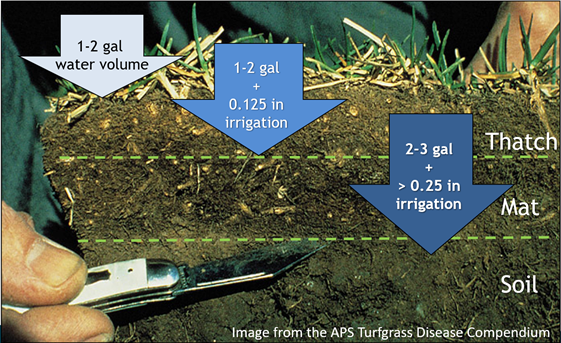
For soil-targeted applications such as those aimed at nematodes, subsurface insects like white grubs and mole crickets, root-infecting fungi like summer patch and fairy ring, and pre-emergence of annual weeds, post-application irrigation is a vital component of the overall process. Products need to get past the upper canopy of turfgrass cover and make their way through the dense network of organic matter and debris, known as the thatch/mat layer, before they reach their final destination in the upper soil/root zone. Much research has gone into this especially with fungicide efficacy more recently at NC State University.
The bottom line, most products have a propensity to bind to the turf/organic matter once dried. If not watered in soon after application, a majority of the active ingredient will not make it to the root zone where the pest or problem resides, thus rendering the application less effective. When used in combination, wetting agents or soil surfactants such as those in Harrell’s HydroMAX® portfolio can help enhance product penetration and moisture uniformity/distribution to maximize performance.
The science behind product application can be overwhelming. Provided here are some reminders around common limitations as well as resources for further reading and gaining a deeper understanding of the complexities around optimizing product performance. The goal is to protect your investment and improve your overall turf health programs and operational efficiencies. As always, your Harrell’s representatives are here to help with the best product recommendations and agronomic advice.
Related Resources

In addition to being the nation’s largest distributor of branded fungicides, herbicides, and insecticides, Harrell’s produces custom-blended fertilizers, specialty liquids, and wetting agents. Additionally, Harrell’s is the exclusive US owner, formulator, and distributor of all POLYON® branded products.
TEAM HARRELL'S
STAY EQUIPPED
Never stop learning. Access FREE continuing education courses from Harrell’s.
LET'S GROW
PRESS RELEASES
PRESS RELEASES
STAY EQUIPPED
Never stop learning. Access FREE continuing education courses from Harrell’s.
LET'S GROW