

Practical Strategies for Limiting Weed and Disease Resistance in Turf
8/9/2021 - By Dr. Paul Giordano
Preventing or delaying resistance should be a primary goal for all turf managers, especially herbicide, and fungicide resistance. Once a pest population becomes resistant, it can severely limit the number of effective product choices, dramatically increase overall treatment costs, and ultimately impact your turf management program. In addition, our industry continues to lose active ingredients from the turf market, with few (if any) new classes of chemistry entering. The result is the number of available modes of action is becoming smaller and the bottom line is herbicide and fungicide resistance (and to a lesser extent, insecticide resistance) is now a critical issue in the turfgrass industry.
Background
Resistance typically develops through a natural genetic mutation, which allows a plant or fungal population to become less sensitive, or tolerant to a pesticidal mode of action (MOA). It would be common to find these natural mutations in an individual weed or pathogen in almost any population, especially in a large population that is relatively unchecked by preventive chemical intervention. Predicting when a particular species develops resistance is virtually impossible, given the wide variety of organisms and contributing management factors. However, it is relatively safe to assume that given enough time and applications of the same active ingredient(s), a weed or disease population will eventually develop resistance to that mode of action. What allows that resistant population to thrive is the repeated applications of the same chemistry (or the same mode of action) resulting in a selection pressure against competing susceptible, or “wild type,” weeds or diseases. Eventually the resistant (mutant) subset of the population can grow unchecked to the point that the pesticide product will no longer control it and resistance is detected.
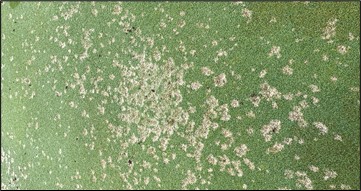
Dollar spot is one of the more common diseases that poses concerns with fungicide resistance. Vast genetic diversity in a large population as shown above, gives rise to more opportunities for naturally occurring mutations.
Factors that lead to resistance
- Naturally occurring factors
- Pests that reproduce prolifically, have a short life cycle, and have extended periods of favorable conditions for development. All of which create the potential for high populations in the turfgrass system and the need for multiple targeted applications. Dollar spot, Pythium blight, the ABW, chinch bugs, Poa annua and goosegrass are all examples.
- High genetic diversity – we now know that well over 30 different species of Pythium infect turfgrass systems, whereas annual bluegrass may have millions of different genetically unique biotypes.
- Controllable factors
- Employing cultural practices favoring survival, reproduction, and spread of target weeds or diseases.
- Allowing populations to build-up prior to making a rescue fungicide or herbicide application. Curative rescue applications are not as effective as early preventative applications, plus later applications allow populations to grow, increasing the chances for a single naturally occurring mutation to exist.
- Using herbicides or fungicides at the lowest or even below label rates to save expenses. These rates are likely not effective and expose the pests to sub-lethal rates, which may aid in selection for resistant individuals in a population.
- Repeated use of a single herbicide or fungicide with the same MOA.
Practical considerations to minimize the chances of resistance:
- Maximize cultural practices to limit pest pressure.
- Make early preventative applications for the primary weed or disease problems.
- Time applications for pests when they are most effective. Early spring preventative fungicide applications for dollar spot, Pythium root rot, etc., and early fall applications of preemergence herbicides for annual bluegrass are a couple of examples.
- Apply fungicides and herbicides at the appropriate rate and interval to keep population levels low, especially during periods or in areas with high pressure.
- Maximize application technique to improve control – increasing spray volume and decreasing droplet size will improve control with most fungicides and preemergence and postemergence herbicides.
- If a control failure occurs, investigate immediately and control with a different MOA if needed.
Minimizing the chances for disease resistance
- Rotate among MOA’s/ (fungicide example - FRAC Codes (Fungicide Resistance Action Committee)) (Table 1) and avoid more than two consecutive applications of fungicides with the same mode of action/FRAC code.
- Include multi-site contact fungicides in tank-mixes like Daconil® or Secure® as often as practical
- There are now at least seven different fungicides containing the SDHI mode of action (Succinate Dehydrogenase Inhibitor). University pathologists are reporting more cases of dollar spot that are no longer controlled by boscalid (Emerald®), the first SDHI used for dollar spot dating back to 2003. The latest research from the University of Massachusetts shows that certain recently developed SDHI fungicides will still control dollar spot populations not controlled by Emerald®.
- Rotating between SDHI’s is likely not an effective long-term strategy for dollar spot control and it is critical to rotate SDHI’s with other MOA’s including DMI’s, dicarboximides, and multi-site contact fungicides.
Minimizing the chances for herbicide resistance
- Use appropriate adjuvants to maximize control of individual applications.
- Use tank mixtures of two or more herbicides with different MOA’s (Table 2), which is preferred over rotation for limiting resistance.
- Rotate herbicides with different modes of action as often as practical, most turf weed scientists agree every 1-3 seasons.
Take home message
Weed and disease resistance is becoming more common in turf and it is critical to understand as we make or recommend applications to golf courses. Some simple steps should help to make our current disease or weed control strategies highly effective now and well into the future.
Table 1. Common single active ingredient fungicides used in turfgrass systems. It is important to tank-mix or rotate different types of fungicides and FRAC Codes when possible to limit chances of resistance.
Brand Name | Common name | Chemical Class | FRAC Code |
26GT® | Iprodione | Dicarboximide | 2 |
3336®/ProtectMAX® T-Methyl | Thiophanate Methyl | Benzimidazole | 1 |
Affirm® / Endorse® | Polyoxin-D | Polyoxin | 19 |
Banol® | Propamocarb | Carbamate | 28 |
Banner® Maxx | Propiconazole | DMI | 3 |
Bayleton® | Triadimefon | DMI | 3 |
Compass® | Trifloxystrobin | QoI | 11 |
Daconil®/ProtectMAX® Chlorothalonil | Chlorothalonil | Chloronitrile | M5 |
Disarm®/Fame® | Fluoxastrobin | QoI | 11 |
Densicor® | Prothioconazole | DMI | 3 |
Emerald® | Boscalid | SDHI | 7 |
Heritage®/ProtectMAX® Azoxy | Azoxystrobin | QoI | 11 |
Insignia® Intrinsic | Pyraclostrobin | QoI | 11 |
Kabuto® | Isofetamid | SDHI | 7 |
Maxtima® | Mefentrifluconazole | DMI | 3 |
Mirage® Stressgard/ProtectMAX® Teb | Tebuconazole | DMI | 3 |
Pinpoint® | Mandestrobin | QoI | 11 |
Posterity® | Pydiflumetofen | SDHI | 7 |
Prostar® | Flutolanil | SDHI | 7 |
Rayora® | Flutriafol | DMI | 3 |
Secure®/ProtectMAX® Fluazinam | Fluazinam | Pyridinamine | 29 |
Segway® | Cyazofamid | Cyanoimidazole | 21 |
Signature® Xtra SG | Fosetyl-Aluminum | Phosphonate | P07 |
Subdue® Maxx | Mefenoxam | Phenylamide | 4 |
Title Phyte® Systemic Fungicide | Potassium Phosphite | Phosphonate | P07 |
Tourney® | Metconazole | DMI | 3 |
Velista® | Penthiopyrad | SDHI | 7 |
Xzemplar® | Fluxapyroxad | SDHI | 7 |
Table 2. Common herbicides used to control annual bluegrass turf. It is important to tank-mix or rotate different types of herbicides and MOA's when possible to limit chances of resistance.
Brand Name | Common Name | Type | Mode of action (WSSA) |
Barricade® | Prodiamine | PRE selective | 3 |
Dimension® | Dithiopyr | PRE selective | 3 |
Finale® | Glufosinate | POST nonselective | 10 |
Katana | Flazasulfuron | POST selective | 2 |
Kerb® | Pronamide | PRE/POST selective | 3 |
Many | MSMA | POST selective | 27 |
Monument® | Trifloxysulfuron | POST selective | 2 |
Pendulum® | Pendimethalin | PRE selective | 3 |
Princep® | Simazine | PRE/POST selective | 5 |
Prograss | Ethofumesate | POST selective | 15 |
Revolver® | Foramsulfuron | POST selective | 2 |
Ronstar® (Restricted Use Pesticide) | Oxadiazon | PRE selective | 14 |
RoundUp® | Glyphosate | POST nonselective | 9 |
Sencor® | Metribuzin | POST selective | 5 |
Specticle® | Indaziflam | PRE selective | 29 |
Xonerate | Amicarbazone | POST selective | 5 |
Table 3. Common herbicides used to control goosegrass in turfgrass. It is important to tank-mix or rotate different types of herbicides and MOA’s when possible, to limit chances of resistance. Always consult the product label prior to application.
Brand Name | Common Name | Type | Mode of action (WSSA) |
Acclaim® Extra | Fenoxaprop | POST seletive | 1 |
Barricade® | Prodiamine | PRE selective | 3 |
Dimension® | Dithiopyr | PRE selective | 3 |
Finale® | Glufosinate | POST nonselective | 10 |
Fusilade II® | Fluazifop | POST selective | 1 |
Pendulum® | Pendimethalin | PRE selective | 3 |
Pylex® | Topramezone | POST selective | 27 |
Revolver® | Foramsulfuron | POST selective | 2 |
Ronstar® (Restricted Use Pesticide) | Oxadiazon | PRE selective | 14 |
RoundUp® | Glyphosate | POST nonselective | 9 |
Sencor® | Metribuzin | POST selective | 5 |
Specticle® | Indaziflam | PRE selective | 29 |
Speedzone® | 2,4-D; MCPP; Dicamba, Carfentrazone | POST selective | 4; 14 |
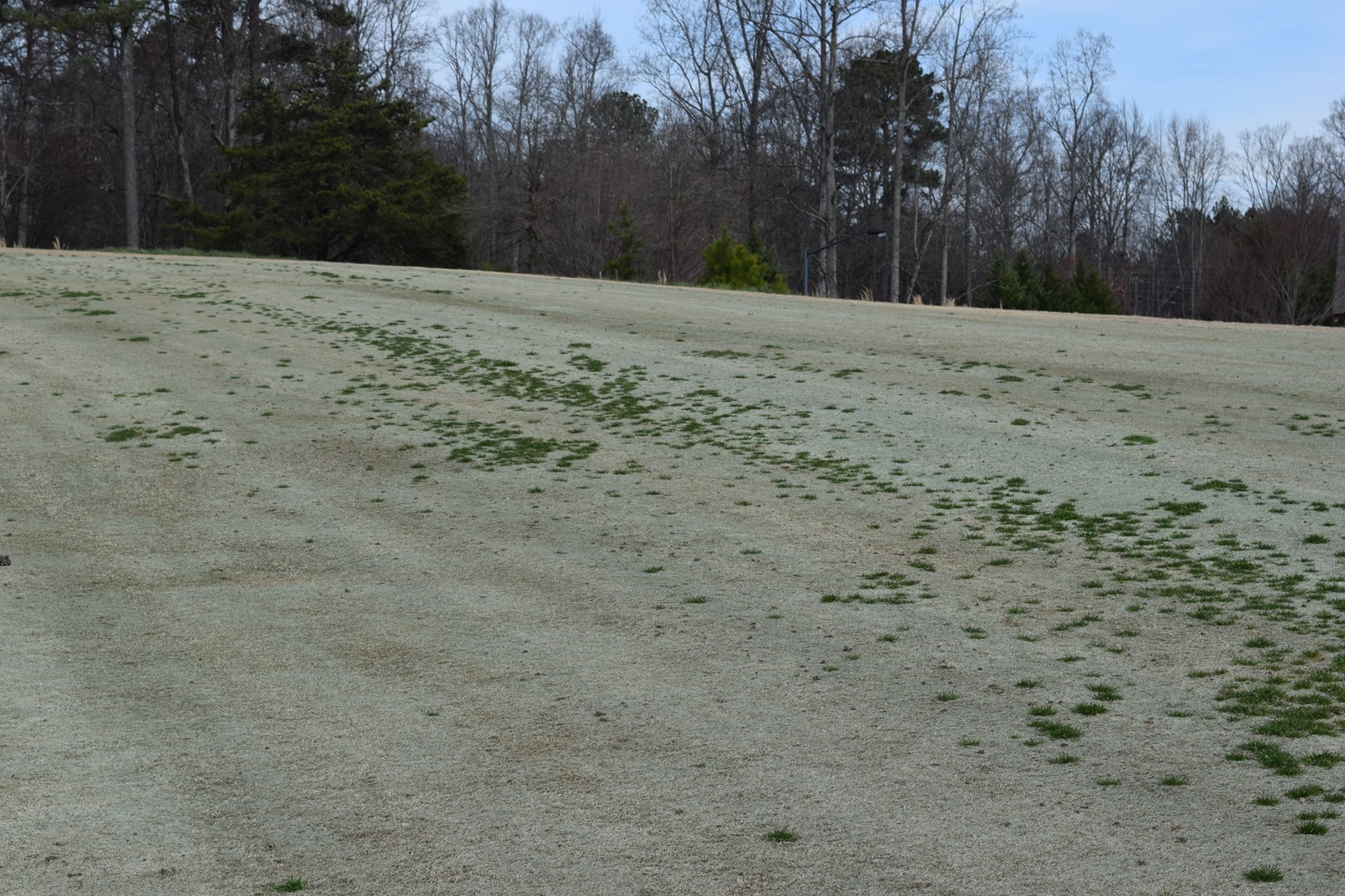
Surviving annual bluegrass, in an otherwise clean fairway of warm-season turf, may indicate the first expression of herbicide resistance. Investigate immediately to determine the cause and control as soon as possible (Zac Reicher, Bayer).
Related Resources

In addition to being the nation’s largest distributor of branded fungicides, herbicides, and insecticides, Harrell’s produces custom-blended fertilizers, specialty liquids, and wetting agents. Additionally, Harrell’s is the exclusive US owner, formulator, and distributor of all POLYON® branded products.
TEAM HARRELL'S
STAY EQUIPPED
Never stop learning. Access FREE continuing education courses from Harrell’s.
LET'S GROW
PRESS RELEASES
PRESS RELEASES
STAY EQUIPPED
Never stop learning. Access FREE continuing education courses from Harrell’s.
LET'S GROW