

Herbicides – Take Care of the Basics
6/16/2022 - By Dr. Jeff Atkinson

In many parts of the United States, winter weeds have bid farewell to the season only to make room for their summer counterparts. With seemingly endless herbicide options for weed control, it is important to remember a few basics, especially when using a new-to-you herbicide for the first time. Appropriate jar testing, carrier water pH, adjuvant selection, and active ingredient selection are fundamental to a successful herbicide program.
Jar Testing
Jar testing is always recommended, but often unheeded. It is commonplace for a variety of product formulations to be combined within a spray tank. Each tank mix is a unique chemistry experiment that may remain stable or may result in chemical or physical incompatibility, leading to a several-hour sprayer clean-out process. Investing a short amount of time to jar test a tank mix is an effective way to avoid the painfully time-consuming process of a spray tank cleanout.
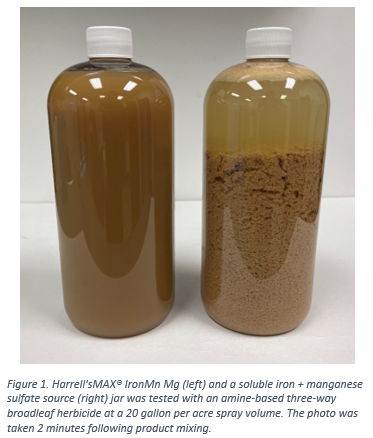
A classic example is illustrated in Figure 1. Harrell’sMAX® IronMn Mg (left) and a soluble iron + manganese sulfate source (right) jar was tested with an amine-based three-way broadleaf herbicide at a 20-gallon per acre spray volume. The photo was taken 2 minutes following product mixing. With a total jar test time for both combinations of less than 10 minutes, it saved a major tank-mix headache down the line. In this case, the chelated form of iron and manganese (Harrell’sMAX® IronMn Mg) was compatible with the amine herbicide formulation, while the non-chelated soluble iron and manganese source immediately demonstrated incompatibility with the amine herbicide formulation.
How to Jar Test Effectively
To effectively jar test, four simple tools are helpful to have on hand, all of which can be purchased for a total of less than $60:
- A container to accurately measure liquid volumes such as a graduated cylinder.
- A scale to weigh dry materials.
- A container to conduct the jar test.
- 10 mL syringes to measure small volumes of liquid materials.
Carrier Water pH
Herbicide-active ingredients are complex molecules. Active ingredient uptake and ultimate efficacy can be significantly influenced by carrier water pH.
Many herbicides have specific pH ranges where they are most effective. For example, the Monument® herbicide label states, ‘if pH of water carrier is less than 5.5, use a buffer solution to raise pH to near 7.0.' It’s a good practice to occasionally test water sources used for spray carrier water as their chemical characteristics can change over time. Further, it is a good practice to check every pesticide label for carrier water pH recommendations.
Harrell’sSprayMAX® pH Buffer is an effective tool to decrease spray tank pH. Increasing spray tank pH can be achieved by including a high-pH nutrient additive such as liquid lime.
Adjuvant Selection
The right active ingredient without the right adjuvant will often lead to disappointing weed control. Sometimes active ingredients need a little help crossing a plant cuticle and reaching the active site within a plant. Other times formulations need help spreading to enhance the total surface area covered by a spray application.
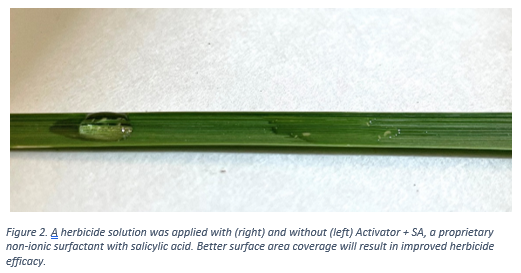
Activator + SA is Harrell’s proprietary non-ionic surfactant formulated with salicylic acid. Figure 2 illustrates an example of a herbicide solution applied with and without Activator + SA. Notice the increase in surface area coverage by including Activator + SA. More surface area coverage by a spray solution will result in greater efficacy of the herbicide.
However, including any adjuvant that is on the shelf is not always the best solution. Herbicide efficacy will likely be reduced if an adjuvant other than the recommended adjuvant is used. Appropriate adjuvants are selected and recommended based on the chemical properties of an herbicide active ingredient and how it will interact with the herbicide formulation.
Many herbicides will recommend a specific adjuvant such as methylated seed oil (MSO), crop oil concentrate (COC), or a non-ionic surfactant (NIS). Other herbicides may recommend against using an adjuvant altogether for the possibility of causing undesirable turf injury. In many cases products that recommend against the addition of an adjuvant are pre-formulated with the appropriate adjuvant.
As always, consult the product label for appropriate adjuvant recommendations. Harrell’s SprayMAX line is a complete line of spray adjuvants with a solution for all common pesticide label recommendations.
Active Ingredient Selection
Although new herbicide active ingredients are few and far between in recent years, new combinations of existing active ingredients are frequently introduced. Each combination controls a unique set of weeds, but it's important to remember that a one-formulation-fits-all product does not exist. Often, the selection of the correct combination or formulation of active ingredients will be the difference between a multiple application program and a single application program.
Poor herbicide efficacy can be a time-consuming annoyance, but the results and time saved are more than worth it! Investing the time to jar test, test carrier water pH, select the correct adjuvant and identify the correct active ingredient(s) will pay dividends in efficacy, fewer herbicide applications, and higher turf quality.
Harrell’s representatives are an outstanding resource to help implement these strategies and discuss how a herbicide program can be designed for any agronomic situation.
Related Resources

In addition to being the nation’s largest distributor of branded fungicides, herbicides, and insecticides, Harrell’s produces custom-blended fertilizers, specialty liquids, and wetting agents. Additionally, Harrell’s is the exclusive US owner, formulator, and distributor of all POLYON® branded products.
TEAM HARRELL'S
STAY EQUIPPED
Never stop learning. Access FREE continuing education courses from Harrell’s.
LET'S GROW
PRESS RELEASES
PRESS RELEASES
STAY EQUIPPED
Never stop learning. Access FREE continuing education courses from Harrell’s.
LET'S GROW