

Agronomic Alert - Gray Leaf Spot Early Arrival in the North?
6/24/2025 - By Dr. Paul Giordano
As turfgrass professionals, we know that plant pathogens do not abide by the calendar, and this year could be proving that once again. It is only mid-June, but we are already hearing of suspected cases of Gray Leaf Spot (GLS) appearing in northern climates, including along the East Coast and as far inland as Syracuse, NY. This would be an unprecedented early arrival for a disease that typically waits until late summer to make its presence known in these regions.
Why This Early Emergence Is Concerning
In most years, GLS becomes a concern north of the transition zone during August and September, when warm, humid weather and frequent storms help transport and trigger fungal outbreaks. Historically, the spores are carried north from southern regions during tropical systems or seasonal storm activity.
This year, an early disease arrival in the southeastern U.S. and a rare May Nor’easter appears to have accelerated that process, bringing spore populations north well ahead of schedule. Combined with persistent wet conditions across the Midwest and Northeast, we are now facing a perfect storm for potential disease development.
What Turf Types Are at Risk?
Gray Leaf Spot can be particularly destructive on:
Perennial ryegrass
Tall fescue
Lawns and sports turf
Golf course fairways, roughs, and intermediates.
If left untreated, GLS can thin turf rapidly and cause widespread damage, especially under stress from elevated temperatures and prolonged moisture.
What Should You Do Now?
1. Scout Early and Often:
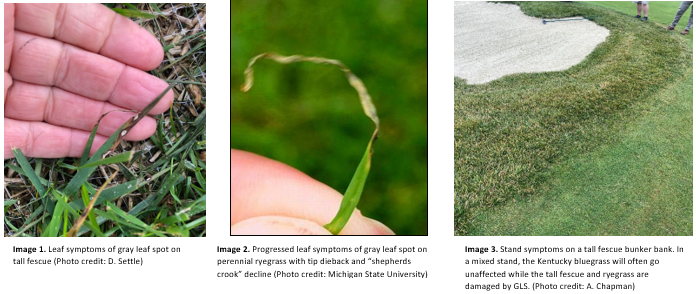
Look for early symptoms such as small, water-soaked lesions that quickly turn dark or grayish and oval-shaped (image 1). Early GLS symptoms can look a lot like bipolaris leaf spot (aka leaf spot); oftentimes, it might be difficult to discern between the two. As GLS progresses, lesions may coalesce, leading to tip dieback, shepherd's crook symptoms (image 2), and a rapid, overall thinning and turf collapse. Stand symptoms can resemble droughty turf with irregular wilting and decline (Image 3). Because GLS is most severe during warm, humid weather, it is frequently mistaken for Pythium blight on perennial ryegrass fairways and intermediate rough areas.
2. Prioritize High-Risk Areas:
Focus scouting and protection efforts on high-maintenance turf areas and those with a history of GLS problems, especially where perennial ryegrass and tall fescue are the dominant species.
3. Implement a Preventive Fungicide Program:
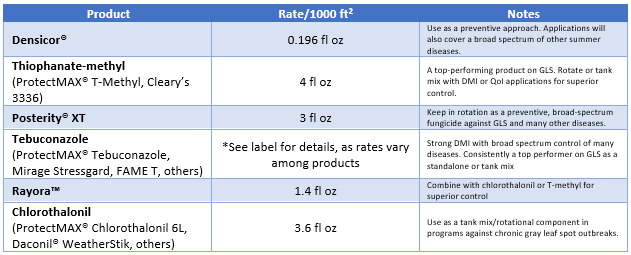
With a potential early onset of the disease, it is critical to begin preventive treatments sooner than usual. Choose fungicides with proven GLS efficacy, and rotate modes of action to prevent resistance (see below).
4. Manage Cultural Conditions:
Reduce leaf wetness by improving air circulation, mowing early in the day, and avoiding excessive nitrogen applications. Good irrigation practices—avoiding night watering and minimizing leaf moisture—are also key.
Management of gray leaf spot:
- Preventive control with fungicides is critical in areas with traditional gray leaf spot activity. Getting out early ahead of the disease is justified since GLS can quickly devastate large areas, disrupting play and requiring expensive and time-consuming overseeding efforts.
- Like all diseases, early fungicide applications when inoculum levels are low are critical for long-term control. Ensuing applications should be made at 14–21-day intervals, with tighter intervals during conducive weather.
- Applications should begin as soon as symptoms are recognized. This may normally be mid-summer but must be moved up due to early prevalence and favorable weather conditions.
- Since infections begin in roughs, consider an additional pass or two into the roughs, intermediates, or step cuts when treating fairways.
- Once epidemics start and turf damage can be seen, curative control is difficult and usually only marginally effective. A combination of DMIs, QoIs, chlorothalonil, and thiopanate methyl should be used at higher rates and shorter intervals to limit damage.
- In areas where GLS is common, some strains have shown resistance to the strobilurin class of chemistry (QoI fungicides). Keep this in mind when making applications, and do not rely exclusively on one class of chemistry for control.
- Some fungicides that have hit the market in recent years have shown excellent control of gray leaf spot in trials and should be considered as part of your overall disease management program in late summer/fall.
The Bottom Line
Gray Leaf Spot seems to have arrived early in many parts of the country, and the conditions across much of the Northeast and Midwest are primed for further outbreaks. If you manage cool-season turf, now is the time to act, not wait. Staying proactive with scouting, cultural practices, and well-timed fungicide applications can mean the difference between maintaining healthy turf and facing costly turf loss.
If you have any questions about the products you need for prevention, your Harrell™s Representative is your best resource, connect with them today.
Related Resources

In addition to being the nation’s largest distributor of branded fungicides, herbicides, and insecticides, Harrell’s produces custom-blended fertilizers, specialty liquids, and wetting agents. Additionally, Harrell’s is the exclusive US owner, formulator, and distributor of all POLYON® branded products.
TEAM HARRELL'S
STAY EQUIPPED
Never stop learning. Access FREE continuing education courses from Harrell’s.
LET'S GROW
PRESS RELEASES
PRESS RELEASES
STAY EQUIPPED
Never stop learning. Access FREE continuing education courses from Harrell’s.
LET'S GROW