

Golf Course Management - Grass Mites
5/4/2023
Grass mites like the bermudagrass mite (Eriophyes cynodoniensis) are a growing pest of concern in parts of the US where bermudagrass is grown. First discovered and described in the late 1950s as a lawn pest in the Southwestern United States, the bermudagrass mite has only more recently been recognized as a significant cause of turf damage on golf courses and has been reported in 11 states from Hawaii to North Carolina.
This small arthropod pest can be very difficult to diagnose, and damage is often mistaken for other biotic or abiotic issues. On top of that, there are very limited solutions for controlling mites in turfgrass settings. Here we discuss some of the basics around the bermudagrass mite and best practices for limiting damage and achieving control of this microscopic pest.
Bermudagrass Mite Symptoms
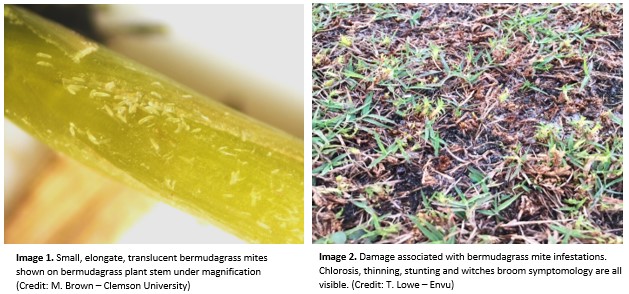
Also known as the ‘stunt mite’ this pest is hardly visible (around 0.2 mm) and spends most of its life cycle hidden between the leaf sheath and stem, making it very difficult to detect and identify (Image 1). The bermudagrass mite is highly specific in its host preference and will only feed on bermudagrass turf. While feeding, the mites pierce the bermudagrass plants through the epidermis and obtain nutrition via plant fluids. Damage to bermudagrass stands is usually noticed in late spring when plants show symptoms of chlorosis (yellowing), stunted growth, delayed green-up, and often a witch’s broom form of growth (Image 2). Mite feeding can significantly weaken bermudagrass causing it to be more susceptible to other pests and abiotic stress like traffic, drought, shade, etc.
When, Where, and How Bermudagrass Mites Sprout Up
In warmer climates such as southern Florida and Texas, bermudagrass mites can be active throughout the year. In the transition zone and areas that go dormant in the winter, the mites tend to be most active in the warmer weather of the summer. However, the damage is most pronounced in the spring coming out of dormancy.
Mites lay eggs under leaf sheaths, and the eggs hatch and larval stages progress quickly through two nymph stages into adults. The entire life cycle of the bermudagrass mite takes only 5-10 days, meaning reproduction and new generations of mites can occur quickly and build to large numbers of infestations quite rapidly throughout the season.

Cultural Control of Bermudagrass Mites
Control measures are somewhat limited for the bermudagrass mite. Culturally, reducing stress from golfers, equipment, and other abiotic factors can help improve stand tolerance to low levels of mite infestation. This comes with proper and balanced inputs ensuring adequate moisture, nutrition, and plant protection throughout the season.
It’s thought that lowering mowing height below 1 inch, especially in home lawn or athletic field settings as well as aggressive removal/collection of clippings, may help reduce mite populations at key times of the year. More practically, chemical intervention with miticides/insecticides can help to reduce populations and mitigate damage. However, solutions are limited, especially for the lawncare market.
Chemical Control of Bermudagrass Mites
Synthetic pyrethroids like bifenthrin (Talstar, FMC) and lambda-cyhalothrin (Scimitar, Syngenta) have been used as short-term “band-aids” that can offer a quick knockdown of bermudagrass mites. Some entomologists suspect however that broad-spectrum insecticides like these may be reducing natural predators of the mites and ultimately making the problem worse over time. A programmatic approach that includes strong but specific insecticides like Abemectin (Divanem, Syngenta) and spirotetramat (Kontos, Envu) is recommended for optimal control. Spriotetramat is the newest solution for bermudagrass mites which has recently been granted a 24(c) special local need label in Florida, Texas, and South Carolina. Combination products like Triple Crown (FMC) have also shown good control when used in programs targeting mites along with other labeled insects.
Regardless of the product, applications need to start in the spring to target early mite populations and be repeated regularly (every 2 weeks) where mite infestations are significant. It’s recommended to use a proper surfactant like Harrell’s Activator + SA or Non-Ionic Penetrant in every application to improve penetration of the insecticide through gaps between stems and leaf sheathes where the mites feed.
Always read and follow label instructions. And as always, if you have any further questions or would like to know more about prevention, reach out to your local Harrell’s Rep.
Related Resources

In addition to being the nation’s largest distributor of branded fungicides, herbicides, and insecticides, Harrell’s produces custom-blended fertilizers, specialty liquids, and wetting agents. Additionally, Harrell’s is the exclusive US owner, formulator, and distributor of all POLYON® branded products.
TEAM HARRELL'S
STAY EQUIPPED
Never stop learning. Access FREE continuing education courses from Harrell’s.
LET'S GROW
PRESS RELEASES
PRESS RELEASES
STAY EQUIPPED
Never stop learning. Access FREE continuing education courses from Harrell’s.
LET'S GROW