

Fertilizer or Filler - What are You Buying?
3/27/2018 - By Harrell's
 Have you ever really thought about what is actually in the bag of fertilizer that you are using?
Given, there are 50 pounds of something in every 50 pound bag and most golf course superintendents just assume it is fertilizer. Well I hate to be the bearer of bad news, but that is not always the case.
The regulatory agency that is responsible for fertilizers is a group called the American Association of Plant Food Control Officials (AAPFCO) and,at this time, they do not require fertilizer formulators to put on the fertilizer labels everything that is present in the bag. They require them to put the nutrients that are in the bag, but they do not require any specifics about any “inert” ingredients.
In recent years, as we all know, the economy has not been just “kicking” so industries such as the golf business have fallen victim to this recession. Golf maintenance budgets have been reduced and fertilizer formulators have tried to figure out ways to lower the price points for their fertilizers.
One way of lowering the cost of a fertilizer is to simply take some fertilizer out of the bag and replace it with “filler”. Filler can be anything from corn cob, clay, limestone, etc….. These fillers are not fertilizers but merely occupy space and provide weight.
One of the most expensive components in a bag of fertilizer are the slow release materials. Many of the fertilizer formulators have started promoting and selling these “diluted” blends of fertilizers with more filler as a way of lowering the cost of the fertilizer. This was in reaction to the fact that many golf course superintendents still make fertilizer purchase decisions based on the cost per bag or cost per ton of the fertilizer without taking into account things like what is in the bag, how much slow release, how long the fertilizer will last, etc.
Yes, these “diluted” blends do have a lower price point per bag or per ton, but agronomically you are getting short changed.
So, how can you determine how much filler is in the fertilizer you are considering? The easiest way is to ask the fertilizer sales person for a print out of the formulation sheet that contains the formula or recipe for making this product. If you add up the fertilizer components and then subtract that from 2,000 pounds, then you will know how many pounds of filler is in the blend or more than likely the formulation sheet will have how many pounds of filler that this particular blend calls for. The only other way is to actually do the formulation on paper yourself which would require knowing the fertilizer components used which is required by AAPFCO to put on the fertilizer label. Then, take these components and using their percent of nutrient they contain to make these calculations. I would ask the sales representative!! If they can’t provide that or do the math for you, then you need a new sales representative.
What would be considered a “diluted” blend? This is a difficult question with many answers. One such opinion may be a fertilizer that contains too much filler. Another answer could be a fertilizer that contains any filler. In my professional opinion, I look more at the amount of slow release components that are in the blend. Since these slow release components are the most expensive components, then superintendents should be sensitive to how much of these are present. More importantly, if there are sufficient amounts of these slow release components present so the slow release can work as designed to provide a consistent turf response over the allocated release time.
From an agronomic point of view, it is easy to tell you what the end results will be from the use and application of these “diluted” blends. Aesthetically when these “diluted” blends are applied the turfgrass will develop this “mottled” appearance where you see spots of different colors of green to yellow turfgrass. The turfgrass remains green where the slow release components are located and releasing while the other turfgrass areas become chlorotic due to the lack of fertility. The filler in these products will produce no turfgrass response. The water soluble or fast release components in the fertilizer will release within a few days of application and provide a turfgrass response for a week or two. Then, the only thing left in the turfgrass to provide a response is the slow release component(s).
If the fertilizer only contains 25% slow release, then you can see that it would be impossible to have the slow release components evenly distributed over the treated area.
My threshold in terms of how much slow release should be utilized in a blend is 70% slow release or more. Anything less than 70% will be a challenge to have sufficient particle distribution that is evenly distributed when applied over the treated turfgrass area to get an even turfgrass response. Why waste money on a “diluted” blend that will not perform any better than a 100% fast release fertilizer? If you are applying a slow release fertilizer to get a slow release of nutrients, then you need to make sure you have sufficient amount(s) of the slow release in the bag to allow these particles to be evenly distributed on the turfgrass when it is applied so the turfgrass response remains consistent over the length of the slow release period. This becomes more of a problem with the larger the particle size of the fertilizer blend due to fewer particles per pound.
Below is an example of a “diluted” fertilizer blend and how much filler is in the blend along with the issues of spread rate of such a product.

24-0-11 with 50% XCU Label
This is the recommended information that AAPFCO requires to be on a fertilizer label. The fertilizer components are given in the “Derived from:” statement which will list all fertilizer components used to make this fertilizer blend. The label also shows you how much slow release component(s) are in the bag with the * footnote “12.0% slow release NITROGEN derived from Polymer Coated Sulfur Coated Urea”. This is the XCU slow release component in this fertilizer blend. If you do the math, the total N content is 24% so if 12% of the N content is from XCU, then that equals a 50% blend.
If you look at the formulation sheet or do the math, you will see that to get a 50% blend with XCU for this product would require 558 pounds of XCU per ton. And, if you do the rest of the math you will find that this fertilizer blend also contains 405 pounds of filler, which is almost as much in terms of pounds as the slow release component itself.
If this product were to be applied at a one pound of nitrogen per 1,000 square feet rate, then the spread rate would be 181 pounds of product per Acre. When you look at the XCU component in this blend, at this spread rate then you are looking at trying to evenly spread 50 pounds of XCU per Acre with this application. That would be impossible to do, so this is what causes the turfgrass “mottling” appearance. This would not be a fertilizer that I would either use or sell to a golf course superintendent even if they ask for it. So what are you buying – fertilizer or filler?
Fertilizante o Relleno – ¿Que está Comprando?
¿Ha pensado en realidad acerca de lo que actualmente está en la bolsa de fertilizante el cual está usando?
De hecho, hay 50 libras de algo en cada bolsa de 50 libras y la mayoría de gerentes de campos de golf asume que es fertilizante. Bueno, no me agradar ser el portavoz de malas noticias pero esto no es siempre el caso.
Desafortunadamente, la agencia regulatoria la cual es responsable de fertilizantes es un grupo llamado La Asociación de Control de Alimento de Plantas (AAPFCO) y ellos no requieren formuladores de fertilizante que ponga una etiqueta de fertilizante todo lo que está presente en la bolsa. Le requieren poner los nutrientes que están en la bolsa, pero no le requieren nada específico acera de ingredientes “inerte”.
En años recientes, como bien sabemos, la economía no ha estado “pateando” así que industria tal como el negocio de golf han caído víctimas de la recesión. El presupuesto de mantenimiento de Golf han sido reducido y los formuladores de fertilizantes han tratado de descifrar modos de rebajar el pinto de precio a sus fertilizantes.
Una forma de rebajar el costo de un fertilizante es simplemente sacar un poco de fertilizante de la bolsa y sustituir con relleno. El relleno puede ser cualquier cosa desde Mallorca de maíz, barro, piedra de cal, etc…. Estos rellenos no so fertilizantes pero meramente ocupan espacio y provee peso.
Uno de los componentes más caro en la bolsa de fertilizante son materiales de liberación lenta. Muchos de los formuladores fertilizante formuladores han comenzado a promover y vender estas mezclas “diluidas” de fertilizante con más rellenos
como una forma de rebajar el costo de fertilizante. Esto fue en reacción al hecho que muchos gerentes de campos de golf todavía hacen decisión de compras de fertilizante en el costo por bolsa o costo por toneladas de fertilizante sin tomar en consideración cosas como que hay en la bolsa, cuanto es la liberación lenta, que largo dura el fertilizante, etc.
Si, estas mezclas “diluidas” tienen un precio más bajo por bolsa o por toneladas, pero agronómicamente le están engañado.
Así que, ¿cómo puede determinar cuánto relleno está en el fertilizante que está considerando? La forma más fácil es preguntarle al vendedor por una hoja imprentada de la formulación que contiene la formula o receta para hacer este producto.
Si suma los componentes del fertilizante y resta esto de 2,000 libras, entonces sabrá como cuantos libras de rellenos está en la mezcla o aún más preciso la hoja de formulación tendrá cuantos libras de rellenos que esta mezcla requiere.
De la única otra forma es de actualmente hacer la formulación en papel usted mismo lo cual requieres conocer los componentes de fertilizante usado lo cual es requerido por AAPFCO para poner en la etiqueta de fertilizante. Entonces, tome estos componentes y usando sus porciento de nutritivos que contiene para hacer estas calculación. ¡Yo le preguntaría al vendedor! Si no le pueden proveerlo o hacer la matemática para usted, entonces necesita un vendedor nuevo.
¿Qué sería considerado una mezcla a diluida? Esta es unas preguntas difícil con muchas contestaciones. Tal opinión puede ser un fertilizante que contiene demasiado relleno. Otra contestación puede ser un fertilizante que contiene cualquier relleno. En mi opinión profesional, miro más a la cantidad de componente con liberación lenta que está en la mezcla. Como estos componentes de liberación lenta son los más caros, entonces los gerentes deben ser sensitivo a cuanto de estos están presente. Aún más importante, si hay suficiente cantidad de estos componentes de lenta liberación presente.
Cantidades eficiente de estos componentes de liberación lenta presente así que la liberación lenta pueda trabajar como fue diseñada para proveer una reacción consistente del césped sobre el tiempo asignado
El punto de vista del agronómica, es fácil decirle cual es el resultado final será del uso y aplicación de estas mezclas “diluido”. Estéticamente, cuando estas mezclas “diluido” son aplicados el césped desarrollara una apariencia “moteado” donde vera manchas de diferentes colores de césped verdes a amarillos. El césped se mantendrá verde donde el componente de liberación lenta están localizado y liberado mientras las otras áreas de césped se hacer clorótica dado a la falta de fertilidad.
Los rellenos que estos productos producirán ninguna reacción de césped. El agua soluble o componente de liberación rápida en el fertilizante será lanzado en algunos días de aplicación y proveerá una reacción del césped entre una o dos semanas. Entonces, lo único que queda en el césped para proveer una reacción es componente de liberación lenta.
Si el fertilizante solo contiene 25% liberación lenta, entonces puede ver que sería imposible tener el componente de liberación lenta distribuida sobre el área tratada.
Mi umbral en términos de la cantidad de liberación lenta debe ser utilizada en una mezcla es 70% liberación lenta o más. Nada menos de 70% será un reto para tener suficiente distribución de partículas que es distribuido igualmente cuando aplicado sobre el área de césped tratada para obtener una reacción de césped anivelada. ¿Porque gastar dinero en una mezcla “diluida” que no trabajara mejor que un fertilizante 100% liberación rápida? Si está aplicando un fertilizante de liberación lenta para obtener nutrientes, entonces debe asegurarse que tiene suficiente cantidad(es) de la liberación lenta en la bolsa para permitir estos partículas sean distribuidas niveladas en el césped cuando es aplicada para que la reacción del césped se mantenga consistente sobre la longitud del periodo de la liberación lenta. Esto viene a ser más de un problema con la talla de partículas más grande que la mezcla de fertilizante debido a menos partículas por libra.
A continuación hay un ejemplo de una mezcla de fertilizante diluido y la cantidad de relleno que está en la mezcla junto con la porción de propagación de tal producto.
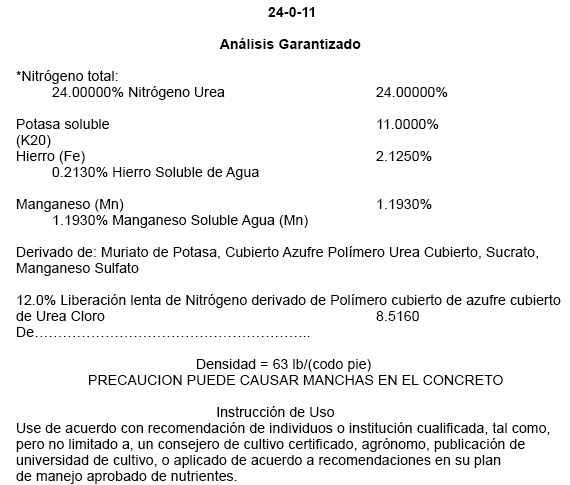
Etiqueta 24-0-11 con 50% XCU
Esta es información recomendada que AAPFCO requerido estar en la etiqueta fertilizante. El componente fertilizante son dado en el “Derivado de:” declaración el cual lista todo componente fertilizante usado para hacer esta mezcla de fertilizante. La etiqueta también muestra como componentes de liberación lenta usado para hacer la mezcla de fertilizante. La etiqueta también te muestra cuanto de componente de liberación lenta está en la bolsa con la *nota “12.0% de nitrógeno derivado de Recubierto polímero revestida con azufre revestida de urea.
Esto es el XCU componente de liberación lenta en este mezcla de fertilizante. Si usted hace la matemática, el total contenido de N es 24% así que si 12% del contenido de N es de XCU, entonces esto suma a 50% de la mezcla.
Si mira la hoja de formulación o hace la matemática, vera que para alcanzar 50% de mezcla con XCU para este producto requiere 558 libras de XCU por toneladas. Y, si hace el resto de matemática, encontrara que la mezcla del fertilizante contiene 405 libras de rellenos, que es casi tanto como en términos de libras de componente de liberación lenta a si misma.
Si este producto fuera aplicado a una libre de nitrógeno por 1,000 pies cuadrados, entonces la proporción de esparcimiento será 181 libras de producto por acre. Cuando usted mira la mezcla de XCU en esta mezcla, en la proporción de esparcimiento entonces está tratando de igualar el esparcimiento de 50 libras de XCU por Acre con esta aplicación. Esto sería imposible hacer, así que esto es lo que causa la apariencia moteada del césped. Esto no sería un fertilizante que ni usaría ni vendería a un gerente de campo de golf aun si lo pidieran. Así que, ¿que está comprando fertilizante o relleno?
Related Resources

In addition to being the nation’s largest distributor of branded fungicides, herbicides, and insecticides, Harrell’s produces custom-blended fertilizers, specialty liquids, and wetting agents. Additionally, Harrell’s is the exclusive US owner, formulator, and distributor of all POLYON® branded products.
TEAM HARRELL'S
STAY EQUIPPED
Never stop learning. Access FREE continuing education courses from Harrell’s.
LET'S GROW
PRESS RELEASES
PRESS RELEASES
STAY EQUIPPED
Never stop learning. Access FREE continuing education courses from Harrell’s.
LET'S GROW