

Make Stains a Non-issue
7/2/2013 - By Dr. Travis Shaddox
The topic of my blog article last month was staining from granular fertilizer, and it may be viewed here. This month I decided to fill in the remaining piece of the staining puzzle by discussing liquid fertilizer.
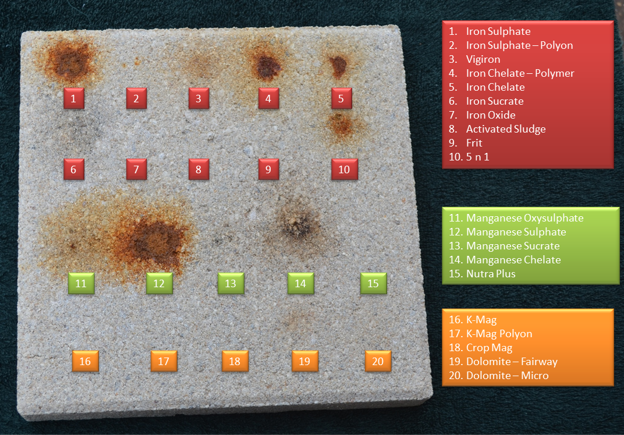
Generally, staining from liquid fertilizer is less of an issue than from granular fertilizers. This is largely due to the broad distribution of fertilizer across a wide area. However, raw materials used to create liquid fertilizer can be the same as granular fertilizer. Based upon last month’s results, we are interested in liquids containing any form of sulfated metal, particularly iron, manganese, or magnesium.
Study
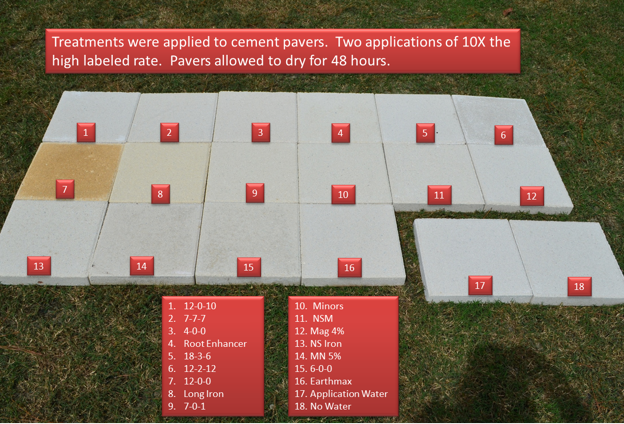
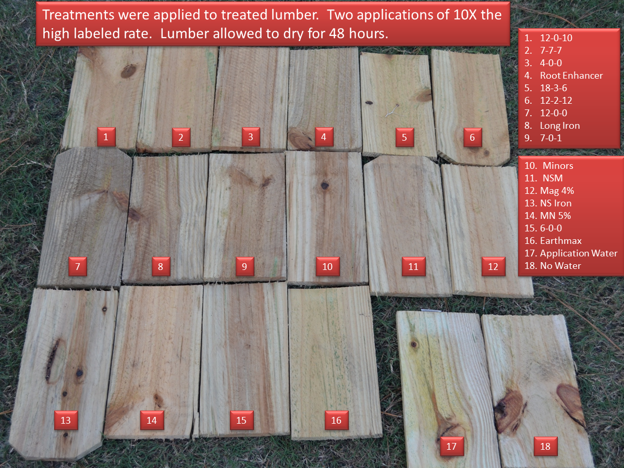
Sixteen liquid fertilizers were applied to dry cement pavers and treated lumber, and labels for each fertilizer may be found on our website. Each fertilizer was applied twice at a rate of 10X the high labeled rate, and the paver or wood was allowed to dry for 48 hours before photographs were taken. Results for cement pavers and treated lumber can be seen in the images below. Of the sixteen products tested, only the 12-0-0 and Long Iron produced any visible stain at 20X the high labeled rate. Based upon these results, every Harrell’s Max product except 12-0-0 and Long Iron may be safely applied to cement or wood up to 20X the highest labeled rate without concern of staining.
Please keep in mind that application water can significantly influence nutrient availability; thus, different results could occur with different application water.
Connect with Your Harrell's Rep to Learn More
Finding the right fertilizer for your property (whether it be liquid or granular) is not as daunting as it may seem. The right balance of nutrition, release window, and application need/efficiency are all important factors to consider, and your Harrell's Rep is the best person to help you determine all of those. Connect with them today to find the perfect product for your turf to deliver proper nutrition, save you time, and do away with stains.
Related Resources

In addition to being the nation’s largest distributor of branded fungicides, herbicides, and insecticides, Harrell’s produces custom-blended fertilizers, specialty liquids, and wetting agents. Additionally, Harrell’s is the exclusive US owner, formulator, and distributor of all POLYON® branded products.
TEAM HARRELL'S
STAY EQUIPPED
Never stop learning. Access FREE continuing education courses from Harrell’s.
LET'S GROW
PRESS RELEASES
PRESS RELEASES
STAY EQUIPPED
Never stop learning. Access FREE continuing education courses from Harrell’s.
LET'S GROW