

Fall POLYON®
10/8/2019 - By Dr. Jeff Atkinson
Consider fall fertilization as an investment in your turf (and your) future. A large segment of the US will shift into recovery mode as the extreme heat and drought that has pushed turf to the brink throughout September breaks over the next couple weeks. Fall seeding is in full swing. As winter approaches turf will undergo a physiological shift into dormancy. All of these are energetic processes which require adequate nutrition. Falling short of providing adequate nutrition during this season can increase the likelihood of winterkill at worst and result in a lackluster spring greenup at best. So, what is an effective fall nutrition program?
A recent extension blog post by Dr. Bill Kreuser from University of Nebraska outlines current research aimed at answering this question. The following is his research-based recommendation for soil-based systems in Nebraska:
• Apply a controlled release granular product in mid-September at 0.7 to 1.0 lb N/1000 ft2. Aim for a product with less than or equal to 50% slow release nitrogen.
So, how does this recommendation for Nebraska apply to your area? When considering how a recommendation for a specific region applies to a different region it’s helpful to compare current and historical climate data for both regions. For this example, let’s compare Lincoln, Nebraska and Charlotte, North Carolina.
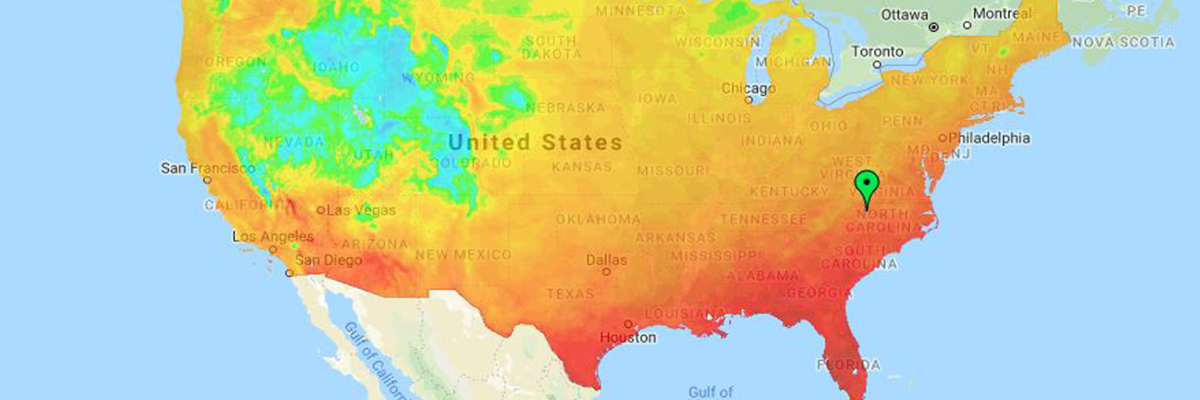
Syngenta provides an excellent soil temperature mapping tool for turf managers. Looking at historical soil temperature data the average soil temperature on September 15th in Lincoln, Nebraska was 77°F. As I write this blog post on October 4th, 2019 at 11 AM EST the soil temperature in Lincoln, Nebraska is 51°F; 24-hour average is 56°F and the 5-day average is 66°F. For comparison in Charlotte, North Carolina the current soil temperature is 77°F; 24-hour average is 86°F; and the 5-day average is 84°F. The difference between 66°F and 84°F is enough to cause a difference in the physiological status of turf. At 66°F turf is able to utilize nitrogen, but as temperatures drop over the next couple weeks N utilization will decline. At 84°F turf is able to efficiently uptake and assimilate applied nitrogen and soil temperatures will remain warm enough to facilitate nitrogen utilization for several weeks to come. The same pattern is true for much of the Mid-Atlantic and Midwest.
To boil it down into a single thought: depending on location you may still have time to reap the benefits of a fall nitrogen application, but you’re running out of time.
I’ll end with an example of how fertilizer technology can be utilized as a failsafe to prevent excessive nutrient loss after a N application this time of year. Afterall, weather is the most unpredictable factor in our business.
The figure below is the predicted release of a Harrell’s custom 30-0-8 blend with 75% controlled-release nitrogen from POLYON® 43 and 25% quick release nitrogen from GreenTRX in the form of ammonium sulfate. On the surface it appears this blend breaks the fall N recommendation above. Looking deeper, the predicted release graph created by Harrell’s proprietary POLYGRAPH® system indicates 0.75 lb of N will be released into the soil between application and December 16th, 61% of which will be released within the first week following application. Considering release characteristics of the blend the application now falls within the recommendation above.
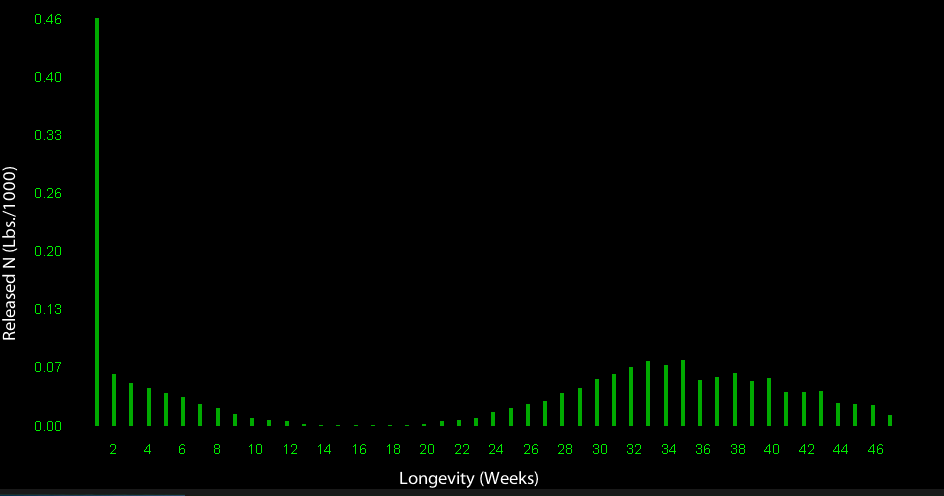

But what happens to the rest of the applied N? POLYON® N release is mediated by soil temperature, not soil moisture like many other slow or controlled-release fertilizers. The remaining 1.04 lbs of N will be released in a controlled fashion starting slowly in the spring as soil temperatures rise then continue to provide a controlled nitrogen feed of 0.04 - 0.07 lb N/1000 ft2 through the spring and early summer, preventing a flush of growth typically associated with application of quick release or lesser controlled-release N sources while providing adequate N for turf health.
Want to design fertilizer blend that matches your location and your schedule? Talk to your Harrell’s rep. Want to dig deeper into Nebraska’s fall fertility recommendations? You can find Dr. Kreuser’s blog post and lots of other great information here.
Spanish Translation:
Considere la fertilización de otoño como una inversión en su territorio (y su futuro). Un gran segmento de los EE. UU. Cambiará al modo de recuperación a medida que el calor extremo y la sequía que han llevado al césped al borde durante los recesos de septiembre en las próximas dos semanas. La siembra de otoño está en pleno apogeo. A medida que se acerca el invierno, el césped sufrirá un cambio fisiológico hacia la latencia. Todos estos son procesos energéticos que requieren una nutrición adecuada. No alcanzar una nutrición adecuada durante esta temporada puede aumentar la probabilidad de muerte invernal en el peor de los casos y, en el mejor de los casos, dar como resultado una primavera verde mediocre. Entonces, ¿qué es un programa de nutrición de otoño eficaz?
Una reciente publicación de blog de extensión del Dr. Bill Kreuser de la Universidad de Nebraska describe la investigación actual destinada a responder esta pregunta. La siguiente es su recomendación basada en la investigación para sistemas basados en el terreno en Nebraska:
• Aplique un producto granular de liberación controlada a mediados de septiembre a 0.7 a 1.0 lb N / 1000 ft2. Apunte a un producto con menos o igual al 50% de nitrógeno de liberación lenta.
Entonces, ¿cómo se aplica esta recomendación para Nebraska en su área? Al considerar cómo una recomendación para una región específica se aplica a una región diferente, es útil comparar los datos climáticos actuales e históricos de ambas regiones. Para este ejemplo, comparemos Lincoln, Nebraska y Charlotte, Carolina del Norte.
Syngenta proporciona una excelente herramienta de cartografía (soil temperature mapping tool) de la temperatura del suelo para los administradores de césped. Al observar los datos históricos de temperatura del terreno, la temperatura promedio del terreno el 15 de septiembre en Lincoln, Nebraska, fue de 77 ° F. Mientras escribo esta publicación de blog el 4 de octubre de 2019 a las 11 a.m. EST, la temperatura del terreno en Lincoln, Nebraska, es de 51 ° F; El promedio de 24 horas es de 56 ° F y el promedio de 5 días es de 66 ° F. Para comparación en Charlotte, Carolina del Norte, la temperatura actual del terreno es de 77 ° F; El promedio de 24 horas es 86 ° F; y el promedio de 5 días es 84 ° F. La diferencia entre 66 ° F y 84 ° F es suficiente para causar una diferencia en el estado fisiológico del césped. A 66 ° F, el césped puede utilizar nitrógeno, pero a medida que las temperaturas bajen en las próximas dos semanas, la utilización de N disminuirá. A 84 ° F, el césped puede absorber y asimilar eficientemente el nitrógeno aplicado y las temperaturas del terreno se mantendrán lo suficientemente cálidas como para facilitar la utilización del nitrógeno durante varias semanas. El mismo patrón es cierto para gran parte del Atlántico Medio y Medio Oeste.
Para resumirlo en un solo pensamiento: dependiendo de la ubicación, aún puede tener tiempo para aprovechar los beneficios de una aplicación de nitrógeno en otoño, pero se está quedando. sin tiempo.
Terminaré con un ejemplo de cómo la tecnología de fertilizantes se puede utilizar como una prueba de fallas para prevenir la pérdida excesiva de nutrientes después de una aplicación de N en esta época del año. Después de todo, el clima es el factor más impredecible en nuestro negocio.
La siguiente figura muestra la liberación prevista de una mezcla 30-0-8 personalizada de Harrell con un 75% de nitrógeno de liberación controlada de POLYON® 43 y un 25% de nitrógeno de liberación rápida de GreenTRX en forma de sulfato de amonio. En la superficie parece que esta mezcla rompe la recomendación de otoño N. Mirando más profundamente, el gráfico de liberación prevista creado por el sistema POLYGRAPH® patentado de Harrell indica que se liberarán 0.75 lb de N en el suelo entre la aplicación y el 16 de diciembre, de los cuales el 61% se liberará dentro de la primera semana después de la aplicación. Teniendo en cuenta las características de liberación de la mezcla, la aplicación ahora se encuentra dentro de la recomendación anterior.
Related Resources

In addition to being the nation’s largest distributor of branded fungicides, herbicides, and insecticides, Harrell’s produces custom-blended fertilizers, specialty liquids, and wetting agents. Additionally, Harrell’s is the exclusive US owner, formulator, and distributor of all POLYON® branded products.
TEAM HARRELL'S
STAY EQUIPPED
Never stop learning. Access FREE continuing education courses from Harrell’s.
LET'S GROW
PRESS RELEASES
PRESS RELEASES
STAY EQUIPPED
Never stop learning. Access FREE continuing education courses from Harrell’s.
LET'S GROW