

Fall to Winter Color as the Turf Goes Dormant
10/1/2021 - By Dr. Raymond Snyder
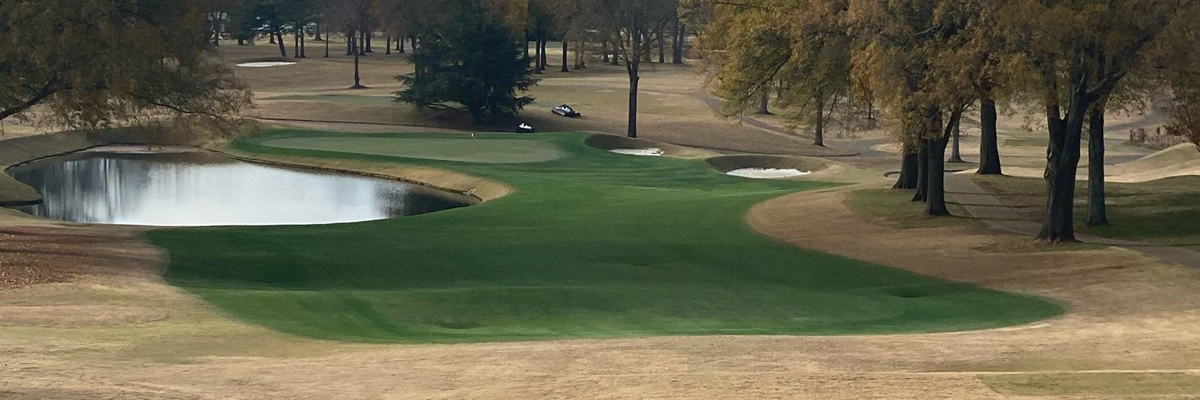
During the Fall and Winter months turf managers often have the goal of providing desirable color on greens, tees, and fairways. Turf colorants are big part of the strategy for imparting a natural, green color that is long lasting during the cooler months in which turf isn’t naturally able to express its inherent green color.
Colorant selection and application timing are very important when executing a successful Fall and Winter colorant strategy. The following describe the general characteristics of turfgrass colorants:
Dye
Highly water soluble and therefore loses its physical structure during application, resulting in rapid fading following application. Normally used as a spray pattern indicator for plant protectants and plant nutrient applications. Dyes can be utilized in conjunction with pigments and polymeric colorants to enhance the effects of pigments and colorants, however, the effects are generally short-lived.
Pigment
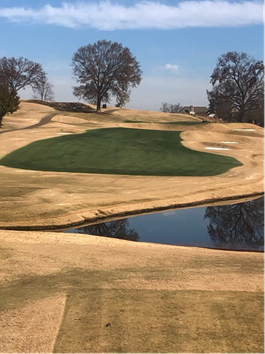
The chemistry of a pigment has low solubility, is highly concentrated, and longer lasting. Penetrating turfgrass leaves shortly after application, resulting in a more natural look, even after sunlight and mowing. Chemistry translocates within the plant, which often provides high quality turf response several days after application. Pigments are a low use rate product. Chemistry can impart physiological plant response. Also ideal for use prior to dormancy and utilization of a polymeric colorant. Not ideal for use on dormant turf. Harrell’s PAR SG® is an excellent pigment option for your turf.
Colorant/Paint
A superficial coating which can be broken down slowly by sunlight and water, and removed by mowing. Generally, it does not penetrate plant tissue, especially when applied to dormant turf. Polymeric colorants are less detrimental to pumps and seals. The primary purpose of this category is for use on semi-dormant to dormant turf. Also useful on athletic fields to indicate necessary field demarcations.
One successful strategy that has emerged during the past few years is using both pigments and polymeric colorants at different times to achieve the best greening enhancement. For example, use the first frost event as a signal to apply a pigment with the goal of "locking-in" an enhanced greening effect, while the turf is still able to assimilate and translocate the pigment. This application can be repeated several times as necessary, to establish a uniform green "canvas"; on which the application of a polymeric colorant will be more successful and require a lower use rate of the polymeric colorant. Painting on a green canvas is much more successful than initiating the use of polymeric colorant on a brown, dormant turf.
Once cold temperatures have become more persistent, the turf will remain dormant at which time the use of a polymeric colorant will be required and most applicable, as the dormant turf will not assimilate or translocate a pigment.
The following are best practices for utilizing a polymeric colorant on dormant and semi-dormant turf:
- Apply at a rate of 2.5 gal/acre in sufficient water to provide thorough coverage, not to exceed 50 gal/acre dilution
- Utilize a surfactant that imparts maximum surface area coverage
- Apply in the presence of dew or lightly water prior to application to further ensure thorough coverage of the leaf surface
- Make subsequent applications at 0.5-3 gal/acre as needed.
For more information about Dye, Pigment, Colorant and Paint, please contact your local Harrell's representative.
Related Resources

In addition to being the nation’s largest distributor of branded fungicides, herbicides, and insecticides, Harrell’s produces custom-blended fertilizers, specialty liquids, and wetting agents. Additionally, Harrell’s is the exclusive US owner, formulator, and distributor of all POLYON® branded products.
TEAM HARRELL'S
STAY EQUIPPED
Never stop learning. Access FREE continuing education courses from Harrell’s.
LET'S GROW
PRESS RELEASES
PRESS RELEASES
STAY EQUIPPED
Never stop learning. Access FREE continuing education courses from Harrell’s.
LET'S GROW