

Fall Fertilizer Boost for Your Turf
8/1/2024 - By John Keeler

After a long summer of stress, your cool season turfgrass
might need a little fertility boost heading into fall. Late-season
fertilization must not be confused with dormant or winter fertilization.
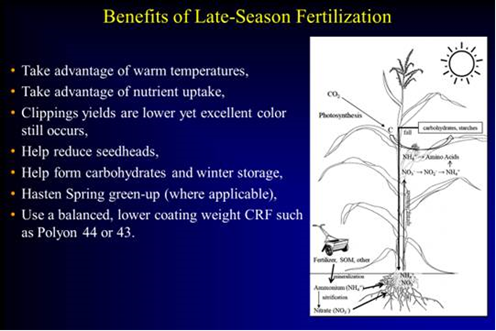
Late-season fertility promotes root development, enhances
carbohydrate reserves, and extends color retention in cool-season turf. The benefits of late fall nitrogen will be seen next
spring and summer with earlier green-up, improved turf density, and improved
tolerance to spring diseases such as red thread and pink patch.
“Physiologically, fall is
one of those times that a plant is sort of in the sweet spot because the
weather conditions are optimal for the plant to be most efficient with those
nutrients,” notes Cale Bigelow, Ph.D., professor of agronomy at Purdue University.
Fall Fertilizer – How to Choose the Best Options
The number of fertilizer choices you have is staggering.
Most options involve organic, sulfur-coated, or poly-sulfur-coated products,
some form of methylene urea, and polymer-coated urea.
Fall Fertilizer - Organic
Fertilizer
Natural organic fertilizers
are typically derived from by-products of plant and animal processing
industries. The nitrogen release rates vary quite a bit
among products since the release of nitrogen is dependent on soil microbes and environmental
conditions like soil temperature, moisture, and pH, which all affect the
release of natural organic fertilizers. Organic fertilizer would be a viable choice for a
dormant feed application.
Fall Fertilizer - Sulfur-Coated Products
Sulfur-coated or poly-sulfur-coated products are made by
spraying urea prills or granules with molten sulfur. A
sealant, such as wax or a mixture of oil and polyethylene, is often applied to
seal pores and imperfections in the sulfur. This is important because it
is those imperfections that absorb moisture and break the sulfur coating
releasing 100% of the nitrogen. This would be a good choice for quick
recovery.
Fall Fertilizer - Methylene
Urea Products
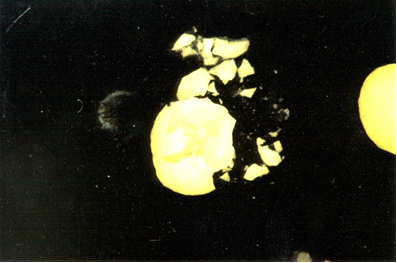
Urea-formaldehyde fertilizers, also known
as methylene urea products, are widely used in turfgrass
as slow-release sources of nitrogen. There are three categories of
methylene urea:
Cold water-soluble
The cold water-soluble
portion provides readily available nitrogen in the first 2-4 weeks.
Water-soluble
The water-soluble portion is predictable in terms of release and provide 4-12 weeks of fertility.
And water insoluble
The water-insoluble is the
least predictable and releases significantly slower than quick release,
granting fertility to your turf within 1-3 years.
A good blend of cold-release, water-soluble, and
water-insoluble is what you should be looking for. Any methylene urea product
that does not claim water-insoluble nitrogen as a percentage of the total
nitrogen, will release nitrogen quickly.
Fall Fertilizer - Polymer-Coated
Urea
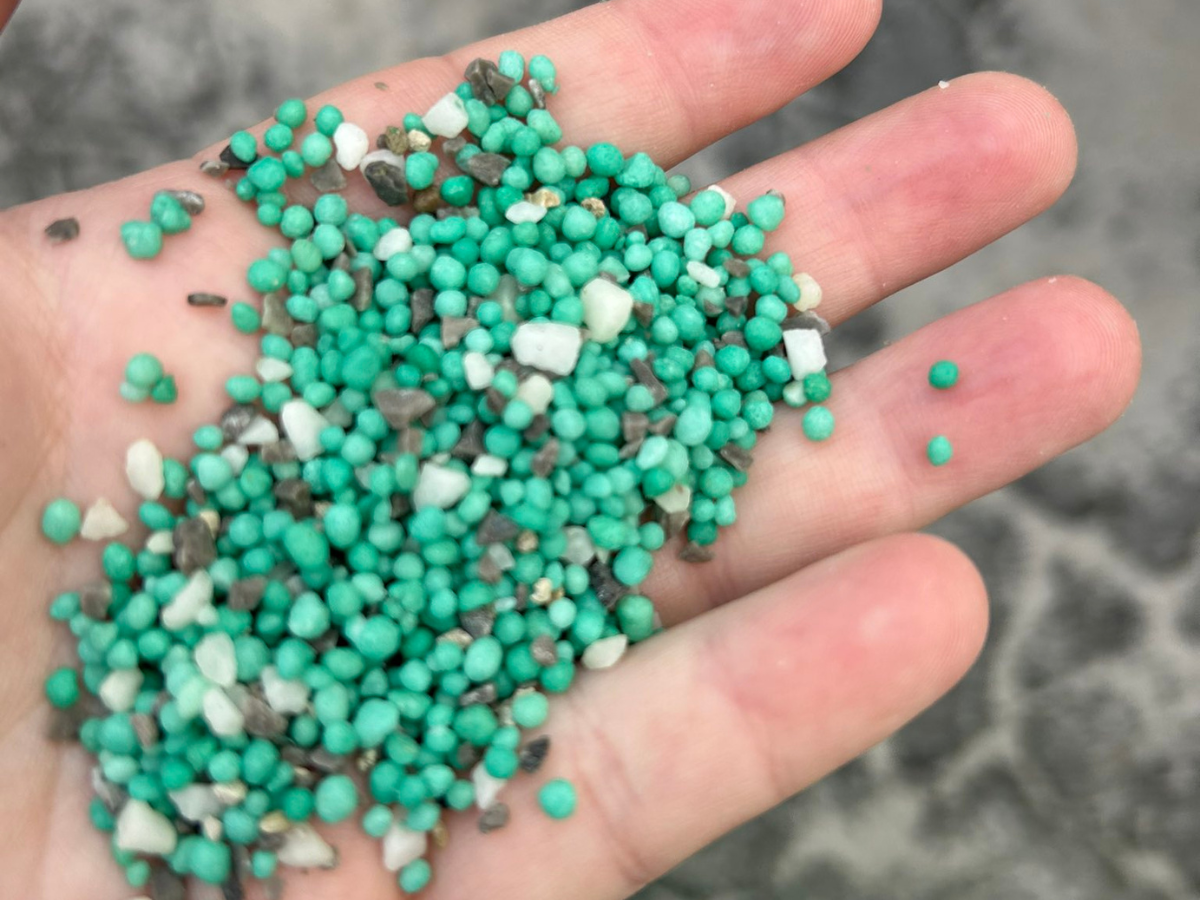
Polymer-coated urea (that’s right, POLYON®)
is a completely different product than any other slow-release product on the
market, and it is the polymer coating process that sets POLYON controlled-release fertilizer apart from the rest. The reactive
layer coating and superior bonding properties applied in this process are
repeated until the desired coating thickness is satisfied. The result is a very
uniform coating on the urea particle.
Different coating thicknesses are used to obtain different nitrogen release rates, the thicker the coating, the slower the release of nitrogen. Nitrogen release increases with higher temperatures and is less dependent on soil moisture levels, soil pH, or microbial activity, in comparison to other fertilizers on the market. Depending on the coating thickness and application rate, POLYON can release nutrients for up to 18 weeks and will even pause its release through dormancy to give your turf nutrients right when the turf and temperatures warm up.
When to Apply Fall Fertilizer
Now that you have chosen
a fertilizer source, when is the best time to apply? For slow-release nitrogen
products, September or October will be your window. This will help build
carbohydrate reserves in your plants, and the roots will still be growing at
the same time as the shoot growth has slowed, thus allowing roots to take full
advantage of the fertilizer application. For quick-releasing fertilizer, most
people feel this application should take place when shoot growth has stopped,
but the grass is still green, and the ground is not frozen. Take note that this timing can vary from year to year
and location to location. So, be flexible.
Let us not forget the
importance of a little potassium in your blend. Potassium (K) promotes winter
hardiness, disease resistance, and wear tolerance in turf. A half pound of
Nitrogen (N) and Potassium (K) just before dormancy is ideal.
For Fall Fertilizer, Contact Your Harrell’s Rep
For more information on fall fertility, your fertilizer
options, when you should apply, benefits, etc., reach out to your local Harrell's Representative.
They are your best resource for product knowledge and any other questions you
may have related to your turf. If you would like to learn more about POLYON controlled-release
fertilizer, check out this video of Dr. Jeff Atkinson walking through how POLYON works.
Related Resources

In addition to being the nation’s largest distributor of branded fungicides, herbicides, and insecticides, Harrell’s produces custom-blended fertilizers, specialty liquids, and wetting agents. Additionally, Harrell’s is the exclusive US owner, formulator, and distributor of all POLYON® branded products.
TEAM HARRELL'S
STAY EQUIPPED
Never stop learning. Access FREE continuing education courses from Harrell’s.
LET'S GROW
PRESS RELEASES
PRESS RELEASES
STAY EQUIPPED
Never stop learning. Access FREE continuing education courses from Harrell’s.
LET'S GROW