

Fall Fertility and the Many Granular Fertilizer Choices
10/1/2021 - By John Keeler

After a long summer of stress, your cool-season turfgrass might need a little fertility boost heading into winter. Fall fertility promotes good root development, enhances storage of energy reserves, and extends color retention in cool-season turf. Most of the benefits we get from late fall nitrogen we’ll see next spring and summer with earlier green-up, improved turf density, and improved tolerance to spring diseases, such as red thread, pink patch and reduced weeds.
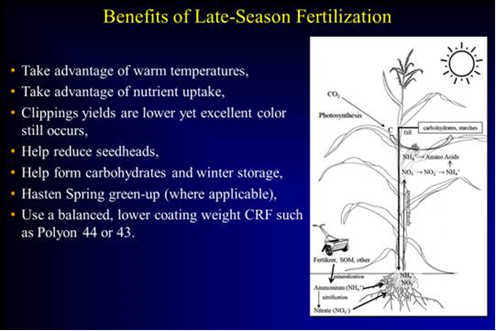
There are many granular fertilizer choices available to the turfgrass manager. Organic, inorganic, synthetic, quick release, slow release, and controlled release fertilizers. The number of choices you have is staggering. Most options involve sulfur-coated or poly sulfur-coated products, some form of methylene urea and polymer-coated urea.
A true organic fertilizer is typically a low nitrogen fertilizer coming from manures, sewage sludges, compost, and meals (blood, bone, fish, and feather meal). These types of products can take up to 10 months to release but are an excellent choice for soil health. Although repeat applications are needed throughout the year, this can be an excellent choice for dormant feeding.
Sulfur-coated or poly sulfur-coated products are usually lower in price and offer a 4 to 6-week release of nitrogen. There are a couple of disadvantages with this product. First, the coating process is not an exact science. The sulfur coating is sprayed into a rotating drum of urea resulting in a “Three Bears” type of result: some particles are coated too thick, some are coated too thin, and some particles are coated “just right”. For nitrogen release, moisture must be absorbed by the particle. The moisture softens the sulfur coat, which breaks open, and you get 100% release of urea from the prill. In a wet year you can get a lot of unwanted release in a very short period of time from SCU/PCSCU.
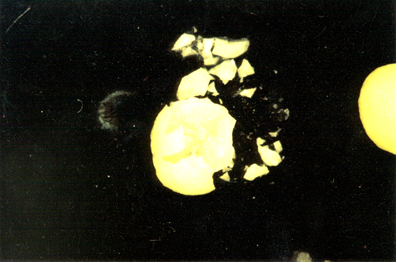
Methylene urea will usually release for 8 to 12 weeks. There are three parts of methylene urea: cold water-soluble, hot water-soluble and hot water insoluble. The cold water-soluble part is readily available nitrogen. The hot water-soluble piece is the good stuff. Because MU is a synthetic organic fertilizer, soil bacteria is needed to synthesize the urea to a usable form. To that end, moisture, soil pH, and temperature are all critical factors effecting the microbial action. Using this too late in the fall or too early in the spring results in delayed release. Only the cold-water soluble portion will be released. The hot water insoluble portion is the most unpredictable of the three. Depending on the total hot water insoluble nitrogen within the blend, that amount might not be available in one growing season. In fact, there’s no timeline of release with hot water insoluble nitrogen. Generally, the set of conditions for the release of hot water insoluble N is very complex and will frequently come together exactly when you don't need excessive nitrogen release; in hot, humid weather.
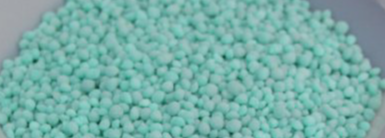
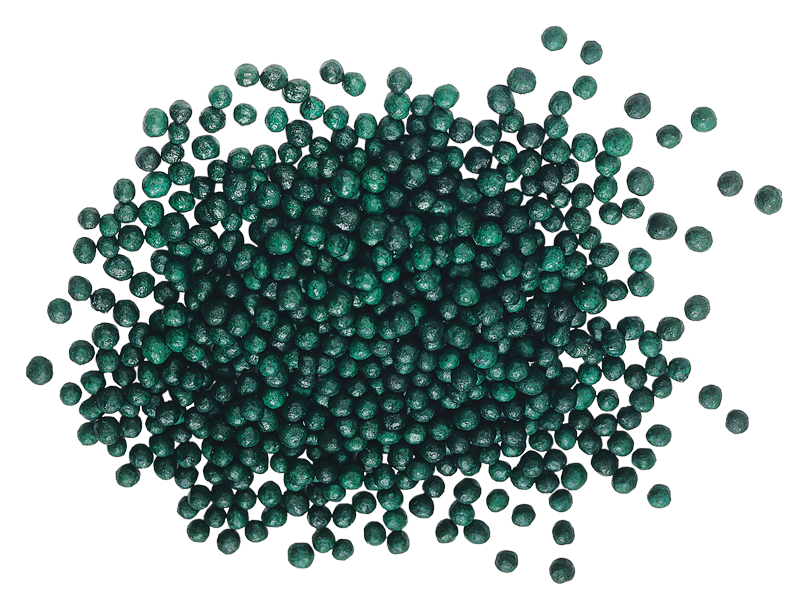
Polymer-coated urea (that’s right, POLYON® Controlled-Release Fertilizer) is a completely different product than the aforementioned products. The coating process is what makes it different. While a hot substrate of urea is in a rotating chamber, a monomer is injected into that chamber. After the particles are coated with the first monomer, a second monomer is injected. The two monomers react together and form a polymer which is bound to the substrate. The process is repeated until the desired coating thickness is satisfied. The result is a strong, durable, uniform coating on the urea particle. PCU only requires a small amount of moisture to be absorbed through the polymer to liquefy the substrate, in turn releasing the dissolved urea through the membrane using osmotic diffusion based on temperature. Temperature, coating thickness, and application rate determines the amount of nitrogen you receive per week. All the nitrogen in the POLYON® Controlled-Release Fertilizer is available in one growing season.
To learn more about POLYON® and the best Controlled-Release Fertilizer plan for you, contact your local Harrell's Representative.
Now that you’ve chosen a fertilizer source, when’s the best time to apply? For slow release nitrogen products, September or October. This will help build carbohydrate reserves in your plants. The roots will still be growing at the same time the shoot growth has slowed, thus allowing the roots to take full advantage of the fertilizer application. For quick releasing fertilizer most people feel this application should take place when shoot growth has stopped, but the grass is still green, and the ground is not frozen. Take note, this timing could vary from year to year and location to location. So, be flexible. Let’s not forget a little potassium in your blend. Potassium (K) promotes winter hardiness, disease resistance and wear tolerance in turf. A half-pound of Nitrogen (N) and Potassium (K) just before dormancy is ideal.
To book your fall fertilizer application, contact your local Harrell's Representative.
Related Resources

In addition to being the nation’s largest distributor of branded fungicides, herbicides, and insecticides, Harrell’s produces custom-blended fertilizers, specialty liquids, and wetting agents. Additionally, Harrell’s is the exclusive US owner, formulator, and distributor of all POLYON® branded products.
TEAM HARRELL'S
STAY EQUIPPED
Never stop learning. Access FREE continuing education courses from Harrell’s.
LET'S GROW
PRESS RELEASES
PRESS RELEASES
STAY EQUIPPED
Never stop learning. Access FREE continuing education courses from Harrell’s.
LET'S GROW