

EarthMAX® Organic Mitigates Salinity Stress & Increases Root Biomass Over Time
10/5/2022 - By Dr. Raymond Snyder
Plant health is directly compromised when high salinity levels
cause osmotic stress, thereby minimizing the plant’s ability to take up water,
resulting in drought stress-like symptoms and reduced growth. While water with high pH and bicarbonates can be more easily addressed with acid injection, this
technique does not necessarily reduce sodium levels, resulting in a water
source that still has high sodium values if all three undesirable
characteristics are present. Harrell'sBio-MAX® EarthMAX® Organic is a great substitute for acid
injections, to fix poor water quality.
Managing Exposure to Low Salinity Water
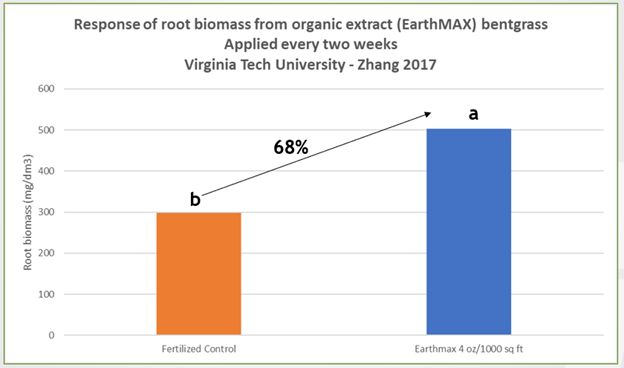
Earlier this year, Dr. Xunzhong Zhang conducted a growth chamber study in which EarthMAX® Organic was applied to creeping bentgrass to improve the turf's physiological fitness when under salt stress. This field study with Dr. Zhang showed that applications of EarthMAX® Organic improved turfgrass quality and root mass when under summer stress (chart 1).
Since that study, we have been able to identify Bacillus Subtillis in EarthMAX® Organic using DNA identification techniques utilized by Waters Agricultural Industries Inc.
Bacillus Subtillis is a microorganism that has demonstrated the
ability to help mitigate soil salinity in some field crops.
Research Procedure
We harvested mature ‘A4’ creeping bentgrass plugs (4” diameter)
from field plots and transplanted them into 6-inch pots filled with USGA sand
(fine sand with 10% calcined clay) on Jan. 16, 2022. The bentgrass was
maintained at 15 mm and fertilized at 0.2 lbs/1000 ft2 at
transplanting and then 0.15 lbs N/1000 ft2 biweekly thereafter.
After about five weeks of non-stressed growth with optimum
temperature, water, fertilizer, and light, we placed the pots in a controlled
environment growth chamber at 71.6 F during the day (12 h)/64.4 F at night,
light intensity at 450 µmol m-2 s-1, 12 h photoperiod, and
65% RH.
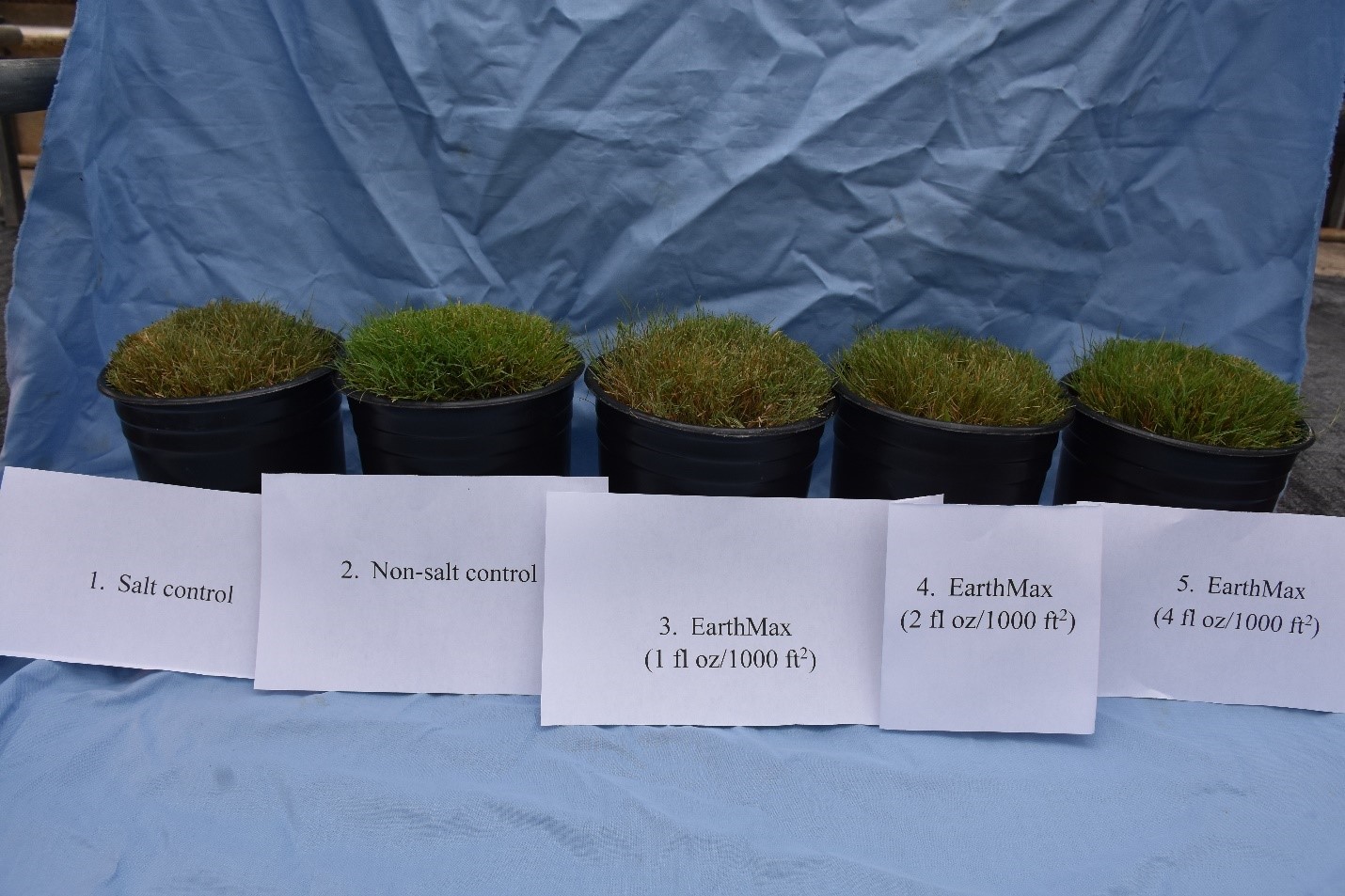
Following this, EarthMAX® Organic and salt stress treatments were initiated,
where there were 5 treatments with 4 replications. The EarthMAX® Organic solution
(at the rates listed below) was applied to the canopy at 2 gallons/1000 ft2
and the same amount of water was applied to the control (treatments #1
and 2).
After 12 hours of EarthMAX® Organic treatment, we initiated salt
stress treatment. Sodium chloride (NaCl) solution at 2 ds/m concentration was
added first, and then 4 ds/m concentration, 6 ds/m concentration, and finally 8
ds/m concentration at 48 hours after initiation of salt stress treatment.
The salt concentration in the growth media was maintained at a
level of about 8 ds/m during the trial by monitoring the salt concentration
with a portable TDR-300 meter. The grass was irrigated with salt water and
fresh water alternatively to maintain water content near field capacity and EC
level at about 8 ds/m during the trial.
Treatments:
- Fertilized control (0.15 lb N/1000 ft2
biweekly) + salt stress
- Fertilized control (0.15 lb N/1000 ft2
biweekly) + non-salt stress
- EarthMAX® Organic at 1 oz/1000 sq ft biweekly
+ salt stress
- EarthMAX® Organic at 2 oz/1000 sq ft biweekly
+ salt stress
- EarthMAX® Organic at 4 oz/1000 sq ft biweekly + salt stress
The rate of N fertilization (from 28-8-18) for treatments 3, 4 and
5 was the same as treatment 1 (fertilized control) and 2, so all five
treatments received identical N input.

Measurements
Lab Analysis
a.
Visual leaf color was rated on a 1-9 scale, with 1 indicating
brown color and 9 indicating dark green color.
b.
Green leaf percentage (GL) was rated visually and expressed as the
percentage of green leaves over total leaves in each pot.
c.
Photochemical efficiency was measured with chlorophyll fluorometer
OS-50II. Three readings were collected from each pot and the average was used
for statistical analysis.
d.
Leaf chlorophyll content and carotenoids were extracted in acetone
and measured with a spectrophotometer after incubation for 72 h.
e.
Fresh clipping weight was determined after trimming the grass
every two weeks.
f.
Leaf antioxidant superoxide dismutase activity was determined
based on the method described by Zhang et al. (2015).
g.
Root viability, root samples were collected at the end of the
trial and the TTC method was used to measure root viability (Zhang et al.,
2017).
h.
Root growth characteristics (root length, root surface area, root
diameter, root length density) were determined using WinRhizo technology.
i.
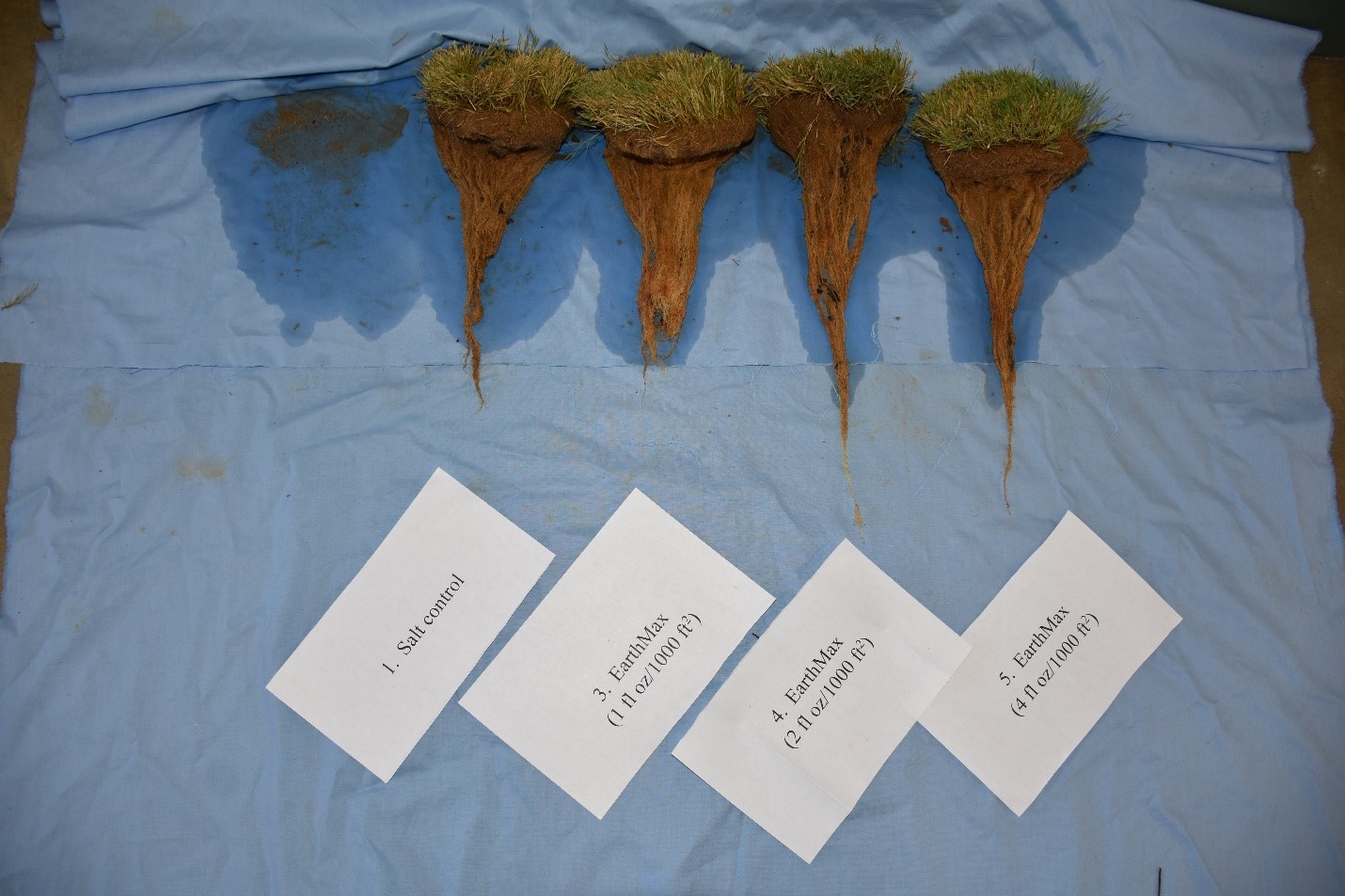
The root biomass of the whole pot was measured at day 56.
j.
Leaf tissue nutrients (K, Na, Ca, Mg) content. The dried leaves (100 mg) were weighed and ash in the muffle
furnace at 520°C for 5 h, the ashes were dissolved with 2 mL 1 M HCl and then
diluted to 10 mL with d.i. H2O. The concentrations of ion elements
were determined by using an inductively coupled plasma mass spectrometer
(Thermo Scientific, Waltham, MA, Wu et al., 2017).
k.
Relative leaf fresh weight (RLW) and relative root weight (RL)
were calculated using non-salt control as the basis.
Conclusions
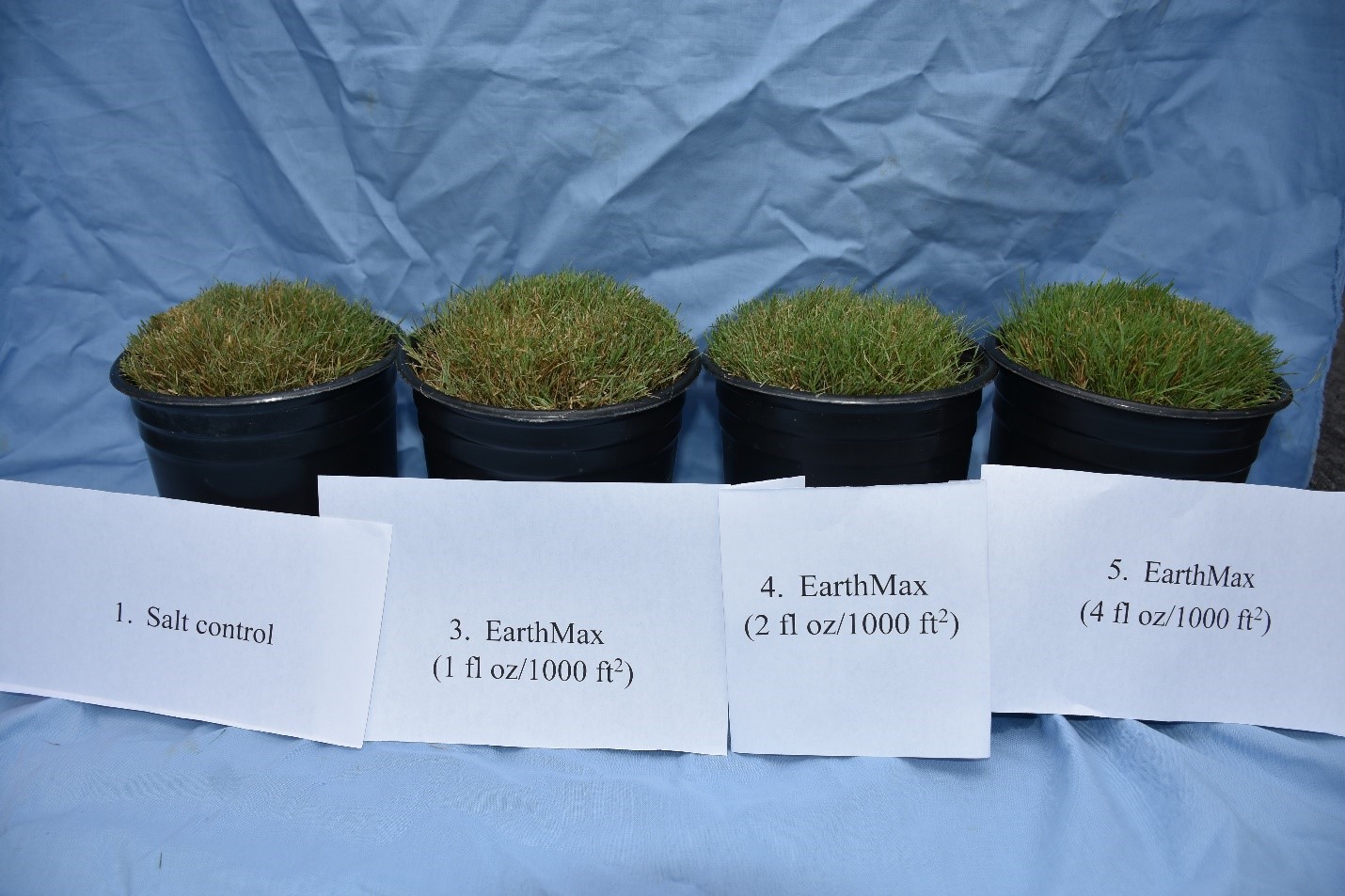
In summary, EarthMAX® Organic applied at all three rates improved leaf
color, clipping production, photosynthetic pigments, photochemical efficiency,
antioxidant SOD activity and root viability.
EarthMAX® Organic tended to reduce Na uptake and increased K
and Mg nutrient uptake relative to the salt control. The results of this study
indicated foliar application of EarthMAX® Organic, especially at a high rate (4
fl oz/1000 ft2) improved physiological fitness, leaf color, and salt stress of
creeping bentgrass.
For more studies like this one, please visit the Research Page on our Harrell's blog. And
if you have any questions about the products mentioned, feel free to contact your Harrell's Rep.
Related Resources

In addition to being the nation’s largest distributor of branded fungicides, herbicides, and insecticides, Harrell’s produces custom-blended fertilizers, specialty liquids, and wetting agents. Additionally, Harrell’s is the exclusive US owner, formulator, and distributor of all POLYON® branded products.
TEAM HARRELL'S
STAY EQUIPPED
Never stop learning. Access FREE continuing education courses from Harrell’s.
LET'S GROW
PRESS RELEASES
PRESS RELEASES
STAY EQUIPPED
Never stop learning. Access FREE continuing education courses from Harrell’s.
LET'S GROW