

Double-Down on Fertilizer Application Efficiency
3/10/2022 - By Dr. Jeff Atkinson
As of December 2021, the U.S. Bureau of Labor Statistics reports there are 0.6 unemployed persons per job opening, the fewest reported since 2006 (Figure 1). The turf industry acutely feels the labor pinch. While not the cure for all labor woes, applying pesticides as a sparged material on a fertilizer carrier is a common way turf managers optimize labor by completing two agronomic inputs at once.
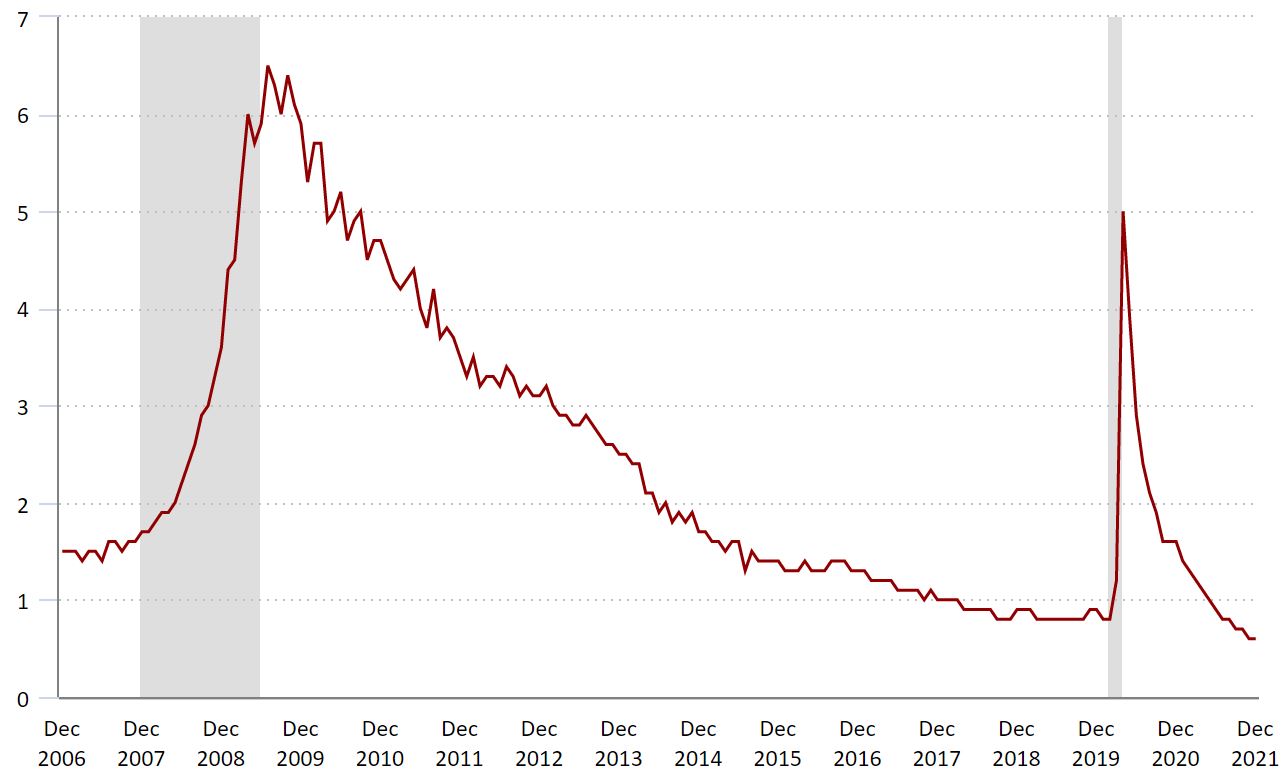
Figure 1 . The number of unemployed persons per job opening, seasonally adjusted. Source: U.S. Bureau of Labor Statistics.
Fertilizer Sparging
Fertilizer sparging is the process of coating a fertilizer substrate with a material such as a preemergence herbicide. Although fertilizer sparging is most often associated with preemergence herbicides, the technique is not limited to this class of products.
To be an effective sparging component a material must:
- Be sparged on the fertilizer substrate at a concentration that provides the desired product rate within typical fertilizer spread rates.
- Have broad compatibility with a wide range of fertilizer substrates.
- And remain stable in a fertilizer bag when in storage.
Applying Sparged Fertilizer
For turfgrass applications, fertilizer application rates most often fall between 150-300 lbs of product per acre. Depending on the active ingredient, herbicides can be applied at rates that range from grams to pounds of product per acre. To be effective, the active ingredient concentration of the material used for sparging must consider the target spread rate per acre of the completed fertilizer blend, so that the correct active ingredient rate per acre is delivered during application.
A typical practice is to register a range of active ingredient concentration loads with the Environmental Protection Agency to allow for a range of spread rates. Allowing you to apply an equal amount of active ingredient per acre.
For example, depending on the state, Barricade preemergence herbicide is available through Harrell’s to be sparged on fertilizer at concentrations of 0.21%, 0.3%, 0.38%, and 0.45%. If the target active ingredient rate is one pound of Barricade per acre, a fertilizer blend could be formulated to apply 476 (0.21%), 333 (0.3%), 263 (0.38%), or 222 (0.45 %) pounds of the fertilizer blend per acre.
Although 476-222 is a wide range of spread rates, each applies one pound of Barricade per acre. For many, 476 pounds per acre would be an excessively high spread rate. Suggesting a 0.21% concentration is not a practical sparge rate for this application.
Particle Zone of Influence
Delivering the correct amount of active ingredient per acre is not the only consideration when it comes to the spread rate. It is also important to consider particle distribution density.
Each applied fertilizer granule has a ‘zone of influence.’ This zone results from the area which the active ingredient influences after it is dislodged from the fertilizer carrier by irrigation or rainfall. Most preemergence herbicides are relatively immobile in the soil, thus the zone of influence from an individual fertilizer particle is relatively small.
To optimize efficacy, it is important to ensure that the spread rate of a sparged fertilizer blend is high enough to provide adequate particle density, so that the zone of influence of individual particles overlaps and gaps between zones are not present.
On a square foot level, too few particles per square foot may result in gaps between the zones of influence, leading to inconsistency of product efficacy (Figure 2). Conversely, an adequate number of particles per square foot will result in a zone of influence overlap, good efficacy, and consistent results (Figure 3).
A good rule of thumb for spread rate minimum in sparged fertilizers is 250 pounds per acre for regular-sized blends and 200 pounds per acre for mini-sized blends. Higher spread rates will further enhance application consistency.
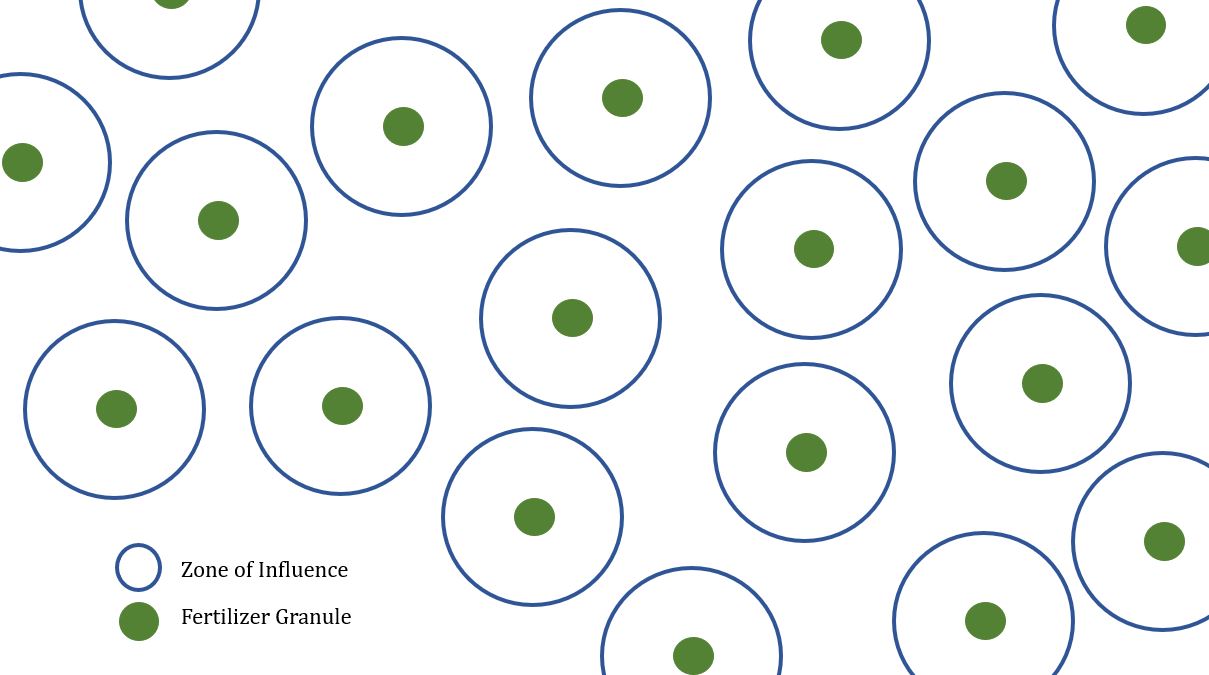
Figure 2 . Example of an inadequate spread rate not providing enough fertilizer particles per square foot to allow for overlap between 'Zones of Influence'.
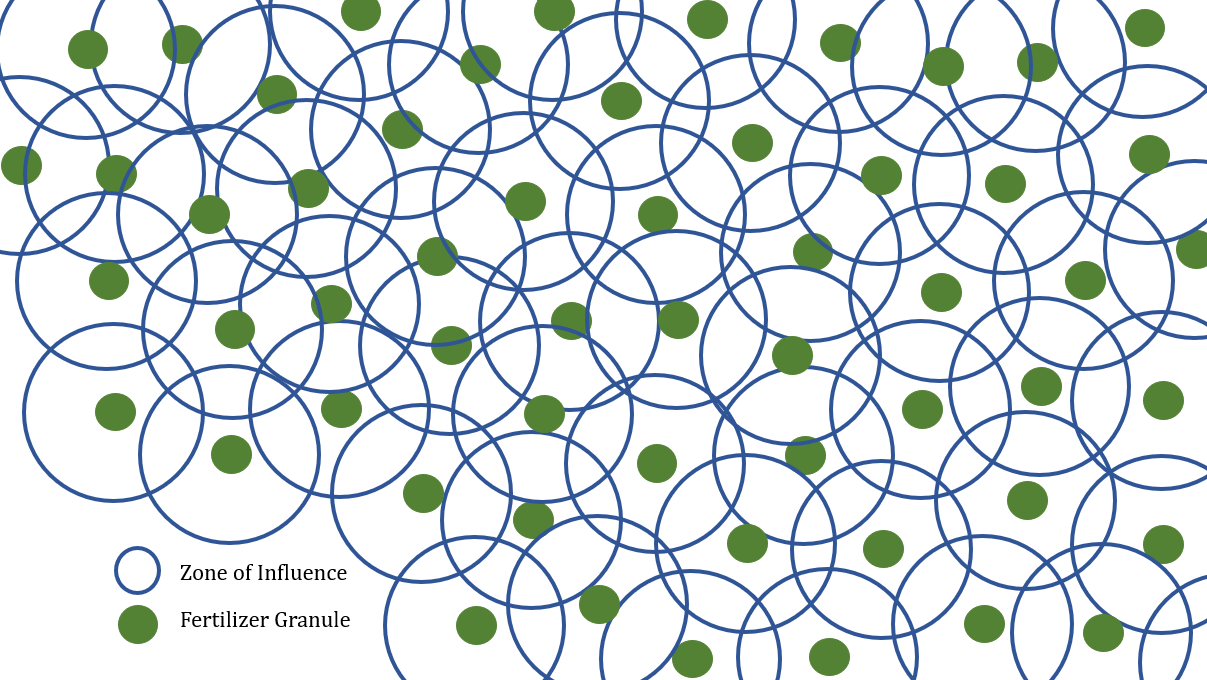
Figure 3 . Example of an adequate spread rate allowing for overlap between fertilizer particle 'Zones of Influence'.
The Art of Blending
Fertilizer blending is an art, not an exact science. Since fertilizers are by nature salts, coating fertilizer in a liquid material can often create interactions between particles which lead to clumping and poor spread characteristics. Through experience and know-how, this can be addressed during the formulation and manufacturing process.
Sparging fertilizer is a tested and effective way to enhance the efficiency of any turf management operation. As a custom fertilizer blender, Harrell’s representatives are knowledgeable resources to work through the nuances of sparged fertilizer blending, to ensure your pest control and fertility goals are met, all in one shot!
Related Resources

In addition to being the nation’s largest distributor of branded fungicides, herbicides, and insecticides, Harrell’s produces custom-blended fertilizers, specialty liquids, and wetting agents. Additionally, Harrell’s is the exclusive US owner, formulator, and distributor of all POLYON® branded products.
TEAM HARRELL'S
STAY EQUIPPED
Never stop learning. Access FREE continuing education courses from Harrell’s.
LET'S GROW
PRESS RELEASES
PRESS RELEASES
STAY EQUIPPED
Never stop learning. Access FREE continuing education courses from Harrell’s.
LET'S GROW