

Increasing Citrus Yields at Reduced Nitrogen Rates
7/6/2021 - By Dr. Tom Reed
Citrus greening (Huanglongbing, HLB) has become very common across Florida citrus groves, threatening production. Recent research has recommended a constant, nutrient rich, soil supply to affected citrus to help improve tree health and productivity. Harrell’s collaborated on two studies with Dr. Tripti Vashisth, University of Florida associate professor of horticultural sciences and citrus extension specialist, to evaluate POLYON® controlled-release fertilizer efficacy, in improving the yield and growth of HLB-affected trees.
The two studies were conducted from 2016-2019 on bearing age Valencia (10 to 15-year-old) with Swingle, in a completely randomized block design with 45 trees per treatment, replicated at two sites (Fort Meade and Arcadia, FL). Fertilizer was applied three times per year.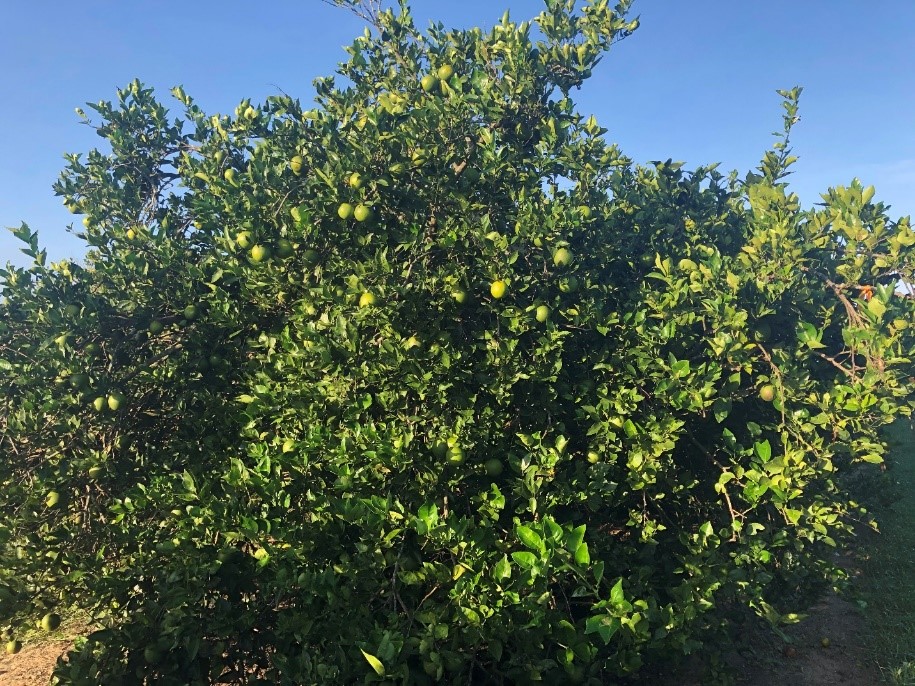
Study 1:
The first study assessed different percentages of POLYON® controlled-release fertilizer in the fertilizer blend (0%, 25%, 50%, 75%, and 100%) with the amount of nitrogen applied decreasing with increasing percentage of POLYON® (150 lb. N/ac in 100% POLYON® , compared to 200 lb. N/ac in the 0% POLYON® control). Increasing the amount of POLYON® in the blend increased the N, P, K, B, and Mn in leaf analysis, increased canopy density, and there was a significant positive correlation between yield and POLYON®, greater yield with greater percentage of POLYON®, even with 25% less N applied in the 100% POLYON® than the 0% POLYON® control. Dr. Vashisth summarized her conclusion. “HLB-affected trees perform better with a higher percentage of POLYON®, as the constant supply of nutrition is beneficial. Improved growth resulted in improved uptake of micronutrients like Mn and B, possibly due to improved root density. Increase in leaf N can result in reduction in total soluble solids, hence a balance between fruit quality and yield is needed.”
Study 2:
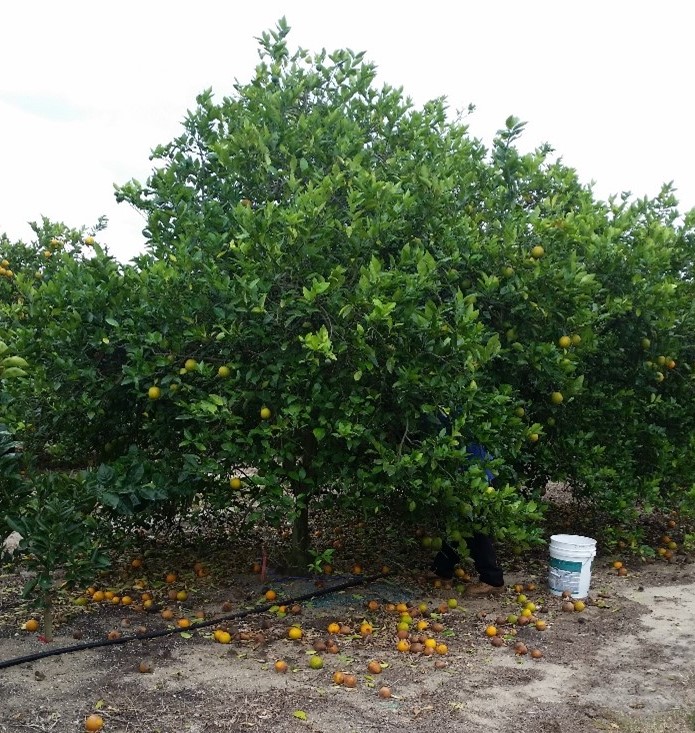
The second study evaluated POLYON® at 150 lb. N/ac compared to conventional granular application at 180 lb. N/ac. The amount of P, K, Ca, and Mg applied was also reduced in the POLYON® applications. These base fertilizer applications each had micronutrients applied as a slow-release granular mix and a foliar application as separate treatments. The control was the conventional granular application with foliar applied micronutrients. This study also looked at increased concentrations of certain micronutrient(s) not discussed here. For all the parameters measured, including yield, canopy volume and fruit quality, the control was always the worst performing treatment. The POLYON® treatments yielded greater boxes/ac than the corresponding conventional treatments with micronutrients applied either by foliar or slow-release granular. The POLYON® treatment with granular micronutrient mix had the greatest yield of these four treatments, with approximately 350 and 150 boxes/ac more than the control at Arcadia and Fort Meade sites, respectively, over the three years. Dr. Vashisth summarized implication for growers, “Overall, the data suggests the continuous supply of soil-applied nutrients through POLYON® in addition to soil pH acidification improved yield and fruit quality.”
The studies are ongoing, and Harrell’s is continuing to collaborate with Dr. Vashisth on nutritional programs to improve citrus production, tree health and fruit quality. Harrell's POLYON® Specialty Ag blends are engineered to provide nutrients over time at a predictable rate under specified conditions. To find the right POLYON® product for you, reach out to your Harrell's Rep.
Related Resources

In addition to being the nation’s largest distributor of branded fungicides, herbicides, and insecticides, Harrell’s produces custom-blended fertilizers, specialty liquids, and wetting agents. Additionally, Harrell’s is the exclusive US owner, formulator, and distributor of all POLYON® branded products.
TEAM HARRELL'S
STAY EQUIPPED
Never stop learning. Access FREE continuing education courses from Harrell’s.
LET'S GROW
PRESS RELEASES
PRESS RELEASES
STAY EQUIPPED
Never stop learning. Access FREE continuing education courses from Harrell’s.
LET'S GROW