

Citrus Controlled-Release Fertilizer Blend Fraction Study
10/25/2021 - By Dr. Tom Reed

Study: | Use of controlled-release fertilizers to improve the performance of Huanglongbing-affected Sweet Orange |
Location: | Arcadia and Fort Meade, FL: Conducted on bearing age (10 to 15-year-old) Valencia on Swingle in a CRB design with 45 trees per treatment. Fertilizer was applied three times per year. |
Collaborator: | Tripti Vashisth, PhD (UF|IFAS CREC) |
Date: | 2016-2019-Fort Meade |
Conclusion:
The study assessed different percentages of POLYON® controlled release fertilizer (CRF) in the fertilizer blend (0%, 25%, 50%, 75%, and 100%). The amount of nitrogen applied decreased with increased percentage of CRF (150 lb N/ac in 100% POLYON® CRF compared to 200 lb N/ac in the 0% CRF control). Increasing the amount of POLYON® CRF in the blend increased the N, P, K, B, and Mn in leaf analysis, increased canopy density, and there was a significant positive correlation between yield and POLYON® CRF, greater yield with greater percentage of POLYON® CRF, even with 25% less N applied in the 100% POLYON® CRF than the 0% CRF control. HLB-affected trees performed better with higher percentage of CRF, as the constant supply of nutrition is beneficial. Improved growth resulted in improved uptake of micronutrients like Mn and B, possibly due to improved root density. Increase in leaf N can result in reduction in total soluble solids, hence a balance between fruit quality and yield is necessary.
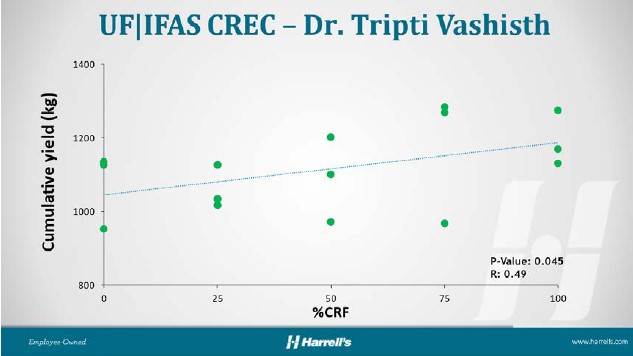
Figure 1: 3-year cumulative yield per tree.
Related Resources

In addition to being the nation’s largest distributor of branded fungicides, herbicides, and insecticides, Harrell’s produces custom-blended fertilizers, specialty liquids, and wetting agents. Additionally, Harrell’s is the exclusive US owner, formulator, and distributor of all POLYON® branded products.
TEAM HARRELL'S
STAY EQUIPPED
Never stop learning. Access FREE continuing education courses from Harrell’s.
LET'S GROW
PRESS RELEASES
PRESS RELEASES
STAY EQUIPPED
Never stop learning. Access FREE continuing education courses from Harrell’s.
LET'S GROW